



























Send USD 200 (SGD 260) from Singapore to Malaysia by DBS bank transfer and it costs SGD 27.03 (10.4% of the amount). Send the same amount with Wise and it costs SGD 1.69 (0.65%). The speed gap is as wide. An instant link to Thailand arrives within minutes, while a bank transfer sent as a wire generally reaches the beneficiary within 1 to 5 business days at UOB.

The gaps come from how the money moves. Swift carries the message and does not move the money, so the banks settle through a correspondent bank. Wise pays out from its own account in the destination country, so its money does not cross a border. An instant link joins PayNow, Singapore’s instant payment service, to Thailand, Malaysia and India, and a QR payment pays a shop abroad from a Singapore app.

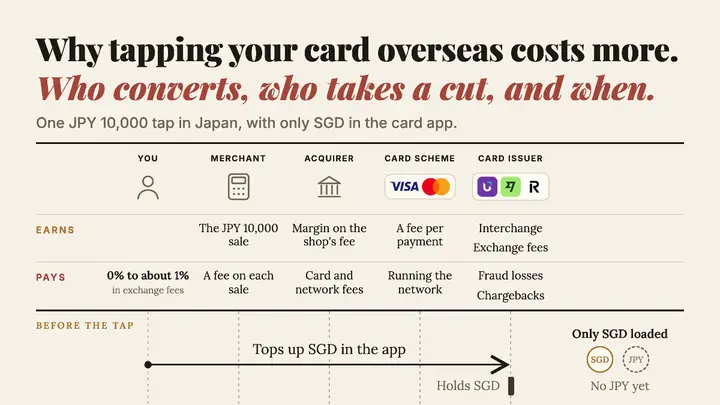
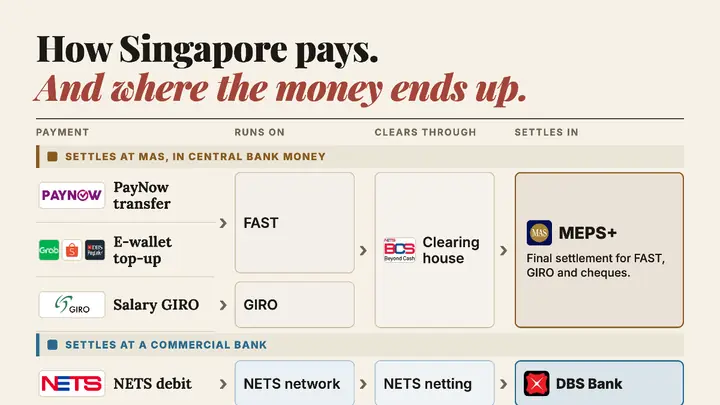
Those links reach a short list of countries, and a bank transfer reaches the rest. The Singapore rails behind these routes are covered in who owns and runs PayNow, FAST, GIRO and NETS, the rails at the other end in ASEAN’s digital payment rails, and paying by card abroad in why your card costs more abroad. Find your country on the map of where each route reaches, then follow the money through each route to see where the fees and delays come in.

  • 6.6B

    Payment messages sent over Swift in 2025, an increase of 8.9% on the year

    Swift annual review 2025

  • SGD 371M

    PayNow-linked payments with India, Malaysia and Thailand in 2025, both directions

    PayNow Gen2 report 2025

  • 6.5%fee

    Average fee and rate margin on sending USD 200 abroad, against a G20 target of 3% by 2030

    FSB report 2025

  • 54.6%< 1 hour

    Share of wholesale payments credited that fast, against a G20 target of 75%

    FSB, from Swift data 2025

Where each channel reaches

Singapore’s instant links and QR payments reach a short list of countries, and a bank wire reaches the rest.

Live Planned, agreed or tested, shown as a dashed dot Priced by the World Bank Heavier line, more live links

Notes and sources (33)

Each country lists the links found on MAS’s list of cross-border payment linkages or in the other documents read. A channel missing from a country means none was found, which is not proof that none exists. The rest of the world is not a list of links. It shows what a wire, a CLS trade and a Nexus test can reach, and the World Bank’s data covers only nine corridors out of Singapore, all in Asia.

DBS, overseas transfers. UOB, telegraphic transfers. MAS, Indonesia local currency framework, 31 August 2026. Bank Indonesia, PADG 25/2026. DBS, RMB clearing bank, 15 December 2025. PBOC, CIPS business rules, 2025. MAS, Cross-border Payment Linkages. MAS and ABS, PayNow Gen2 Phase 1 report, June 2026. MAS, PayNow and PromptPay launch, 29 April 2021. MAS, PayNow and DuitNow launch, 17 November 2023. MAS, PayNow and UPI launch, 21 February 2023. MAS, MAS and BSP to pursue cross-border payment linkages, 8 November 2021. NETS, NETS and National ITMX expand cross-border QR payment collaboration, 4 August 2022. MAS, NETS QR and DuitNow QR launch, 31 March 2023. MAS, QRIS and NETS QR launch, 17 November 2023. DBS, Scan to pay overseas with DBS PayLah!. MAS, Interoperable QR payments in Singapore, whitepaper, 2023. Nexus Global Payments, documentation. Nexus Global Payments, technical operator, 9 February 2026. World Bank, Remittance Prices Worldwide, Singapore to Thailand. World Bank, Remittance Prices Worldwide, Singapore to Malaysia. World Bank, Remittance Prices Worldwide, Singapore to Indonesia. World Bank, Remittance Prices Worldwide, Singapore to India. World Bank, Remittance Prices Worldwide, Singapore to China. World Bank, Remittance Prices Worldwide, Singapore to the Philippines. Wise, how it compares with bank transfers. Western Union, Form 10-K for 2025. Swift, who we are. CLS, CLSSettlement overview, February 2024. MAS, BIS Project Nexus prototype links Eurosystem, Malaysia and Singapore, 23 March 2023. World Bank, Remittance Prices Worldwide, Singapore to Bangladesh. World Bank, Remittance Prices Worldwide, Singapore to Pakistan. World Bank, Remittance Prices Worldwide, Singapore to Sri Lanka.

The routes side by side

Who converts and earns, what it costs, how long it takes, how much can be sent and where it settles.

Route
Conversion Who converts and earns?
Price What does it cost?
Speed How long does it take?
Limit How much can be sent?
Settlement Where does it settle?
Not tied to a country Live

A bank transfer, sent as payment messages over the Swift network.

Bank

Your bank

  • Commission and cable charge
  • Rate set by your bank

Converts at its own rate and prints no margin. The World Bank logged 0.78% to 0.79% at DBS in each of six countries.

10.4% to 21.0%

of USD 200 sent, all in

  • Commission and cable charge
  • Rate margin 0.78% to 0.79% at DBS

DBS charged 10.4% to each of six countries, from a SGD 25 fee. Maybank charged 20.0% to Malaysia by branch and 21.0% online to the Philippines. A fixed fee weighs most on small amounts. UOB charges SGD 10 to 100, set at 1/16%.

1 to 5

business days

secminhrsdays

Varies by bank

Wires take 1 to 5 days at UOB and 2 to 4 at DBS. The World Bank logged 2 days at DBS in all six countries, and at Maybank 2 days to Malaysia and 3 to 5 to the Philippines.

SGD 5,000

default at UOB, up to SGD 100,000

  • You can raise it

UOB sets a default of SGD 5,000 and a maximum of SGD 100,000, and a rise can carry a 12-hour wait.

Bank

Correspondent banks

  • SGD at your bank
  • USD at a correspondent

The correspondent moves US dollars on its books or in Fedwire, and your bank keeps the SGD. UOB names three New York agents.

3 countries Live

An instant payment link, from PayNow to PromptPay, DuitNow or UPI.

Bank

Your bank

  • Markup, size not stated
  • Rate shown first

The bank sets the rate and shows it first in Thailand, Malaysia and India, as OCBC and UOB do. UOB benchmarks to market rates through US dollars, and a small markup is built in. No bank prints its size.

0%

fee at DBS, for now

  • No sending fee
  • Rate set by your bank

UOB also waives its charges. DBS prints no margin, and a recall costs THB 300, MYR 47 or INR 750 plus any FX loss.

Minutes

secminhrsdays

Near real time

Funds arrive in near real time at DBS and near instantly at UOB. India is credited in real time.

SGD 1,000

a day

  • Differs by country

DBS and UOB both cap it at SGD 1,000 a day, and the other side allows THB 25,000, MYR 3,000 or INR 60,000.

Bank

Settlement banks

  • SGD at DBS
  • THB at Bangkok Bank

The Thai link settles twice a day, gross, with the settlement bank debiting your bank’s baht account. The Malaysian and Indian links do not publish theirs.

4 countries Live

A QR payment, where a Singapore app reads a shop’s code abroad.

Bank

Your bank

  • Markup on the interbank rate
  • Rate shown first

DBS PayLah! and OCBC start from the interbank rate and show it before you confirm. UOB shows an indicative rate.

2%

markup at DBS PayLah!

  • No sending fee
  • Rate markup

OCBC and UOB also charge no fee beyond the conversion, and neither prints a markup.

Instant

per UOB

secminhrsdays

Confirmed in the app

Payment is instant at UOB, and all three banks show the rate before you pay.

SGD 1,000

a day for each country

  • Cannot be raised

UOB and OCBC both fix it at SGD 1,000 for each country, and neither lets you change it.

Bank

Settlement banks

  • Debit at a local bank
  • Credit at a cross-border bank

For DuitNow QR, the system notifies a local settlement bank of the debit and a cross-border one of the credit and updates both liquidity positions, and PayNet names neither. Indonesia’s nine dealer banks hold SGD accounts under the 2026 rules.

5 countries Not live

A planned link between five countries’ instant payment systems.

Firm

FX provider

  • Spread on its posted rate
  • Rate shown first

Its rate is posted ahead of time, so the sender sees it first. The banks on each side also take a fee.

1.5%

bank fee in the BIS example

  • Bank fee, at its discretion
  • Example, not a price

The recipient’s bank takes SGD 0.67 in the same BIS example. Nexus is not live, so nothing is priced.

60 seconds

the goal

secminhrsdays

Not live yet

The design goal in most cases. The scheme is not live, so nothing is measured.

None set

by Nexus

  • Each country’s own limit

Nexus sets no value limit, so each country’s system sets its own.

System

Instant payment systems

  • Each currency in its own system
  • Nexus holds no funds
9 countries priced Live

A transfer firm, with local bank accounts in each country.

Firm

The firm

  • Sending fee
  • Rate shown first

Wise converts at the mid-market rate. The World Bank logged a margin of 0.14% or less in eight countries and 3.97% to Bangladesh.

0.65% to 5.97%

of USD 200 sent, all in

  • Sending fee
  • Rate margin up to 3.97%

The fee ranged from SGD 1.66 to SGD 5.56. The total was lowest to Malaysia and highest to Bangladesh, where the margin was 3.97%.

Under 1 hour

to next day

secminhrsdays

Varies by country

The World Bank logged under an hour in six countries and next day to Bangladesh, Indonesia and the Philippines.

SGD 200,000

a transfer paid by PayNow

  • Starts at SGD 1,000
  • You can raise it
Firm

Wise’s own accounts

  • SGD at DBS or OCBC
  • Payout from its own account

Customer SGD is held at DBS and OCBC, and Wise pays out from its own account in the destination country, through systems it connects to directly in nine markets.

200+ countries Live

A transfer firm, with agents in 200+ countries and territories.

Agents

The operator

  • Sending fee and rate markup
  • Agents earn a commission

Sets a rate above a wholesale rate and keeps the gap, then pays both agents a commission.

1.52% to 6.14%

of USD 200 sent, all in

  • Sending fee
  • Rate margin 0.37% to 4.99%

The cheapest option charged a fee of SGD 3 at an agent and up to SGD 13.10 online in China. The total was lowest to India and highest to Bangladesh.

Under 1 hour

in all nine countries

secminhrsdays

Agents settle in a week

SGD 5,000

a transfer online

  • After verification

Online it is SGD 5,000 once your profile is verified. At an agent you can usually send SGD 3,000.

Agents

Operator and agents

  • Operator pays out first
  • Agents settle later

The operator pays out first and settles with its agents up to a week later.

18 currencies Banks only

A rail between banks, settling both sides of a trade at once.

By design

Not applicable

  • Instruction and value fees

The two banks agree the rate when they make the trade, before it reaches CLS. CLS settles that trade, so no party converts inside this route.

Per trade

not a share of a payment

  • Instruction and value fees
  • Paid by banks

Members pay GBP 0.275 an instruction, falling to GBP 0.055 at top volumes, plus a fee on the value settled.

07:00 CET

start

secminhrsdays

Done by 09:00

The completion target is 09:00 CET, once a day.

Set per member

  • Business only
  • None on instruction value

Banks and other financial institutions use it. CLS caps each member’s short position in each currency and in total, but not the value of instructions it submits.

System

CLS Bank

  • Accounts at CLS Bank
  • Central bank account per currency
Notes and sources (44)

Prices, margins and speeds for the banks and transfer firms are the World Bank’s figures for SGD 260 sent from Singapore to nine countries, collected 19 to 25 August 2025 and 19 to 20 August for Pakistan. A fixed fee weighs most on a small amount.

Nexus is a design and a worked example. CLS is a business-only rail for settling currency trades, not a way for a person to pay.

World Bank, Remittance Prices Worldwide, Singapore to the Philippines. PayNow-PromptPay linkage white paper, April 2022. ABS, PayNow and DuitNow FAQ, 9 November 2023. NPCI International, UPI and PayNow guide, July 2025. OCBC, FAQs for PayNow to PromptPay, December 2023. UOB, overseas funds transfer by PayNow link. World Economic Forum, How ASEAN is making instant cross-border payments a reality, November 2023. OCBC, scan and pay overseas. DBS, Scan to pay with DBS PayLah! overseas, FAQ. UOB, scan to pay overseas. Nexus, role of the FX provider. Wise, how Wise works. World Bank, Remittance Prices Worldwide, Singapore to Bangladesh. Western Union, Form 10-K for 2025. CLS, CLSSettlement overview, February 2024. World Bank, Remittance Prices Worldwide, Singapore to Malaysia. UOB, Outward remittance fees. DBS, PayNow-PromptPay. DBS, PayNow-DuitNow. DBS, PayNow-UPI. BIS Innovation Hub, Project Nexus, March 2025. World Bank, Remittance Prices Worldwide, Singapore to China. World Bank, Remittance Prices Worldwide, Singapore to India. CLS, CLSSettlement pricing. UOB, telegraphic transfers. DBS, overseas transfers. World Bank, Remittance Prices Worldwide, Singapore to Indonesia. UOB, transaction limits. MAS, PayNow and PromptPay launch, 29 April 2021. Nexus, value limit of a payment. Wise, sending and spending limits in Singapore. Wise, paying by PayNow. Western Union, send money online from Singapore. Western Union, sending at an agent in Singapore. CLS Bank, PFMI disclosure, as of 13 February 2017. Federal Reserve Financial Services, Fedwire operating hours. UOB, list of nostro agents. ABS, PayNow and DuitNow fact sheet. PayNet, DuitNow QR cross-border inbound. Bank Indonesia, FAQ on PADG 25/2026. Nexus, ensuring settlement certainty. Wise, Singapore customer agreement. Wise Newsroom, direct connection to PayNet, 30 July 2026. MAS, MEPS+ disclosure, December 2024.

Pick a route, walk the money

Every route has up to four steps. What changes is who holds the money and who converts it.

1Initiation2Conversion3Clearing4Settlement

Bank wirescompared with A

Instant payment linkscompared with C

Transfer firmseach route on its own

The currency tradeeach route on its own

AWire to US dollars

End to end 1 to 5 business days Varies by bank

0 Before the payment The two banks have no account with each other, so the correspondent holds one for each. Holds your SGD account Holds a USD account for your bank Holds an account for the beneficiary’s bank Holds the beneficiary’s account 1 Initiation You confirm at your bank, which debits the amount and its fees. You confirm the transfer Debits your SGD account, plus fees 2 Conversion Your bank swaps your Singapore dollars for US dollars at the rate it quotes. Swaps your SGD for USD at its rate 3 Clearing Most within 10 minutes Your bank sends the payment request over Swift, and the correspondent screens it. Requests USD payment onward Screens the payment 4 Settlement 1 to 5 business days The correspondent moves the money between its accounts, then tells the beneficiary’s bank to credit. Debits the USD account your bank keeps here Credits the beneficiary’s bank with USD Instructs it to credit the beneficiary Checks the account named in it Credits that account in USD, less fees Confirms credit over Swift GPI Keeps the SGD you paid Earns Pays –A fee and cable chargeSome banks waive the feewith an exchangeAn exchange rate marginThe gap between its rateand the marketCorrespondent bankcharges, if anyBilled to your bank ortaken from the amountIts own charge, if anyTaken from the amount, ifshared or beneficiary pays–A fee and cable chargeSet by your bank on eachwireAn exchange rate marginBuilt into the rate yourbank quotesCorrespondent bankchargesBilled to you, or takenfrom the amountThe cost of funding theUS dollarsAssumed to sit inside themargin––Intermediary andbeneficiary bank chargesIf shared or beneficiarypays You Your bank DBS, OCBC, UOB Correspondent bank Holds accounts forother banks Beneficiary’s bank Abroad Beneficiary

Expand to read the labels.

Bank wire

Wire to US dollars

A bank transfer in US dollars. Your bank sends a payment message over Swift, the messaging network that banks use, and the money moves between accounts that banks hold with each other. If your bank and the beneficiary’s bank have no account with each other, a correspondent bank holds an account for each.

Who runs it
Messages
Swift A cooperative society under Belgian law, owned and controlled by its shareholders, with over 12,500 institutions in more than 200 countries and territories. It carries the message and does not move the money.
Your bank
DBS, OCBC or UOB Takes your instruction, sets its fee and its rate, and keeps the SGD you paid.
US dollars
Fedwire The US Federal Reserve’s payment system, used where a payment system is involved.
How long
Message
10 minutes for most messages
Money
1 to 5 days business days at UOB
Who pays the bank charges
Sender pays
You all the bank charges, at UOB
Shared
Split intermediary and beneficiary bank charges come out of the amount sent
Beneficiary pays
Recipient the same charges, taken from the amount sent

Key facts

Notes on the earns and pays rows

The commissions are UOB and DBS price lists. DBS’s margin was 0.78% to 0.79% in the six countries the World Bank priced it to, for SGD 260 in the week of 19 to 25 August 2025. UOB’s charge options decide who bears the intermediary and beneficiary bank charges. The banks’ price lists call correspondent bank charges agent bank charges. A dash means that party takes or pays nothing in this route. Lines in italics are assumptions, with the reason underneath.

Not stated (4)
  • UOB names its US dollar agents, but DBS and OCBC do not in the pages read, and how many banks sit in a given chain is not stated.
  • How the bank funds the US dollars it sells is not published.
  • Whether banks settle customer wires one by one or net them between themselves is not stated in the documents read.
  • Neither DBS nor UOB prints its exchange rate margin, and OCBC’s outward transfer fees were not found.

Sources (12) CPMI, Correspondent banking, July 2016Swift, who we areSwift, Swift GPIUOB, list of nostro agentsCLS, CLSSettlement overview, February 2024Federal Reserve Financial Services, Fedwire operating hoursDBS, overseas transfersUOB, telegraphic transfersUOB, Outward remittance feesFATF, update to Recommendation 16, June 2025FATF, explanatory note for revised Recommendation 16 (PDF download)World Bank, Remittance Prices Worldwide, Singapore to the Philippines

BWire to another currency

End to end 1 to 5 business days Varies by bank

0 Before the payment The correspondent and the beneficiary’s bank both take part in the target currency’s own system. Holds your SGD account Holds a target-currency account for your bank Has the correspondent and the beneficiary’s bank as participants Holds the beneficiary’s account 1 Initiation Same as typical wire You confirm the transfer Debits your SGD account, plus fees 2 Conversion Same as typical wire Your bank converts at the rate it quotes, as it does for US dollars. Swaps SGD for the target currency 3 Clearing Differs from typical wire Your bank sends the payment request over Swift, and the correspondent screens it. Requests payment onward Screens the payment 4 Settlement Differs from typical wire 2 to 4 working days The correspondent acts on the request and submits it to the currency’s own system, which settles it. Debits the target-currency account your bank keeps here Submits the payment for settlement Reports it passed outside Swift Settles the payment Credits the beneficiary’s bank in the target currency Instructs it to credit the beneficiary Checks the account named in it Credits that account in the target currency, less fees Keeps the SGD you paid Earns Pays –A fee and cablechargeSome banks waive thefee with an exchangeAn exchange ratemarginThe gap between itsrate and the marketCorrespondent bankcharges, if anyBilled to your bank ortaken from the amountScheme fee, if anyAssumed small, andtaken from the amountIts own charge, ifanyTaken from the amount,if shared–A fee and cablechargeSet by your bank oneach wireAn exchange ratemarginBuilt into the rateyour bank quotesCorrespondent bankchargesBilled to you, or takenfrom the amountThe cost of fundingthe target currencyAssumed to sit insidethe margin–––Bank chargesIf shared orbeneficiary pays You Your bank DBS, OCBC, UOB Correspondent bank Holds accounts inthe target currency Target system Such as CIPS forrenminbi Beneficiary’s bank Abroad Beneficiary 0 Before the payment The correspondent and the beneficiary’s bank both take part in the target currency’s own system. Holds your SGD account Holds a target-currency account for your bank Has the correspondent and the beneficiary’s bank as participants Holds the beneficiary’s account 1 Initiation Same as typical wire You confirm the transfer Debits your SGD account, plus fees 2 Conversion Same as typical wire Your bank converts at the rate it quotes, as it does for US dollars. Swaps SGD for the target currency 3 Clearing Differs from typical wire Your bank sends the payment request over Swift, and the correspondent screens it. Typical wireThis flow Requests USD payment onward Screens the payment Requests payment onward Screens the payment 4 Settlement Differs from typical wire 2 to 4 working days The correspondent acts on the request and submits it to the currency’s own system, which settles it. Typical wireThis flow Debits the USD account your bank keeps here Credits the beneficiary’s bank with USD Instructs it to credit the beneficiary Checks the account named in it Credits that account in USD, less fees Confirms credit over Swift GPI Keeps the SGD you paid Debits the target-currency account your bank keeps here Submits the payment for settlement Reports it passed outside Swift Settles the payment Credits the beneficiary’s bank in the target currency Instructs it to credit the beneficiary Checks the account named in it Credits that account in the target currency, less fees Keeps the SGD you paid Earns Pays –A fee and cablechargeSome banks waive thefee with an exchangeAn exchange ratemarginThe gap between itsrate and the marketCorrespondent bankcharges, if anyBilled to your bank ortaken from the amountScheme fee, if anyAssumed small, andtaken from the amountIts own charge, ifanyTaken from the amount,if shared–A fee and cablechargeSet by your bank oneach wireAn exchange ratemarginBuilt into the rateyour bank quotesCorrespondent bankchargesBilled to you, or takenfrom the amountThe cost of fundingthe target currencyAssumed to sit insidethe margin–––Bank chargesIf shared orbeneficiary pays You Your bank DBS, OCBC, UOB Correspondent bank Holds accounts inthe target currency Target system Such as CIPS forrenminbi Beneficiary’s bank Abroad Beneficiary

Expand to read the labels.

Bank wire

Wire to another currency

A bank transfer in a currency other than US dollars, such as the baht, ringgit or renminbi. Your bank sends a payment message over Swift, the messaging network that banks use to a correspondent bank that holds an account in that currency, as UOB lists for renminbi, rupees and baht. The correspondent passes the payment to the destination currency’s own payment system, which settles the last leg.

Who runs it
Messages
Swift A cooperative society under Belgian law, owned and controlled by its shareholders, with over 12,500 institutions in more than 200 countries and territories.
What it costs
Other wires
As a wire correspondent bank charges may apply
How long
DBS Remit
Same day in the destination country’s currency
Other wires
2 to 4 days working days, as outward telegraphic transfers

Key facts

Notes on the earns and pays rows

The charges are those of a wire, drawn for any target currency, and the parties are generic. UOB names agents for some currencies only. Other currencies and destinations go as outward telegraphic transfers at the prices on the wire routes. The banks’ price lists call correspondent bank charges agent bank charges. A dash means that party takes or pays nothing in this route. Lines in italics are assumptions, with the reason underneath.

Not stated (2)
  • The parties are drawn generically. UOB names agents for some currencies and none for the ringgit, rupiah or peso, DBS and OCBC name none in the pages read, and how a bank buys the currency is not stated.
  • The currency trade does not settle through CLS’s payment-versus-payment service, and how it does settle is not stated.
Sources (8) CLS, CLSSettlement overview, February 2024PBOC, CIPS business rules, 2025CPMI, Correspondent banking, July 2016UOB, list of nostro agentsDBS, RMB clearing bank, 15 December 2025Bank Indonesia, PADG 25/2026MAS, Indonesia local currency framework, 31 August 2026DBS, overseas transfers

DScan a QR code abroad

End to end Instant per UOB Confirmed in the app

0 Before the payment Described for DuitNow QR in Malaysia. Each payment checks and updates these liquidity positions. Holds your SGD account Keeps positions for your bank and the cross-border settlement bank Keeps positions for the merchant’s bank and the local settlement bank 1 Initiation Differs from instant link Described for DuitNow QR in Malaysia. The other countries’ messages are not published. Scans the merchant’s QR code Reads the QR for the acquirer Requests an account enquiry 2 Conversion Differs from instant link In Malaysia the DuitNow system validates the rate and converts. DBS PayLah! adds a 2% markup. Validates the rate, converts SGD to MYR Validates the merchant’s account Returns the account name Presents the name and amounts 3 Clearing Differs from instant link Instant at UOB You confirm, and the merchant’s bank posts the credit and notifies the merchant. You confirm Debits your SGD account Requests the credit transfer Checks the liquidity position Checks the account enquiry was made Posts the credit, notifies the merchant Payment status, successful 4 Settlement Differs from instant link Each payment sets off the notices in turn, and your bank is told last. Notifies the local settlement bank of the debit Updates the liquidity positions Sends the payment status Notifies the cross-border bank of the credit Updates your bank’s liquidity position Sends the payment status Shows the payment as successful In Indonesia, dealer banks hold SGD accounts Earns Pays –The markupCovers the bank and itsprovidersClearing fee, if anyAssumed small, paid bythe banksNetwork fee, if anyAssumed small, paid bythe banksMerchant feeAssumed as for adomestic QR paymentSettlement fee, ifanyAssumed small, paid bythe banksA spread on SGD andrupiahAssumed, in IndonesiaonlyA markup on the rateA percentage set byeach bankNo other feeBeyond the conversionNetwork feesAssumed small, to theclearing house––Network feeAssumed small, to thepartner network– You Your bank DBS, OCBC, UOB Clearing house Not named forSingapore Partner QR network QRIS, PromptPay, DuitNow, UnionPay DuitNow Merchant’s bank The acquirer, abroad Settlement banks Local andcross-border 0 Before the payment Described for DuitNow QR in Malaysia. Each payment checks and updates these liquidity positions. Holds your SGD account Keeps positions for your bank and the cross-border settlement bank Keeps positions for the merchant’s bank and the local settlement bank 1 Initiation Differs from instant link Described for DuitNow QR in Malaysia. The other countries’ messages are not published. Instant linkThis flow Mobile number or UPI ID, SGD 100 Requests recipient lookup Screens the sender, Thailand Returns the name, partly masked Presents the name and both amounts You confirm Debits SGD 100 and any fee Scans the merchant’s QR code Reads the QR for the acquirer Requests an account enquiry 2 Conversion Differs from instant link In Malaysia the DuitNow system validates the rate and converts. DBS PayLah! adds a 2% markup. Instant linkThis flow Converts SGD at the rate it shows Validates the rate, converts SGD to MYR Validates the merchant’s account Returns the account name Presents the name and amounts 3 Clearing Differs from instant link Instant at UOB You confirm, and the merchant’s bank posts the credit and notifies the merchant. Instant linkThis flow Screens the sender Sends the payment and its screening result Confirms it is on its way Notifies you it is on its way Screens both names, then credits Confirms receipt You confirm Debits your SGD account Requests the credit transfer Checks the liquidity position Checks the account enquiry was made Posts the credit, notifies the merchant Payment status, successful 4 Settlement Differs from instant link Each payment sets off the notices in turn, and your bank is told last. Instant linkThis flow Computes the settlement figures Sends the settlement report Debits your bank’s baht account Pays the recipient’s bank in baht Notifies the local settlement bank of the debit Updates the liquidity positions Sends the payment status Notifies the cross-border bank of the credit Updates your bank’s liquidity position Sends the payment status Shows the payment as successful In Indonesia, dealer banks hold SGD accounts Earns Pays –The markupCovers the bank and itsprovidersClearing fee, if anyAssumed small, paid bythe banksNetwork fee, if anyAssumed small, paid bythe banksMerchant feeAssumed as for adomestic QR paymentSettlement fee, ifanyAssumed small, paid bythe banksA spread on SGD andrupiahAssumed, in IndonesiaonlyA markup on the rateA percentage set byeach bankNo other feeBeyond the conversionNetwork feesAssumed small, to theclearing house––Network feeAssumed small, to thepartner network– You Your bank DBS, OCBC, UOB Clearing house Not named forSingapore Partner QR network QRIS, PromptPay, DuitNow, UnionPay DuitNow Merchant’s bank The acquirer, abroad Settlement banks Local andcross-border

Expand to read the labels.

Instant payment link

Scan a QR code abroad

Scanning a QR code abroad lets you pay a shop in another country straight from a Singapore bank or wallet app, in the shop’s local currency. NETS, the Singapore payment network that runs NETS QR, links to national QR standards abroad, which are PromptPay QR in Thailand, DuitNow QR in Malaysia, QRIS in Indonesia and UnionPay QR in China. Bank apps such as DBS PayLah! scan the same codes.

Rate shown before you pay
Thailand
Yes the local amount, the rate and the SGD amount
China
Yes in DBS PayLah!
Malaysia, Indonesia
Not stated
What it costs
Other banks
Not found
How long
UOB
Instant payment is instant
Other banks
Not stated

Key facts

Notes on the earns and pays rows

DBS’s 2% markup and the absence of other fees are from DBS’s PayLah! overseas QR page. The base rate is the wholesale interbank rate or a government-mandated rate, set by the card associations or payment service providers. The MAS and Bank Indonesia releases read give no fee or rate. A dash means that party takes or pays nothing in this route. Lines in italics are assumptions, with the reason underneath.

Not stated (2)
  • The messages and settlement are documented for DuitNow QR only. For PromptPay QR, QRIS and UnionPay QR they are not published, and the specification names neither Singapore’s clearing house nor the settlement banks.
  • No limit is stated in the MAS or Bank Indonesia releases read. The markup is known for DBS PayLah! only, and the rate is shown before you pay only in Thailand and China.
Sources (12) PayNet, DuitNow QR cross-border inboundMAS, QRIS and NETS QR launch, 17 November 2023MAS, NETS QR and DuitNow QR launch, 31 March 2023Bank of Thailand, cross-border payment linksNETS, NETS and National ITMX expand cross-border QR payment collaboration, 4 August 2022DBS, Scan to pay overseas with DBS PayLah!MAS, Interoperable QR payments in Singapore, whitepaper, 2023MAS, Cross-border Payment LinkagesMAS, MAS and BSP to pursue cross-border payment linkages, 8 November 2021Bank Indonesia, FAQ on PADG 25/2026MAS, Indonesia local currency framework, 31 August 2026DBS, Scan to pay with DBS PayLah! overseas, FAQ

ENexus, planned

End to end 60 seconds the goal Not live yet

0 Before the payment The FX provider holds both currencies before any payment. Nexus holds none. Joined the source system Connected to a Nexus gateway Holds no funds and keeps no ledger Connected to a Nexus gateway Joined the target system Holds an account in each country’s system, or uses a settlement access provider 1 Initiation Differs from instant link The sender sees the exact amount, rate and fees first, and pays in the source currency. Country, amount and mobile number Requests lookup and quote Masked name, rate and fees Presents the amount received and the rate You send Debits sender, takes its fee 2 Conversion Differs from instant link Each corridor has providers posting rates ahead of time. Posts its rate for the corridor 3 Clearing Differs from instant link 60 seconds, the goal ISO 20022 messages. The design goal is 60 seconds. Payment instruction, pacs.008 Moves the source currency to the FX provider Forwards the instruction through Nexus Checks the rate against the quote Requests the FX provider’s review Confirms funds, instructs payment Forwards it for review Screens it, then accepts Confirms acceptance 4 Settlement Differs from instant link Each country settles its own currency in its own system. Moves the target currency from the FX provider Credits the recipient in the target currency, less its fee Confirms completion through Nexus Tells the sender it is complete Earns Pays –A bank feeAt its discretionScheme fee, ifanyAssumed small, paidby the banksFees to coverits costsIt is anot-for-profitScheme fee, ifanyAssumed small, paidby the banksA bank feeOn the receivingsideA spread on itsrateAssumed, since thereport gives nofigureA bank feeSet by the sender’sbank at itsdiscretionScheme and NexusfeesAssumed small–––Scheme feeAssumed small– Sender Sender bank The source PSP Source system Instant payments Nexus Nexus Global Payments Target system Instant payments Recipient bank The destination PSP FX provider Holds bothcurrencies 0 Before the payment The FX provider holds both currencies before any payment. Nexus holds none. Joined the source system Connected to a Nexus gateway Holds no funds and keeps no ledger Connected to a Nexus gateway Joined the target system Holds an account in each country’s system, or uses a settlement access provider 1 Initiation Differs from instant link The sender sees the exact amount, rate and fees first, and pays in the source currency. Instant linkThis flow Mobile number or UPI ID, SGD 100 Requests recipient lookup Screens the sender, Thailand Returns the name, partly masked Presents the name and both amounts You confirm Debits SGD 100 and any fee Country, amount and mobile number Requests lookup and quote Masked name, rate and fees Presents the amount received and the rate You send Debits sender, takes its fee 2 Conversion Differs from instant link Each corridor has providers posting rates ahead of time. Instant linkThis flow Converts SGD at the rate it shows Posts its rate for the corridor 3 Clearing Differs from instant link 60 seconds, the goal ISO 20022 messages. The design goal is 60 seconds. Instant linkThis flow Screens the sender Sends the payment and its screening result Confirms it is on its way Notifies you it is on its way Screens both names, then credits Confirms receipt Payment instruction, pacs.008 Moves the source currency to the FX provider Forwards the instruction through Nexus Checks the rate against the quote Requests the FX provider’s review Confirms funds, instructs payment Forwards it for review Screens it, then accepts Confirms acceptance 4 Settlement Differs from instant link Each country settles its own currency in its own system. Instant linkThis flow Computes the settlement figures Moves the target currency from the FX provider Credits the recipient in the target currency, less its fee Confirms completion through Nexus Tells the sender it is complete Earns Pays –A bank feeAt its discretionScheme fee, ifanyAssumed small, paidby the banksFees to coverits costsIt is anot-for-profitScheme fee, ifanyAssumed small, paidby the banksA bank feeOn the receivingsideA spread on itsrateAssumed, since thereport gives nofigureA bank feeSet by the sender’sbank at itsdiscretionScheme and NexusfeesAssumed small–––Scheme feeAssumed small– Sender Sender bank The source PSP Source system Instant payments Nexus Nexus Global Payments Target system Instant payments Recipient bank The destination PSP FX provider Holds bothcurrencies

Expand to read the labels.

Planned, not live

Nexus, planned

Nexus is a planned scheme, not yet live, that would link the instant payment systems of India, Malaysia, the Philippines, Singapore and Thailand. A sender in one country would pay a recipient in another through a single gateway, with an FX provider converting the currency. The design goal is a payment within 60 seconds in most cases, with the sender shown the amount, the rate and the fees first.

Key facts

Notes on the earns and pays rows

The amounts are the BIS design report’s worked example, euros to Singapore dollars, and are illustrative. The scheme is not live. A dash means that party takes or pays nothing in this route. Lines in italics are assumptions, with the reason underneath.

Not stated (1)
  • Which Singapore banks and providers will offer it, what it will cost and the live date are not published. The design is still being refined.
Sources (6) Nexus Global Payments, documentationNexus Global Payments, technical operator, 9 February 2026BIS Innovation Hub, Project Nexus, March 2025Nexus, role of the FX providerNexus, ensuring settlement certaintyNexus, value limit of a payment

FWise, local accounts

End to end Under 1 hour to next day Varies by country

0 Before the payment Wise holds money in both countries, so none has to cross the border. Opens and verifies an account Holds your SGD account Holds an SGD account you pay into Holds an account in the destination country Connected to Wise directly, in nine markets 1 Initiation You set it up in the Wise app and pay from your own bank. Amount and the recipient’s bank details Rate, fee and a PayNow QR code Scans the PayNow QR Pays SGD 260 by PayNow 2 Conversion Wise converts at the mid-market rate and shows its fee apart. Receives the SGD, converts it 3 Clearing Under 1 hour to next day Wise screens the payment and instructs the payout from its own account. Screens the payment Requests the payout Forwards the instruction 4 Settlement The money does not cross a border. The payout comes from Wise’s account in the destination country. Pays out the target currency Credits the recipient Keeps the SGD in its account at DBS or OCBC Earns Pays –Nothing extraAssumed, as it is anordinary PayNow paymentIts feeCharged on top of themid-market rateScheme fee, if anyAssumed small, paid by WiseNothing for receivingAssumed, as with a localtransferIts feeShown apart from the rate–Its payout costAssumed to sit inside itsfee–– You Your bank Pays by PayNow Wise Wise Destination system Such as InstaPay orDuitNow Receiving bank

Expand to read the labels.

Transfer firm

Wise, local accounts

Wise is a money transfer firm that holds local bank accounts in each country it serves. You pay into its Singapore account, by PayNow, Singapore’s instant payment service, for example, and it pays out from its own account in the destination country, so the money does not cross a border. Where it can, it uses money from people sending the other way.

What it costs
Rate margin
0.00% to 0.14% in eight countries, and 3.97% to Bangladesh
All in
0.65% to 5.97% lowest to Malaysia and highest to Bangladesh
Who converts
Notes on the earns and pays rows

In the World Bank’s data for SGD 260 to nine countries in August 2025, the fee was SGD 1.66 to SGD 5.56 and the margin 0.00% to 0.14%, except 3.97% to Bangladesh. The mid-market rate claim is Wise’s own. A dash means that party takes or pays nothing in this route. Lines in italics are assumptions, with the reason underneath.

Not stated (1)
  • How Wise funds and settles the local balances behind each payout is not described in the documents read.
Sources (10) Wise, how it compares with bank transfersWise, how Wise worksWise Newsroom, integration with InstaPay and PESONet, 19 August 2025Wise Newsroom, direct connection to PayNet, 30 July 2026Wise, paying by PayNowABS, FAST fact sheet, 7 July 2026Wise, Singapore customer agreementWorld Bank, Remittance Prices Worldwide, Singapore to the PhilippinesWorld Bank, Remittance Prices Worldwide, Singapore to MalaysiaWorld Bank, Remittance Prices Worldwide, Singapore to Bangladesh

GAgent network

End to end Under 1 hour in all nine countries Agents settle in a week

0 Before the payment The operator contracts agents on both sides and pays them a commission. Contracts the agents on both sides 1 Initiation You pay the agent or pay online, and get a reference number to give the recipient. Beneficiary and how they are paid Pays SGD 260 and the fee Gives you a reference number Shares the reference number 2 Conversion At the rate the operator sets for you. Sets the SGD rate for the transfer 3 Clearing Usually within minutes The operator’s own system. Records the transfer Makes the funds available Reference number and ID Checks the reference and ID Beneficiary paid 4 Settlement Within about a week Later, the operator and its agents settle, generally within one week. Pays in the SGD collected Settles what it owes Earns Pays –A commissionA percentage of theoperator’s revenueIts fee and the rate gapIts rate less a wholesalerateA commissionA percentage of theoperator’s revenue–A fee and a rate marginBoth set by the operator–Commission to bothagentsSend agent and receiveagent–Usually nothingA local tax or an accountfee, in limited cases You Collection point An agent or thewebsite Operator Western Union Payout agent Or the recipient’sbank Beneficiary

Expand to read the labels.

Transfer firm

Agent network

A money transfer firm that works through agents. You pay a collecting agent, or the firm’s website, and get a reference number. The recipient shows the number and ID at a payout agent and collects cash, or is paid into an account. The firm pays out first and settles with its agents afterwards.

What it costs
Rate margin
0.37% to 4.99% in the same options
Who earns
Operator
Fee and rate gap its rate less a wholesale rate
Both agents
Commission a share of the operator’s revenue
How long
Pick-up
Minutes usually
Agents settle
About a week

Key facts

Notes on the earns and pays rows

In the World Bank’s data for SGD 260 to nine countries in August 2025, the cheapest Western Union option charged a fee of SGD 3.00 to SGD 13.10, with margins of 0.37% to 4.99%. The commissions, the rate gap and the recipient’s position are from Western Union’s 2025 annual report. A dash means that party takes or pays nothing in this route.

Not stated (1)
  • How a Singapore agent or website settles with the operator, and which banks sit between them, is not in the documents read. The operator’s figures are for its whole network.
Sources (4) Western Union, Form 10-K for 2025World Bank, Remittance Prices Worldwide, Singapore to the PhilippinesWorld Bank, Remittance Prices Worldwide, Singapore to IndiaWorld Bank, Remittance Prices Worldwide, Singapore to Bangladesh

HCLS, payment versus payment

End to end 07:00 CET start Done by 09:00

0 Before the payment Each member’s account is at zero at the start and end of every settlement day. Holds a multi-currency account for each member Holds an account at each central bank 1 Initiation The two banks have already agreed the trade. Each side submits its payment instruction. Submits its payment instruction Submits its payment instruction 3 Clearing CLS matches and stores the instructions until the settlement date, then issues each pay-in schedule. Authenticates and matches the two instructions Issues its pay-in schedule Issues its pay-in schedule 4 Settlement From 07:00 CET Pay-in, then both legs settle at the same time, then pay-out. The completion target is 09:00 CET. Pays in SGD, through MEPS+ Pays in USD, through the US system Settles both legs at once Pays out SGD Pays out USD Earns Pays –Fees on value andinstructionsPlus account and liquidityfees–A fee per instructionFalls as volume risesA fee on the valuesettledFalls as CLS’s daily valuerisesIts net funding onlyNetting cuts it by over 96%–A fee per instructionFalls as volume risesA fee on the valuesettledFalls as CLS’s daily valuerisesIts net funding onlyNetting cuts it by over 96% Bank selling SGD Buys USD CLS Bank CLS Bank buying SGD Sells USD

Expand to read the labels.

The currency trade

CLS, payment versus payment

CLS is a rail between banks for settling currency trades. When two banks agree to swap one currency for another, each pays in its side to CLS, and CLS releases both payments at the same time, so neither bank pays without being paid. It is a business-only rail, used by banks and other financial institutions and not by people directly. It is how banks settle the currency trade behind a payment.

Key facts

Notes on the earns and pays rows

From CLS’s February 2024 overview and its pricing page. Each member pays a value-based fee and a volume-based fee, and also an account opening fee, annual account maintenance and liquidity usage fees, and sometimes late payment and in/out swap fees. A retail sender never sees this trade. A dash means that party takes or pays nothing in this route.

Not stated (1)
  • A retail sender never sees this trade. Whether a given Singapore bank settles its US dollar and Singapore dollar trades at CLS, and what it pays CLS in total, is not stated in the documents read.
Sources (4) CLS, CLSSettlement overview, February 2024MAS, MEPS+ disclosure, December 2024CLS, CLSSettlement pricingCLS Bank, PFMI disclosure, as of 13 February 2017

What sending USD 200 costs by country and company

The same amount priced to nine countries by seven firms, from green at the cheapest to red at the dearest, with gold at the 3% remittance target.

USD 200 sent to
India
Philippines
Indonesia
Pakistan
Sri Lanka
Thailand
Malaysia
China
Bangladesh
InstaReM Local rails
0.53%USD 1.06 0.76%USD 1.52 0.56%USD 1.12 – 0.94%USD 1.88 1.01%USD 2.02 0.87%USD 1.74 – 4.39%USD 8.78
DBS Remit Agent banks
1.09%USD 2.18 1.16%USD 2.32 1.43%USD 2.86 –– 1.43%USD 2.86 0.9%USD 1.80 1.05%USD 2.10 –
Wise
0.83%USD 1.66 0.86%USD 1.72 0.92%USD 1.84 1.26%USD 2.52 1.68%USD 3.36 1.23%USD 2.46 0.65%USD 1.30 2.15%USD 4.30 5.97%USD 11.94
MoneyGram
1.36%USD 2.72 1.71%USD 3.42 2.69%USD 5.38 1.36%USD 2.72 1.78%USD 3.56 5.33%USD 10.66 1.82%USD 3.64 4.15%USD 8.30 5.7%USD 11.40
Remitly Partner payouts
2.73%USD 5.46 3.15%USD 6.30 – 1.52%USD 3.04 4.03%USD 8.06 3.7%USD 7.40 2.84%USD 5.68 3.07%USD 6.14 8.19%USD 16.38
Western Union
1.52%USD 3.04 1.58%USD 3.16 2.55%USD 5.10 4.02%USD 8.04 3.07%USD 6.14 4.34%USD 8.68 4.45%USD 8.90 5.46%USD 10.92 6.14%USD 12.28
DBS bank transfer
10.41%USD 20.82 10.41%USD 20.82 10.41%USD 20.82 –– 10.4%USD 20.80 10.4%USD 20.80 10.4%USD 20.80 –
Cheapest of the seven
0.53% 0.76% 0.56% 1.26% 0.94% 1.01% 0.65% 1.05% 4.39%
Average of all firms
2.92%14 firms 3.16%19 firms 3.23%19 firms 3.26%4 firms 3.9%7 firms 4.49%10 firms 4.59%19 firms 5.14%9 firms 6.54%10 firms
Notes and sources (9)

Each cell is the firm’s cheapest listed option for sending USD 200, as a share of the amount, with the cost in US dollars underneath. The World Bank prices USD 200 as SGD 260 on its Singapore pages, and the US dollar cost is the percentage of USD 200. Some firms list several ways to send, such as an agent or the internet, at different prices.

Each company shows the route from this piece that it runs on, and the pill opens that route. DBS’s bank transfer is an outward telegraphic transfer, Wise pays out from its own account in the destination country, and Western Union and MoneyGram both work through agent locations and a reference number.

Three firms run on routes this piece does not diagram, so their pills have no arrow and open nothing. DBS Remit names agent banks and pays some Thai banks through PromptPay International. InstaReM pays the recipient’s bank account in local currency over local payment rails where available, and does not say whether it holds money in each country. Its parent Nium says its payouts are funded when needed and not prefunded. Remitly pays out through disbursement partners in the destination country, and sometimes releases a payout before it has collected the sender’s money.

The nine countries are every corridor the World Bank prices from Singapore, so they are the ones with data. It prices the same USD 200 and USD 500 to each.

The World Bank prices no corridor from Singapore to a financial hub such as the United States, the United Kingdom, Hong Kong, Japan, Australia or Switzerland. The pages for those countries carry no prices.

A dash means the World Bank priced no option from that firm in that country. The seven firms are those priced in at least six of the nine countries, and the last row is the World Bank’s average of every firm it priced.

The FSB puts the global average cost of sending USD 200 at 6.5%, against a target of 3% by 2030. That was measured in March 2025. In the August 2025 week, eight of the nine corridors average below it and Bangladesh is level with it at 6.54%.

DBS bank transfer carries a SGD 25 fee in every country it is priced, so it costs about 10.4% of USD 200 wherever it goes.

Maybank, not shown above, charges nothing to send online to Malaysia and costs 0.80%, but online to the Philippines it costs 21.02% with a SGD 40 fee. Its branch option to Malaysia costs 20.03%.

Data were collected 19 to 25 August 2025, and 19 to 20 August for Pakistan. One week in one quarter is not a yearly figure.

World Bank, Remittance Prices Worldwide, Singapore to India. World Bank, Remittance Prices Worldwide, Singapore to Philippines. World Bank, Remittance Prices Worldwide, Singapore to Indonesia. World Bank, Remittance Prices Worldwide, Singapore to Pakistan. World Bank, Remittance Prices Worldwide, Singapore to Sri Lanka. World Bank, Remittance Prices Worldwide, Singapore to Thailand. World Bank, Remittance Prices Worldwide, Singapore to Malaysia. World Bank, Remittance Prices Worldwide, Singapore to China. World Bank, Remittance Prices Worldwide, Singapore to Bangladesh.

How long a payment takes and when it can settle

Most of the delay is the receiving bank, and each currency settles only while its own system is open.

Global Large payments, USD 100,000 or more, from the sender starting them to the customer being credited, in every corridor Swift carries

  • Sending bank to receiving bankOver Swift

    88.5%credited within an hour

    Above the target of 75

  • Receiving bank to the customerThe last leg

    61.7%credited within an hour

    Below the target of 75

  • Start to finishThe whole journey

    54.6%credited within an hour

    Below the target of 75

Where the region sits, wholesale payments credited

Within an hour

Worldwide 54.6%
Asia-Pacific 25.6%

Within a day

Worldwide 93.2%
Asia-Pacific 84.6%

Counted by the receiving region. The FSB gives no figure for Singapore alone.

Notes and sources (3)

The speed figures are global. Swift supplied them for its cross-border payments of USD 100,000 or more, across all corridors, and the FSB publishes no figure for Singapore.

75% of payments reach the receiving bank within 10 minutes, and the last leg is over 80% of the time a payment takes.

By region, Asia-Pacific credited 25.6% of wholesale payments within one hour and 84.6% within one day, against 54.6% and 93.2% worldwide. Wholesale payments are counted by the receiving region.

The 2025 indicators show only a slight improvement at the global level since 2023, and satisfactory improvements are unlikely in line with the 2027 timetable.

FSB, G20 Roadmap consolidated progress report, October 2025. FSB, Targets for addressing the four challenges, October 2021. Swift, how long a payment takes.

Banks rarely swap two smaller currencies directly. The Bank for International Settlements reports that the US dollar was on one side of 89.2% of foreign exchange trades in April 2025, and that trades between two other currencies are made through the dollar rather than directly. A bank that turns Singapore dollars into Thai baht therefore usually trades through US dollars on the way.

The dollar leg of that trade has to be paid between banks in US dollars. Fedwire is the Federal Reserve’s system for settling those payments, and its hours are the same for domestic and cross-border transfers. So a dollar leg sent through Fedwire can settle only while Fedwire is open, and the Singapore dollar side can settle only while MEPS+, the Monetary Authority of Singapore’s system for Singapore dollar payments between banks, is open. The clocks below show where the two overlap.

US summer time

0003060912151821 SGD in MEPS+ USD in Fedwire Both open CLS 10 hours of overlap

Fedwire opens at 09:00 Singapore time

US winter time

0003060912151821 SGD in MEPS+ USD in Fedwire Both open CLS 9 hours of overlap

Fedwire opens at 10:00 Singapore time

  • SGD in MEPS+ 09:00 to 19:00, weekdaysAs published
  • USD in Fedwire 09:00 to 07:00 the next day in summer, 10:00 to 08:00 in winterOpens 21:00 ET the evening before and closes 19:00 ET
  • CLS settlement window 14:00 to 16:00Starts 07:00 CET, completion target 09:00 CET
  • Both open 09:00 to 19:00 in summer, 10:00 to 19:00 in winterComputed from the hours above

Singapore time, 24 hour clock, midnight at the top. Weekdays only, and each system keeps its own holidays.

Notes and sources (6)

In US summer time the whole of the MEPS+ day overlaps Fedwire. In winter the first hour does not, because Fedwire opens at 10:00 Singapore time, so a payment that needs a US dollar leg cannot complete it in that hour.

CLS is the rail between banks that settles both sides of a currency trade at the same time, and MEPS+ hours may need to be extended to settle those trades if CLS is disrupted.

MAS, MEPS+ disclosure, December 2024. Federal Reserve Financial Services, Fedwire operating hours. BIS, OTC foreign exchange turnover in April 2025. BIS Quarterly Review, December 2022, the international role of the US dollar. Federal Reserve Financial Services, Fedwire international wires, October 2025. CLS, CLSSettlement overview, February 2024.

Who runs the other end

The local companies behind each role in the sequence diagrams, as the launch documents name them.

Keep exploring

Prying Why your card costs more abroad: YouTrip, Wise, Revolut or your bank Prying Why can’t every app scan every QR code? Singapore’s PayNow vs NETS QR Prying How money changes hands in Singapore: PayNow, FAST, GIRO, NETS and MEPS+

All interactive pieces