How it works today
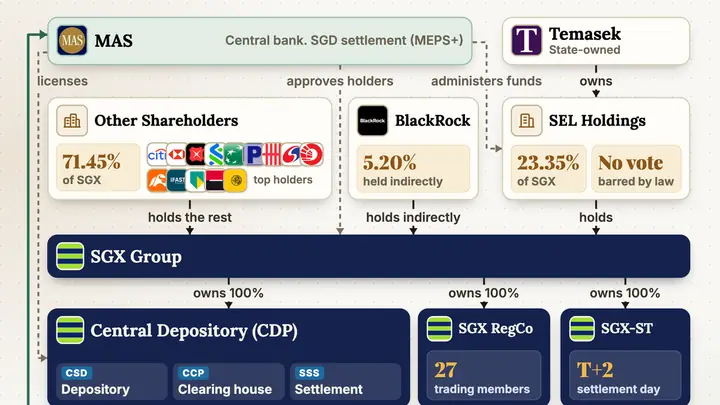
The record sits with CDP.
CDP alone maintains the record, so every party settles through CDP.
Prying Power & Control
Tokenisation promises to make share settlement more efficient. Today, trading a share on the Singapore Exchange (SGX) settles two business days later. The shares and the cash move together, and the cash is finalised by the Monetary Authority of Singapore (MAS), but only from 9 a.m. to 7 p.m. on weekdays. How much tokenisation improves this depends on what is tokenised and who runs the ledger.
A token is a twin, which has to be reconciled with an underlying ledger, or a native, which is the only ledger. For shares, CDP is SGX’s depository and a transfer is made by an entry in CDP’s register. Unless CDP tokenises that register, every other party still deals with CDP and not with a shared ledger. The same holds for the cash, which stays with MAS unless MAS tokenises it.
Instant settlement is the prize, and it has a price. Swapping the shares and the cash in one step needs both in place at each trade, and a shared ledger takes more coordination to maintain. In return, cash and shares sit idle for less time. Singapore has run several tokenisation efforts. SGX’s 2020 bond pilot recorded proof of ownership on an SGX operated ledger, and MAS is trialling the issuance of tokenised MAS Bills in 2026. This piece sets out what tokenising shares would speed up, what it would put at risk and what stays the same.
T+2settlement cycle 
Business days from trade to settlement on SGX’s main market, the baseline for every path
SGX-ST Rule 9.2.1 4 Nov 2026
2runs a day
Settlement runs at CDP, at 10.00 a.m. and 1.30 p.m. on the value date
CDP disclosure 30 Jun 2023
10hours, weekday only 
Singapore dollar cash settles in MEPS+, the central bank’s payment system, from 9 a.m. to 7 p.m.
MEPS+ disclosure 9 May 2016
1.5morders 
Fund orders processed in 2025, says Marketnode, a tokenised fund platform 37.3% held by SGX Group
A twin reconciles with another ledger, a native is the only one.
Shown for shares The diagrams below show the share leg of a trade at CDP. The cash leg follows the same test.
The record sits with CDP.
CDP alone maintains the record, so every party settles through CDP.
Reconciles with another ledger.
Holders maintain the share token, but it settles through the broker’s link to CDP.
The only ledger.
Every party maintains the share token directly.
How it works today
For a share held at CDP, the Singapore Exchange’s central depository, a transfer is made by CDP making an entry in its Depository Register. CDP novates trades between clearing members and settles their cash through settlement banks, so the other parties settle against CDP.
SGX and CDPSingapore, every listed share Twin
The US market infrastructure group DTCC calls it a digital record that represents an asset whose official record is kept somewhere else, and not a second ownership claim. The Guardian fixed income group, a Singapore industry group, describes securities issued and held in the traditional way, then represented by tokens. For a share at CDP, the official ledger stays CDP’s register, so the share token’s ledger and CDP’s register have to be reconciled.
The Bermuda Monetary Authority says twins introduce intermediary and credit risk and need ongoing reconciliation between the token and the asset.
 DTCCUS post-trade infrastructure group, glossary defines both MAS GuardianIndustry group run by Singapore’s regulator, fixed income framework defines both
 Bermuda Monetary AuthorityBermuda’s financial regulator, uses both terms for operations and not as legal definitions DTC tokenization serviceUnited States, live
The definitions are DTCC’s and the Guardian group’s. Who has to change under each is reasoning, and no published rule states it.
Native
The US market infrastructure group DTCC calls it an asset whose main record is the token itself, with no other system of record behind it, so there is no other ledger to reconcile with. The Guardian fixed income group, a Singapore industry group, describes securities issued and held natively as tokens. If CDP’s own record became a share token, every broker, clearing member and settlement bank would connect to it.
The Bermuda Monetary Authority says natives reduce intermediary risk but rely entirely on the integrity of the underlying system and its governance.
DTCCUS post-trade infrastructure group, glossary defines both MAS GuardianIndustry group run by Singapore’s regulator, fixed income framework defines both  EuroclearEuropean settlement group, calls its notes Digital Native Notes Bermuda Monetary AuthorityBermuda’s financial regulator, uses both terms for operations and not as legal definitions Euroclear D-FMIEurope, live, bonds SGX digital bondsSingapore, 2020 pilot and 2022 channel
 Swiss lawLedger-based securities
 German lawElectronic securities
The definitions are DTCC’s and the Guardian group’s. Who has to change under each is reasoning, and no published rule states it.
Shares and cash can settle in one step, but only if both legs are tokenised.
Today
The share token is a twin, reconciled with a ledger kept elsewhere
The share token is a native, the only ledger
Expand to read the labels.
What to know
The exchange matches the order on the trade date, and CDP posts the cash and the shares together two business days later.
Key facts
Not in the public record How and when the investor funds the broker is set by the broker’s own terms. The public CDP rules start at the clearing member.
Expand to read the labels.
Twin, an illustration
One firm tokenises a holding it already keeps at CDP, so the share token is a twin of a share the firm holds. The trade clears and settles at CDP as today, and no other broker, clearing member or bank has to change.
Key facts
Not in the public record Whether a broker in Singapore could issue such a token for an SGX-listed share, and on what terms. None has been announced.
Expand to read the labels.
Twin, live in the United States
DTC is itself the US central securities depository, and the securities token is still a twin. What decides it is where the official record sits, and at DTC that stays in its book-entry books. Holders can convert the securities token back, which is a conversion and not a trade.
Key facts
Not in the public record How the securities token and the DTC record are reconciled in detail. DTCC’s pages do not say. DTCC’s own pages also give two counts for the securities at launch, 34 and 25.
Expand to read the labels.

Native, an illustration
CDP is the record that every broker, clearing member and settlement bank settles against. If CDP tokenised its own register, the share token would be the share and its register entry, a native, and every one of their flows would change. This is an illustration for listed shares.
Key facts
Not in the public record Whether the Act would let a share token be the register entry for a listed share, who would run the ledger, and what it would mean for finality and for the cash leg.
Expand to read the labels.
Native, an illustration
The share record at CDP becomes a token, and the cash does not. Singapore dollars still settle through the settlement banks and MEPS+, so the banks and the central bank do not change.
Key facts
Not in the public record How CDP would link a share ledger to MEPS+ so the two legs stay delivery versus payment is not publicly stated.
Expand to read the labels.
Native, Singapore, a 2020 pilot
SGX ran a digital bond on a ledger it operated, so the proof of ownership was recorded there. It was a pilot for primary issuance, a bond sale and not a trade on the exchange.
Key facts
Not in the public record What triggers the atomic transfer, and how investors fund the cash side before it. Whether the ledger entry is the legal register for the bonds, and whether the same would be allowed for listed shares.
Expand to read the labels.
Two ledgers, Singapore, a 2018 prototype
MAS and SGX tested a swap between a cash ledger and a securities ledger for government securities, with a hash lock tying the two legs together.
Key facts
Not in the public record How each side learns that the other’s lock is confirmed. Both have access to the ledgers, and no alert is described. How clearing would work, and whether the securities ledger would be the legal register, is also not publicly stated.
Expand to read the labels.
Native, live in Europe
Euroclear runs a ledger component for issuance. The notes are issued on it, held in wallets there, and moved to the traditional platform for secondary trading.
Key facts
Not in the public record Which record is the legal register once the notes move to the traditional platform, and whether they stay tokens there. Whether a participant’s securities wallet is self-hosted or has to be approved first. Euroclear’s page does not say.
Tokenisation could speed up settlement, but it adds new risks and new coordination.
Reach
A twin touches the parties that agree to use its ledger, and the holders. A change at CDP touches everyone who settles there.
Not publicly stated Whether CDP or SGX plans any change.
Timing
Tokenised shares are meant to shorten the lag between trade and settlement, and the cash, the trade’s other leg, has to speed up in parallel. A twin leaves CDP’s settlement as it is, with both legs at T+2 in its 10.00 a.m. and 1.30 p.m. runs, though its parties could transfer the share token among themselves sooner. A native could settle both legs together on the trade date, if the cash is tokenised too.
Not publicly stated A date for any tokenised settlement of an SGX-listed share, whether it would run outside CDP’s 10.00 a.m. and 1.30 p.m. runs, and whether a transfer inside a twin’s group has any effect at CDP.
Both legs
A trade has two legs, the shares and the cash. Simultaneous settlement means neither leg is final without the other, which is delivery versus payment. Today CDP enforces settlement in each run, and a ledger could settle both legs automatically in one transfer, under rules the group agreed, visible to everyone on it. The cash leg settles in MEPS+, the interbank payment system run by MAS.
Not publicly stated How a share ledger at CDP would settle simultaneously with cash settled in MEPS+, and who would run and govern it.
Liquidity
Today CDP settles in batches. The cash is netted, so each net payer’s bank sends only the difference to CDP before the run, and the shares are reserved for it. Instant settlement handles each trade as it happens, so cash and shares must be in place at that moment, but they sit idle for less time.
Not publicly stated How much more liquidity a tokenised settlement of SGX shares would need.
Counterparty risk
Today CDP stands between buyer and seller, backed by margin and a Clearing Fund. The risk that the other side fails shrinks with the gap between trade and settlement.
Not publicly stated Whether CDP would confirm that it still novates trades if its register ran on a ledger, and how the parties on a twin ledger share liability if it strays from CDP’s record.
Register
At CDP an investor holds directly, named on CDP’s register, or through a broker custody account, where the broker is named and the investor claims through it. A twin leaves both as they are. A native could make the share token the register entry, and whose name sits on it, and which protections follow, is not publicly stated.
Not publicly stated Whether a share token could be the register for a share listed on SGX, which holder it would name, whether a token of a CDP-held share could sit in a wallet outside CDP, and whether tokenised settlement changes legal title.
Cash and securities are tokenising on separate tracks, and no live service settles a listed share.
None confirmed. DTCC lists digital cash on its roadmap for 2027 and beyond.
None confirmed.
None confirmed. Pontes links market DLT platforms and TARGET Services.
The source for each names one leg and not the other.
A statute decides what a ledger entry is, for the securities leg only.
Expand to read every tile.
Australia, a peer exchange
ASX is Australia’s main stock exchange. Its tokenisation working group met on cash equities on 14 October 2026.
The working group brings industry participants together to discuss where tokenisation could apply to the steps after a share trade, and whether it should.
Participants did not identify an immediate priority for tokenisation across the cash equities post trade lifecycle.
Key facts
Not in the public record Any ASX plan for a live tokenised service.


Singapore
BLOOM is a public and private initiative on settlement in digital money, such as tokenised deposits and regulated stablecoins. MAS, Singapore’s central bank, launched it on 16 October 2025, and Bank Negara Malaysia and the Bank of Thailand joined as policymaker members on 23 October 2026.
Banks and countries are building different forms of digital money. BLOOM develops common approaches for how they can be accepted, exchanged and settled across institutions, networks and jurisdictions.
No outcome is published yet. Participation has since grown, and the industry side now includes Airwallex, Mastercard, Maybank, Monee, Nium, Ripple, ShopeePay, Visa and the World Bank Group.
MASBank Negara MalaysiaBank of ThailandBanks, payment networks and technology providers Key facts
Europe
Pontes is a European Central Bank service that links the ledgers where tokenised assets trade to the Eurosystem’s payment and settlement services, known as TARGET. That lets deals settle in central bank money, which is a claim on the central bank itself and not on a commercial bank. The Eurosystem launched Pontes on 21 September 2026.
Tokenised assets trade on market ledgers, while large cash payments settle in central bank money. Pontes lets wholesale transactions in tokenised assets settle in central bank money.
Pontes is live, and the ECB plans longer Pontes hours by mid-2027 and round the clock availability in 2028.
Key facts
Singapore
A wholesale central bank digital currency, or wholesale CBDC, is the central bank’s own money issued as a cash token for banks to settle with. On 13 November 2025 MAS announced the successful completion of a live trial settling interbank overnight lending in wholesale CBDC on its Singapore dollar test network, with DBS, OCBC and UOB.
The test network, the SGD Testnet, is a shared ledger that lets financial institutions test the settlement of tokenised assets using wholesale CBDC. The network offers a common settlement asset, programmable payments and atomic settlement of cash and securities.
The trial was completed successfully, and MAS will build on this CBDC settlement pilot with tokenised MAS Bills.
 DBS
 OCBC
 UOB
Key facts
Not in the public record Whether Singapore dollar wholesale CBDC will settle a listed share. MAS names tokenised MAS Bills as the next trial.
United States
DTC is the US central securities depository, the institution that holds US securities and settles trades in them, and it is part of DTCC. DTC launched the service on 28 October 2026 after an SEC no-action letter in December 2025 covering Russell 1000 stocks, index ETFs and Treasuries.
The service aims to keep liquidity in traditional markets while expanding it through the tokenized service, with holders able to convert between the two forms.
20 DTC participants have signed, and more networks, more eligible securities, digital cash and a consolidated stock record are on the roadmap for 2027 and beyond.
Key facts
Not in the public record How the securities token and the DTC record are reconciled.
Europe
Euroclear is a European settlement group, and D-FMI is its regulated platform that issues bonds on a ledger. Euroclear launched its first D-FMI service on 24 October 2023. Participants hold the notes in securities wallets on the ledger, and the notes can move to the traditional platform for secondary trading.
The aim is to bring bond issuance onto a ledger inside a regulated depository, and D-FMI is fully integrated with Euroclear Bank, which gives it compliance with the CSD Regulation.
Issuance, distribution and secondary activity all settle on the same day.
Key facts
Not in the public record Which record is the legal register once the notes move to the traditional platform, whether they stay tokens there, and whether a participant’s securities wallet is self-hosted or has to be approved first.
Europe
Caisse des Dépôts, a French public financial institution, issued a EUR 100 million note on 7 November 2024 on Euroclear’s D-FMI platform, settled through Banque de France’s DL3S platform for digital currency. Banque de France is France’s central bank.
The operation allowed Banque de France to enrich its connectivity solutions by setting-up a new interoperability link between the 2 DLT.
Caisse des DépôtsBanque de FranceEuroclear Key facts
Not in the public record Whether this became a standing service. It was a single issue.

Singapore, Guardian
A repo is a short-term loan against a security, repaid with interest. On 15 November 2023 UBS, SBI and DBS announced, as part of MAS’s Project Guardian, that they had launched the world’s first live repo with a natively-issued digital bond on a public blockchain.
It tested whether a whole transaction could run on a public blockchain. The deal automatically and instantly settled a repo, digital bond purchase and redemption using regulated digital payment tokens, across regulated entities located in three different jurisdictions.
UBSSBIDBS Key facts
Not in the public record Singapore dollar settlement. The transaction was in yen.
Singapore
Project Ubin was a MAS programme to put Singapore dollars and securities on ledgers. This phase tested delivery versus payment, where the shares and the cash move only together, across separate ledgers. MAS and SGX announced on 11 November 2018 that the prototypes had worked.
The prototypes demonstrated the functional capabilities of three different blockchain pairs to establish an interledger DvP settlement system, and highlighted the need for an arbitrator for dispute resolution. Five areas were left for later work: rulebook integration, compression of the settlement cycle, arbitration design, enhanced security and privacy, and liquidity and market structure.
Key facts
Not in the public record Whether the tokenised securities are twins or natives, and whether the securities ledger would be the legal register.
Singapore
MAS Bills are short-term bills that MAS issues. MAS is trialling the issuance of tokenised MAS Bills in 2026, settled using wholesale CBDC through the Singapore dollar test network.
The trial builds on MAS’s wholesale CBDC trial, after which MAS planned in a future trial to issue tokenised MAS Bills to Primary Dealers which will be settled using CBDC.
The trial is under way, and the page lists issues from 23 September 2026. No results are published yet.
Key facts
Not in the public record Whether the bill token is the legal bill or a representation of a bill held elsewhere, which ledger holds it, and so whether it is a twin or a native.
Switzerland
Project Helvetia is the Swiss National Bank’s pilot on settling tokenised assets in central bank money. The SNB has provided wholesale CBDC on the SIX Digital Exchange trading and settlement platform since the end of 2023.
The SNB evaluated the project and decided to extend it for a further year, to at least mid-2027, and added a second route that settles tokenised assets with traditional central bank money.
 SIX Digital ExchangeBXBX Digital
Key facts
Not in the public record Which tokenised assets settle, and whether they are twins or natives.
Singapore
SGX is Singapore’s exchange and CDP is its central depository. SGX has run bond issuance on a ledger it operates, and CDP has taken digital debt issuance since June 2022. Both are for debt and neither is for listed shares.
The 2022 channel is meant as a blueprint for a digital bond infrastructure utility within a regulated securities depository. On its 2020 platform, an atomic transfer of assets and proceeds is triggered, and proof of ownership is recorded on an SGX operated ledger.
SGX says the pilot cut primary issuance settlement from 5 days to 2 days and automated registrar functionality.
Key facts
Not in the public record Whether the ledger entry is the legal register for those bonds, what triggers the atomic transfer, and how investors fund the cash side before it.

Singapore
Marketnode is a digital asset infrastructure company, a venture of SGX and Temasek in which SGX Group holds 37.3 percent. SGX and Temasek announced it on 22 January 2021. Its Fundnode service covers order routing, settlement orchestration and record-keeping for funds.
Marketnode uses smart contracts, ledger and tokenisation technologies for traditional capital markets products.
Key facts
Not in the public record Whether Fundnode’s records are tokens, and whether they are the legal register of the funds it handles.
Singapore
Project Guardian is a MAS-led sandbox where policymakers and the financial industry run trials of asset tokenisation and write frameworks. MAS launched it on 31 May 2022, and SGX Group and Euroclear are in its industry group.
Key facts
Not in the public record A share listed on SGX, which the Guardian papers leave out.
Switzerland, law
Switzerland’s Code of Obligations lets a right exist as a ledger-based security, a right that exists and moves only through a securities ledger. The ledger entry is the record.
The rules came with the Federal Act on the Adaptation of Federal Law to Developments in Distributed Ledger Technology, in force since 1 February 2021.
Key facts
Germany, law
German law lets an issuer create a security by an entry in an electronic register instead of a paper certificate, and lets that register run on a ledger.
Before the Act, a security needed a certificate. The Act lets an issuer issue a security by making an entry in an electronic securities register instead of issuing a certificate.
Key facts

Europe, law
EU law lets a settlement system record and settle instruments on a ledger, as a capped pilot. It is the clearest case of shares on a ledger as the primary record, and it is bounded.
The Regulation sets up a pilot regime for market infrastructures based on distributed ledger technology, so trading and settling on a ledger can be tested within limits.
Key facts
The statute and MAS guidance frame the questions, and neither answers them for a listed share.
A twin has to be reconciled with CDP’s record, so CDP stays the record and the trade settles as today. A native is the only ledger, so it replaces CDP’s record and everyone who deals with CDP has to connect to it.
No. Tokenising the share and tokenising the cash are separate choices, and each leg can sit on today’s rails, as a twin or as a native. Settling both legs in one step needs both tokenised, on one ledger or linked.
Settling each trade instantly gives up today’s netting and needs the cash and shares in place at the trade. They then sit idle for less time, because they are no longer reserved for a batch run.
Not publicly stated for SGX. What exists is a statute that names CDP’s register for deposited shares, guidance that asks issuers to say which record counts, and a US letter on DTC’s twin.
The Guardian fixed income paper calls it a key open question where settlement finality and beneficial ownership will be recorded.
The BIS says legal and regulatory uncertainty remains a challenge for tokenised bonds.
Not publicly stated for Singapore. Switzerland and Germany already let a ledger be the legal register, and industry papers describe it for funds, but the Act points to CDP’s register for deposited shares.
For shares of a variable capital company, the Guardian paper on tokenised funds says there is no express guidance on whether a blockchain instruction can be an instrument of transfer.
Not announced. SGX and CDP have done digital debt issuance on a ledger, and that work is for bonds.
Get an email when a new piece goes up.