No single rulebook covers all of this. Which rule applies depends on what the token is, what the firm does with it, and where its customers are. The rules also differ in strength. Some sit in an Act or regulations with an offence attached. Others are notices that bind named firms, guidelines that MAS weighs in supervision, or proposals still in consultation.
This piece maps which rule applies to which activity, how firmly it binds, and where to read it. It is not
legal advice, and every rule links to its source. Start with the tokens and licences below.
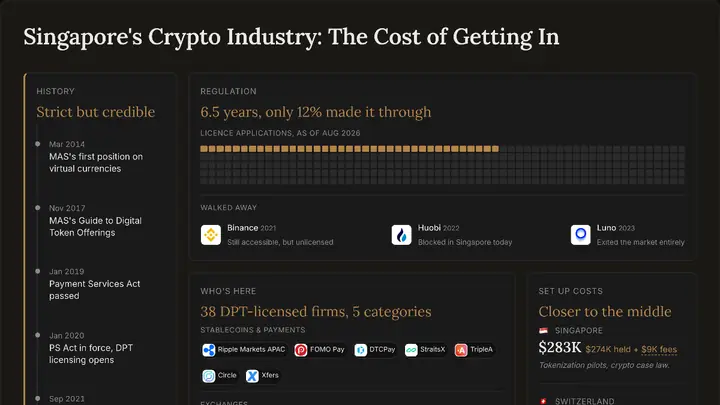
38licensed
Entities hold a payment services licence for token services, from close to 300 applications since 2020.
In the Payment Services Act, a unit of digital value that is not denominated in or pegged by its issuer to any currency, is or is meant to be a medium of exchange accepted by the public, and can be transferred, stored or traded electronically.
Loyalty points and in-game assets that cannot be returned, transferred or sold for money are limited purpose tokens, outside the digital token services of the FSMA.
A token whose issuer pegs it to a currency. The Act's definition of a payment token leaves out a pegged unit. MAS applies the Act to it as a matter of policy, and the 2026 draft would write that into the Act.
A draft issuance licence would let only licensed issuers hold a token out as MAS-regulated, with reserves at least equal to par, a par redemption right and no interest to holders.
A token with the rights of a share, a debenture or a fund unit is a capital markets product under the Securities and Futures Act. MAS applies the same rules to it as to that product in any other form.
Key facts
Capital markets products are securities, units in a collective investment scheme, derivatives contracts, leveraged spot foreign exchange, and any product MAS prescribes.
Dealing needs the capital markets services licence, a trading platform needs approval or recognition, and advice needs the adviser licence or an exemption. An adviser abroad who induces the public in Singapore counts as acting here.
Still open
A ruling on a borderline token, which the Guide lets an issuer ask MAS for
A token with no claim on money or assets. The Guide's case studies include a vote on platform features, a meme token, a record of data and a collectible.
The licence under the Payment Services Act for a firm that deals in, exchanges, transmits or provides custody of payment tokens. It comes as a standard or a major licence, and a firm moves up to the major licence once its monthly volume passes SGD 3 million for one service or SGD 6 million for two or more.
Key facts
A business of providing a payment service without the licence is an offence, with a fine up to SGD 250,000 for a company, or SGD 125,000 or three years for an individual.
A customer's tokens must be in a trust account or returned to the customer by the next business day after the firm receives them from, or on account of, the customer.
Every customer gets MAS's risk warning before using the service, and it says a licence does not mean the customer can recover tokens if the firm fails.
Who does not need it
The Act exempts five kinds of firm from holding the licence, so they can provide payment token services without it. They are exempt providers, and they are not unregulated.
What it covers.The exemption covers the digital payment token service and e-money issuance. It also covers account issuance and domestic money transfer when these are not only incidental to the firm's banking or financing business. A card licensee can also provide cross-border money transfer, merchant acquisition and money-changing.
What still applies.Parts of the Act apply to an exempt provider as if it were a licensee, among them notifying MAS of certain events, giving it information and periodic reports, using only licensed agents, safeguarding customer money and an audit. The token custody regulations apply as conditions, and MAS can add conditions or end the exemption.
The Securities and Futures Act licence for a firm that carries on a regulated activity in capital markets products. For tokenised securities that means dealing, custodial services, fund management or corporate finance advice.
Key facts
The seven regulated activities are dealing in capital markets products, advising on corporate finance, fund management, real estate investment trust management, product financing, credit rating and custodial services.
Only advice on corporate finance is on the list. Advice on investment products falls under the Financial Advisers Act, and a capital markets services licensee is exempt from holding that licence.
The Financial Advisers Act licence for a firm that advises others on investment products. Tokenised capital markets products are investment products, and payment tokens are not.
Key facts
The Act lists three types of financial advisory service. They are advising others on an investment product, issuing research analyses or reports on one, and arranging life policies. Advice on corporate finance falls under the capital markets services licence instead.
Payment tokens are not capital markets products, so advice on them is not a financial advisory service. Inducing a trade in payment tokens is a payment token service instead.
Acting as a financial adviser without a licence or an exemption is an offence, with a fine up to SGD 75,000 or three years or both. A person who induces the public in Singapore to use its advice is treated as acting in Singapore, wherever the firm sits.
The exempt include banks, merchant banks, insurers and insurance brokers, holders of a capital markets services licence, and finance companies MAS has exempted. An approved exchange or recognised market operator is exempt for advice that is only incidental to running its market. An exempt adviser follows the Act's conduct rules as if it were licensed.
A recommendation needs a reasonable basis. The adviser must consider the person's investment objectives, financial situation and particular needs, and is liable for damages if the person relies on a recommendation made without one.
A licence under the Financial Services and Markets Act 2022 for a Singapore company that provides digital token services only to customers outside Singapore.
The Act covers a person operating from a place of business in Singapore, even when the service runs alongside another business.
It applied from 30 June 2025 with no transition period, and MAS says it has set the bar high.
A company must hold base capital, and an individual makes a cash deposit with MAS instead.
A person who is required to be licensed, or is exempt, under the SFA, the Financial Advisers Act or the Payment Services Act for the same activity is not caught.
A licence MAS proposed in its September 2026 consultation for firms that issue stablecoins. Only a licensed issuer could call its token MAS-regulated, and the Act has no issuer licence today.
Key facts
Only licensed issuers may hold a token out as MAS-regulated, with a "MAS-regulated stablecoin" label, reserves at least equal to par, a par redemption right, no interest to holders, safeguarding of money before issuance, stress tests and wind-down plans.
A Singapore entity that issues a stablecoin that is not MAS-regulated would be deemed to provide payment token services and need a major payment institution licence.
Under the Securities and Futures Act, a person who runs an organised market, or holds out as running one, must be approved by MAS as an exchange or recognised as a market operator.
Which licence it sits beside
Tokenised securities, derivatives and fund units.A venue needs this approval or recognition. A firm that also deals on it needs the capital markets services licence. On MAS's directory, ADDX, DigiFT and Asia Digital Exchange hold both, and DBS Digital Exchange holds the recognition alone.
Payment tokens and stablecoins.No approval applies. Running an exchange for them is part of the payment services licence, and MAS treats a stablecoin as a payment token. An exchange that allows no trading of securities, derivatives or fund units is outside the securities Act. If it lists a token that is one of these, it is running an organised market and needs the approval or recognition too.
Key facts
The market can be for tokenised securities, derivatives or fund units, and running one without approval or recognition is an offence.
The Securities and Futures Act bars an offer of securities or securities-based derivatives unless it is made in, or with, a prospectus lodged with and registered by MAS. The Guide applies this to tokens that are securities, and an offer of fund units also needs the fund authorised or recognised.
Who files it, and whether a licence comes with it
The rule falls on whoever makes the offer, the issuer or a firm distributing for it. It is not a licence, and a licence does not replace it. A firm that runs the platform for the offer can need the capital markets services licence, and an issuer that pools the money and manages the portfolio can need it for fund management.
The regime for tokens used as money. A firm that deals in, exchanges, transmits or provides custody of them needs a payment services licence, unless it is exempt. MAS treats a stablecoin as a payment token.
The regime for tokens that carry the rights of a share, a debenture or a fund unit. The same activity, the same risk, the same regulatory outcome, so the form of the token does not change the licence.
Offering a token to the public, or issuing it. Securities tokens follow the prospectus rules, and a stablecoin issuer would need a new licence under the draft.
Payment tokensA separate check under the Act
StablecoinsNo issuer licence yet, and a draft would add one
The licence under the Payment Services Act for a firm that deals in, exchanges, transmits or provides custody of payment tokens. It comes as a standard or a major licence, and a firm moves up to the major licence once its monthly volume passes SGD 3 million for one service or SGD 6 million for two or more.
The Securities and Futures Act licence for a firm that carries on a regulated activity in capital markets products. For tokenised securities that means dealing, custodial services, fund management or corporate finance advice.
Among 1,580 capital markets services licensees on MAS's directory
Under the Securities and Futures Act, a person who runs an organised market, or holds out as running one, must be approved by MAS as an exchange or recognised as a market operator.
Among 79 recognised market operators on MAS's directory
Retail assetsCannot be moved by contract, except lending that meets regulation 45
For a licence holder that holds customers' tokenised assets. They go into a custody account held on trust by the next business day and are not mixed with the firm's own. AML notices apply too.
ExemptionA personal offer up to SGD 5 million in 12 months
ExemptionA private placement to no more than 50 people
ExemptionOffers to institutional or accredited investors
The Securities and Futures Act bars an offer of securities or securities-based derivatives unless it is made in, or with, a prospectus lodged with and registered by MAS. The Guide applies this to tokens that are securities, and an offer of fund units also needs the fund authorised or recognised.
The Financial Advisers Act licence for a firm that advises others on investment products. Tokenised capital markets products are investment products, and payment tokens are not.
For a payment token offered to the public, the Guide's case studies tell the issuer to assess separately whether its activities are regulated under the Payment Services Act. No prospectus rule applies to a payment token.
A licence MAS proposed in its September 2026 consultation for firms that issue stablecoins. Only a licensed issuer could call its token MAS-regulated, and the Act has no issuer licence today.
No firm holds it yet. Issuers today hold payment services licences.
A licence under the Financial Services and Markets Act 2022 for a Singapore company that provides digital token services only to customers outside Singapore.
MAS's Tokenisation Guide finds in its case studies that a token with no financial rights, such as a vote, a record or a collectible, is unlikely to be a capital markets product. It is a payment token only if it is meant as a medium of exchange.
The licence depends on where the customers are. A Singapore firm that serves only customers abroad falls under the digital token service provider licence.
These tiers show which Singapore licences each firm holds. They do not show who controls the tokenised products these firms issue, hold or service. The piece on who controls tokenised real-world assets maps that web, and Franklin Templeton, Fidelity, Apollo and BNY sit in it.
Xfers is a payment infrastructure company built to simplify sending and receiving funds, and its MAS licence is held under the names Fazz and StraitsX.
Key facts
One licence covers the token service and the money services around it, account issuance, domestic transfer, cross-border transfer, merchant acquisition and e-money issuance
The directory shows the licence under the names Fazz and StraitsX
Not in the public record
When the licence was granted, which the entry does not show
One licence covers the token service and the money services around it, account issuance, domestic transfer, cross-border transfer, merchant acquisition and e-money issuance
Not in the public record
When the licence was granted, which the entry does not show
On MAS's directory
DIGITAL TREASURES CENTER PTE. LTD. ↗Major payment institutionAccount issuanceDomestic transferCross-border transferMerchant acquisitionE-money issuanceDigital payment token139 Cecil Street #08-01 YSY Building 069539
Stablecoins and payments · Payment services licence
One licence covers the token service and the money services around it, account issuance, domestic transfer, cross-border transfer, merchant acquisition and e-money issuance
One licence covers the token service and the money services around it, account issuance, domestic transfer, cross-border transfer, merchant acquisition and e-money issuance
Not in the public record
When the licence was granted, which the entry does not show
One licence covers the token service and the money services around it, account issuance, domestic transfer, cross-border transfer, merchant acquisition and e-money issuance
Not in the public record
When the licence was granted, which the entry does not show
Licensed for digital payment tokens only, with no money transfer, account or e-money service
Also holds a capital markets services licence, for dealing (securities, funds, derivatives, leveraged FX), product financing, custody, investment product advice and research reports
Not in the public record
When the licence was granted, which the entry does not show
DBS Group Holdings is a financial services group headquartered and listed in Singapore, with a presence in 19 markets across Greater China, Southeast Asia and South Asia.
Key facts
A bank is exempt from the payment services licence
As a bank it carries out fund management, dealing, custody, corporate finance advice and investment product advice without a capital markets services licence
Is a primary dealer in Singapore government securities
Is a settlement institution for designated payment systems
What the member does in the project, which the page does not say
Which entity of the group is the member. The page names the group, and the directory lists its entities
On MAS's directory
DBS BANK LTD. ↗Local bankSettlement institution for designated payment systemsPrimary dealer in Singapore government securitiesFund managementDealingCustodyCorporate finance adviceInvestment product advice12 Marina Boulevard, Marina Bay Financial Centre Tower 3 018982
As a bank it carries out fund management, dealing, custody, corporate finance advice and investment product advice without a capital markets services licence
Is a primary dealer in Singapore government securities
What the member does in the project, which the page does not say
Which entity of the group is the member. The page names the group, and the directory lists its entities
On MAS's directory
OVERSEA-CHINESE BANKING CORPORATION LIMITED ↗Local bankPrimary dealer in Singapore government securitiesFund managementDealingCustodyCorporate finance adviceInvestment product advice63 Chulia Street #10-00 OCBC Centre East 049514
As a bank it carries out fund management, dealing, custody, corporate finance advice and investment product advice without a capital markets services licence
Is a primary dealer in Singapore government securities
What the member does in the project, which the page does not say
Which entity of the group is the member. The page names the group, and the directory lists its entities
On MAS's directory
UNITED OVERSEAS BANK LIMITED ↗Local bankPrimary dealer in Singapore government securitiesFund managementDealingCustodyCorporate finance adviceInvestment product advice80 Raffles Place, UOB Plaza 048624
As a bank it carries out fund management, dealing, custody, corporate finance advice and investment product advice without a capital markets services licence
Is a primary dealer in Singapore government securities
What the member does in the project, which the page does not say
Which entity of the group is the member. The page names the group, and the directory lists its entities
On MAS's directory
STANDARD CHARTERED BANK (SINGAPORE) LIMITED ↗Qualifying full bankPrimary dealer in Singapore government securitiesFund managementDealingCustodyCorporate finance adviceInvestment product advice8 Marina Boulevard #27-01 Marina Bay Financial Centre Tower 1 018981
As a bank it carries out fund management, dealing, custody, corporate finance advice and investment product advice without a capital markets services licence
Is a primary dealer in Singapore government securities
Is a settlement institution for designated payment systems
Not in the public record
What the member does in the project, which the page does not say
Which entity of the group is the member. The page names the group, and the directory lists its entities
On MAS's directory
CITIBANK SINGAPORE LIMITED ↗Qualifying full bankDealingCustodyInvestment product advice8 Marina View, Asia Square Tower 1 018960
CITIBANK N.A. ↗Full bankSettlement institution for designated payment systemsPrimary dealer in Singapore government securitiesFund managementDealingCustodyCorporate finance adviceInvestment product advice8 Marina View #21-00 Asia Square Tower 1 018960
As a bank it carries out fund management, dealing, custody, corporate finance advice and investment product advice without a capital markets services licence
Is a primary dealer in Singapore government securities
Not in the public record
What the member does in the project, which the page does not say
Which entity of the group is the member. The page names the group, and the directory lists its entities
On MAS's directory
THE HONGKONG AND SHANGHAI BANKING CORPORATION LIMITED ↗Full bankPrimary dealer in Singapore government securitiesFund managementDealingCustodyCorporate finance adviceInvestment product advice10 Marina Boulevard #48-01 Marina Bay Financial Centre Tower 2 018983
As a bank it carries out fund management, dealing, custody, corporate finance advice and investment product advice without a capital markets services licence
Not in the public record
What the member does in the project, which the page does not say
Which entity of the group is the member. The page names the group, and the directory lists its entities
As a bank it carries out dealing, product financing, corporate finance advice, investment product advice and research reports without a capital markets services licence
Is a primary dealer in Singapore government securities
Not in the public record
What the member does in the project, which the page does not say
Which entity of the group is the member. The page names the group, and the directory lists its entities
On MAS's directory
AUSTRALIA AND NEW ZEALAND BANKING GROUP LIMITED ↗Wholesale bankPrimary dealer in Singapore government securitiesDealingProduct financingCorporate finance adviceInvestment product adviceResearch reports9 STRAITS VIEW #19-07 MARINA ONE WEST TOWER 018937
As a bank it carries out fund management, dealing, product financing, custody, corporate finance advice, investment product advice and research reports without a capital markets services licence
Is a primary dealer in Singapore government securities
Not in the public record
What the member does in the project, which the page does not say
Which entity of the group is the member. The page names the group, and the directory lists its entities
On MAS's directory
DEUTSCHE BANK AKTIENGESELLSCHAFT ↗Wholesale bankPrimary dealer in Singapore government securitiesFund managementDealingProduct financingCustodyCorporate finance adviceInvestment product adviceResearch reports1 RAFFLES QUAY #17-00 SOUTH TOWER 048583
Its holding company, its securities exchange and its derivatives clearing arm are an approved holding company, an approved exchange and an approved clearing house
Not in the public record
What the member does in the project, which the page does not say
Which entity of the group is the member. The page names the group, and the directory lists its entities
Before serving an individual, the firm assesses the user's knowledge of the risks. If the user knows too little, the firm should not serve them, though it may assess them again after explaining the risks.
The firm shows MAS's risk warning before the user uses the service. It states that a licence does not mean a user can recover tokens if the firm fails.
Retail customers are everyone except institutional investors, accredited investors who opted in, token providers and foreign regulated equivalents. For the asset tests, token holdings count at a haircut of at least 50% and are capped at SGD 200,000.
Before it serves a retail customer who is an individual, a provider runs a risk awareness assessment. A customer who lacks sufficient knowledge should not be served, though a re-assessment is allowed after the risks are explained.
Every customer and prospect gets MAS's risk warning statement before using the service. It must be published at least once, not buried in other text, and set in a reasonable size and typeface.
A licensee must not carry on a business of granting credit facilities to individuals in Singapore. A breach is an offence with a fine up to SGD 100,000.
Do not entice a retail customer to lend, stake, pledge or mortgage assets, and do not do it for them. A transfer to the customer's own specified account is not lending or staking by the provider.
Puts each deposit in trust by the next business day
The rules
Customer tokens go into a trust account
The firm puts tokens it receives into a designated trust account, or returns them to the customer, by the next business day after it receives them. The account is kept apart from the firm's own, and its contents cannot pay the firm's debts.
The firm may not mix customer tokens with its own, except with other customers' tokens. It may add its own tokens to open the account or settle fees. Moving tokens out needs the customer's specific written instruction.
If the firm uses a third-party custodian to hold customer tokens, which the regulations call a safeguarding person, it checks the custodian is suitable before opening the account and every year after, keeps its grounds for five years, and gives written notice that the tokens are held on trust.
Breaking nearly any of these regulations is an offence. The headline breaches (18B(1) and (2), 18C(1)(a), (b) and (d), and 18G) carry a fine up to SGD 250,000 and SGD 25,000 for each continuing day. Breaches of the book entry rules in 18F carry up to SGD 100,000 and SGD 10,000 a day for a company. The offences apply to licensees and not to exempt providers.
A separate book entry for each customer. By the end of each business day, a computation of tokens held in trust, tokens required in trust and the firm's residual interest, kept for five years.
At least 90% of customer tokens should be held in cold wallets, with the share reviewed. Senior managers and staff who control the movement of customer assets should be resident in Singapore.
Providers should send monthly statements, disclose storage and loss-handling policies, and use separate blockchain addresses for customer tokens and their own.
Moves tokens only on written instruction and applies the travel rule
The rules
No mixing with the firm's own tokens
The firm may not mix customer tokens with its own, except with other customers' tokens. It may add its own tokens to open the account or settle fees. Moving tokens out needs the customer's specific written instruction.
For a transfer of SGD 1,500 or less, the originator's name and account number (or reference) and the beneficiary details travel with it. Above that, the originator is identified and verified, and more details are added.
The travel rule paragraph does not apply to transfers with parties outside the "ordering institution" and "beneficiary institution" definitions, such as unhosted wallets. A provider may engage in them but must apply enhanced measures, for example having the customer prove control of its wallet.
MAS's July 2026 paper says risk mitigation must cover every transfer that misses the travel rule, and not only those flagged by blockchain analytics. About a quarter of providers use more than one travel rule tool.
On a sanctions hit a provider freezes without delay, reports it, and files a suspicious transaction report within 1 business day. The duty covers payment tokens.
In ByBit v Ho Kai Xin, the Singapore High Court treated USDT as property that can be held on trust. It found that a former employee who took USDT from the exchange held it for the exchange, so tokens can be held on trust for the person they belong to.
In Re Taylor (Eqonex Capital), the customers owned their tokens outright, and the exchange's terms let it sell what was left after a closing period. The court found no trust. The events were in 2022, before the trust regulations took effect in October 2024.
MAS proposes that every major and standard payment institution join FIDReC, so eligible customers can take disputes to mediation and adjudication. It is a route for disputes and not a compensation fund. Comments close on 30 November 2026.
Breaking nearly any of these regulations is an offence. The headline breaches (18B(1) and (2), 18C(1)(a), (b) and (d), and 18G) carry a fine up to SGD 250,000 and SGD 25,000 for each continuing day. Breaches of the book entry rules in 18F carry up to SGD 100,000 and SGD 10,000 a day for a company. The offences apply to licensees and not to exempt providers.
The law decides who needs a licence, and notices and guidelines set most of what a licensed firm must do once it has one.
Act or regulationA duty, often an offence
NoticeBinds named licensees
GuidelineMAS expects it
ProposedNot yet in force
Classifying the token
Act or regulationTwo legal categories of token2 rules
Payment token: money-like, no currency peg
A payment token is a unit that is not denominated in or pegged by its issuer to any currency, that is or is meant to be a medium of exchange accepted by the public, and that can be transferred, stored or traded electronically.
Capital markets product: shares, funds, derivatives
Capital markets products are securities, units in a collective investment scheme, derivatives contracts, leveraged spot foreign exchange, and any product MAS prescribes.
Loyalty points and in-game assets that cannot be returned, transferred or sold for money count as limited purpose tokens, which sit outside the FSMA's digital token services.
The Guide's case studies find a token that only votes on features, carries no rights, records data, or is a collectible with limited rights unlikely to be a capital markets product. Each tells the issuer to check the Payment Services Act separately.
MAS's current policy treats stablecoins as a subset of payment tokens. A stablecoin that is not MAS-regulated stays in the payment token regime, where every intermediary service is regulated.
ProposedDraft adds "any stablecoin" to the definition
The draft adds a second limb to the payment token definition ("any stablecoin") and excludes stablecoins from e-money. The existing "not pegged to any currency" limb stays as it is.
Act or regulationFive activities are regulated services
Dealing in, exchanging, transmitting, safeguarding and carrying out instructions for payment tokens are payment token services. Holding a token or key counts where the provider has control, alone or jointly.
GuidelineStandard or major licence, by volumeSGD 100,000 or SGD 250,000
A firm needs a payment services licence unless exempt. The licence is standard or major depending on volume, with base capital of SGD 100,000 for a standard licence and SGD 250,000 for a major licence.
New applicants file a legal opinion and an independent auditor's assessment of AML/CFT and consumer protection. A technology and cyber assessment follows in-principle approval. Applicants state each token's nature under MAS's framework.
Act or regulationCustomer tokens held on trust, unmixed2 rules
Customer tokens go into a trust account
The firm puts tokens it receives into a designated trust account, or returns them to the customer, by the next business day after it receives them. The account is kept apart from the firm's own, and its contents cannot pay the firm's debts.
The firm may not mix customer tokens with its own, except with other customers' tokens. It may add its own tokens to open the account or settle fees. Moving tokens out needs the customer's specific written instruction.
If the firm uses a third-party custodian to hold customer tokens, which the regulations call a safeguarding person, it checks the custodian is suitable before opening the account and every year after, keeps its grounds for five years, and gives written notice that the tokens are held on trust.
A separate record and a daily countEvery business day
A separate book entry for each customer. By the end of each business day, a computation of tokens held in trust, tokens required in trust and the firm's residual interest, kept for five years.
Breaking nearly any of these regulations is an offence. The headline breaches (18B(1) and (2), 18C(1)(a), (b) and (d), and 18G) carry a fine up to SGD 250,000 and SGD 25,000 for each continuing day. Breaches of the book entry rules in 18F carry up to SGD 100,000 and SGD 10,000 a day for a company. The offences apply to licensees and not to exempt providers.
At least 90% of customer tokens should be held in cold wallets, with the share reviewed. Senior managers and staff who control the movement of customer assets should be resident in Singapore.
Providers should send monthly statements, disclose storage and loss-handling policies, and use separate blockchain addresses for customer tokens and their own.
For AML purposes a provider has control of a token if it has control jointly or severally with others, and a token instrument is anything that enables control, such as a private key.
PSN02 applies customer due diligence at any amount to a customer without business relations, requires enhanced measures for transfers with parties that are not financial institutions, and bars cash payments of SGD 20,000 or more.
Suspicious activity or fraud that is material to the firm's safety, soundness or reputation is reported to MAS on Form F1 within 5 working days. Suspicious transaction reports to the police unit continue as well.
PSN03 4 to 8Conduct notices and a risk warning2 rules
Records, receipts, returns and cyber notices
Licensees follow the conduct notice PSN07 and the Act on records, receipts, display of exchange rates and fees, and business hours. Periodic returns (PSN04), cyber hygiene (FSM-N14) and technology risk (FSM-N13, from 6 November 2024) also apply.
Every customer and prospect gets MAS's risk warning statement before using the service. It must be published at least once, not buried in other text, and set in a reasonable size and typeface.
GuidelineMAS expects real-time screening and tracing2 rules
Real-time screening, tracing and analytics
MAS expects real-time transaction screening, tracing a token back as far as needed, ledger analytics tools, an enterprise-wide risk assessment reviewed at least every two years, and no reliance on other licensed providers for due diligence.
A July 2026 MAS paper sets supervisory expectations in seven areas, from risk assessment before listing a token to travel rule tools and staff training, with case studies from inspections.
Suspicious transactions are reported5 business days
A suspicious transaction report should be filed within 5 business days of suspicion being established, and within 1 business day for sanctioned parties.
Act or regulationA trading venue needs approvalSGD 250,000
Operating an organised market for tokenised securities, derivatives or fund units needs approval as an exchange or recognition as a market operator. A breach carries a fine up to SGD 250,000 or three years or both.
GuidelineVenue, broker and own trading kept apart2 rules
No market and broker in one entity
A firm should not operate a market and act as broker or agent in the same legal entity. A market operator should not trade over the counter for its own account on its own market, except back-to-back matched trades.
A firm publishes its listing, review and delisting policies, with criteria, fees received and customer rights. Senior managers answer for them. A new token gets a money laundering risk assessment before it is offered.
Do not promote token derivatives as a convenient unregulated alternative. Offer them through a separate entity that is not licensed under the Act. MAS does not regulate them unless an approved exchange offers them.
MAS proposed order-handling and surveillance duties and statutory bans on manipulation and insider trading for payment tokens. MAS's page shows no response. Neither the Payment Services Act nor the FSMA has such provisions today.
NoticeSender and recipient details travelSGD 1,500
For a transfer of SGD 1,500 or less, the originator's name and account number (or reference) and the beneficiary details travel with it. Above that, the originator is identified and verified, and more details are added.
GuidelineExtra checks outside the travel rule2 rules
Unhosted wallets get enhanced checks
The travel rule paragraph does not apply to transfers with parties outside the "ordering institution" and "beneficiary institution" definitions, such as unhosted wallets. A provider may engage in them but must apply enhanced measures, for example having the customer prove control of its wallet.
MAS's July 2026 paper says risk mitigation must cover every transfer that misses the travel rule, and not only those flagged by blockchain analytics. About a quarter of providers use more than one travel rule tool.
On a sanctions hit a provider freezes without delay, reports it, and files a suspicious transaction report within 1 business day. The duty covers payment tokens.
Act or regulationCredit to individuals is barredSGD 100,000
A licensee must not carry on a business of granting credit facilities to individuals in Singapore. A breach is an offence with a fine up to SGD 100,000.
Retail customers are everyone except institutional investors, accredited investors who opted in, token providers and foreign regulated equivalents. For the asset tests, token holdings count at a haircut of at least 50% and are capped at SGD 200,000.
Before it serves a retail customer who is an individual, a provider runs a risk awareness assessment. A customer who lacks sufficient knowledge should not be served, though a re-assessment is allowed after the risks are explained.
PS-G03 4.2No credit, leverage, lending or staking2 rules
No lending or staking offered
Do not entice a retail customer to lend, stake, pledge or mortgage assets, and do not do it for them. A transfer to the customer's own specified account is not lending or staking by the provider.
For customers who are not retail, lending or staking needs clear written risk disclosure and the customer's written acknowledgment first.
PS-G03 3.7.2No public advertising or sign-up rewards2 rules
No public advertising or influencers
Providers should not promote token services in public areas or through media aimed at the public, should not use influencers or third-party sites, and should not install public ATMs. Their own site, app and official social accounts are allowed.
Act or regulationCustody needs a licence and a trust account2 rules
Custody needs a capital markets services licence
Providing custodial services for tokenised securities, derivatives or fund units, where the firm has possession or control and does settlement, distribution, tax, rights or safeguarding work, needs a capital markets services licence.
Customer assets go into a custody account held on trust, or one the customer directs, by the next business day, or go back to the customer. They are not commingled with the firm's assets.
For tokenised securities held by a capital markets services licence holder, a retail customer's assets cannot be moved to the firm or others by contract, except securities lending that meets regulation 45.
Dealing in capital markets products is a regulated activity needing a capital markets services licence. A licence breach carries a fine up to SGD 150,000 or three years or both.
Advising on tokenised capital markets products needs a financial adviser licence or an exemption. Holders of a capital markets services licence are exempt.
Running a platform for primary offers of tokenised products can need a capital markets services licence. Advising on them needs a financial adviser licence or an exemption.
An offer of securities or securities-based derivatives needs a prospectus lodged with and registered by MAS, unless an exemption applies. The Guide applies this to tokens that are securities.
An act partly in Singapore, or outside it with a substantial and reasonably foreseeable effect here, can be an offence under the Act's market and offer Parts.
MAS counts control if a person can control access or execute transactions, including by holding one of several keys or one shard that can co-authorise a transaction.
AML notices for capital markets services licence holders apply to tokenised products, including value transfer requirements when tokens are sent or received.
Guide 4.8Small and private offers are exemptSGD 5 million or 50 people
Exemptions named in the Guide include a personal offer up to SGD 5 million in 12 months, a private placement to no more than 50 people, and offers to institutional or accredited investors, each with conditions.
For a payment token issued to the public, the Guide's case studies tell the issuer to assess separately whether its activities are regulated under the Payment Services Act.
Act or regulationWho needs the licence, and who is exempt2 rules
Serving only people abroad needs a licence
A Singapore company, or a person operating from a place of business in Singapore, that carries on a business of digital token services outside Singapore needs a licence. A service run alongside another business still counts. An offence carries up to SGD 250,000 for a company, plus SGD 25,000 a day.
A person who is required to be licensed, or is exempt, under the SFA, the Financial Advisers Act or the Payment Services Act for the same activity is not caught.
Base capital of at least SGD 250,000 for a company, or a SGD 250,000 cash deposit with MAS for an individual. Fees are SGD 1,500 to apply and SGD 10,000 a year. A licence lapses if the business does not run for six months.
Seven notices apply to the licence holder. They cover AML, reporting, returns, technology risk (4 hours of downtime a year, 1 hour to notify MAS), cyber hygiene, conduct and disclosures.
MAS says it has set the bar high and will generally not issue the licence. Its guidelines call the room for a licence extremely limited, and there was no transition period.
Applicants file a legal opinion, keep a permanent place of business in Singapore, and complete an independent technology and cyber assessment after in-principle approval.
MAS says tokens used only as utility and governance tokens are outside the regime. Providers serving customers in Singapore are regulated already and may also serve people abroad.
ProposedA non-regulated issuer needs a major licence
A Singapore entity that issues a stablecoin that is not MAS-regulated would be deemed to provide payment token services and need a major payment institution licence. The Act has no separate issuer licence today.
MAS proposes a new stablecoin issuance licence. Only licensed issuers could hold a token out as MAS-regulated. Issuers would hold reserves at least equal to par, give holders a par redemption right, pay no interest, safeguard money before issuance, and run stress tests and wind-down plans.
For licensed providers dealing in stablecoins that are not MAS-regulated, MAS is considering reserve disclosure and risk warnings for retail customers and a bar on marketing the token to them as a "stablecoin".
Banks and merchant banks would issue a MAS-regulated stablecoin through a separate non-bank entity. Wholesale and merchant banks would face restricted depositor scopes. Tokenised deposits stay outside, with separate guidance to come.
Act or regulationExempt from the licence, bound by custody rules2 rules
No payment services licence needed
Banks, merchant banks, finance companies and card licensees do not need a payment services licence. Parts of the Act, including safeguarding in section 23, apply to them as if they were licensees.
ProposedLighter capital treatment proposed2% and 5% of Tier 1
MAS's April 2026 consultation proposes that banks could treat some permissionless cryptoassets as Group 1 if they meet principle-based tests. Interim caps would be 2% of Tier 1 capital for exposures and 5% for issuances (0.2% and 1% of Singapore assets for branches). Comments closed on 18 May 2026.
What the Act says a payment token isA unit that is "not denominated in any currency, and is not pegged by its issuer to any currency" and is a medium of exchange. The word "stablecoin" does not appear in the Act.The same limb stays. A second limb is added, "any stablecoin", with a new definition. E-money would exclude any stablecoin.
How MAS treats a stablecoinAs a subset of payment tokens, on its stated current policy. Dealing, exchanging, transmitting and custody are payment token services.Still a payment token. A token issued by a licensed issuer could be held out as "MAS-regulated".
Who may issueNo separate issuer licence in the Act. MAS set out its intended approach in its 2023 response.A new stablecoin issuance licence. MAS expects to authorise or recognise a limited number of tokens. Banks issue through a separate non-bank entity.
Reserves and redemptionNo statutory rule for stablecoins. MAS's 2023 framework set the intended content, such as reserves at least equal to par and redemption within five business days.Reserves at least equal to par, a par redemption right within a time MAS will prescribe, and safeguarding of money before issuance.
Interest to holdersNo statutory ban.An issuer may not pay interest, a return or any benefit attributable to holding the token. Revenue-sharing with a third party is not caught.
Retail customersThe retail guidelines for payment tokens apply to a provider dealing in a stablecoin.MAS is considering reserve disclosure, risk warnings and a bar on marketing non-regulated tokens to retail customers as "stablecoins".
ComplaintsHandled by the provider. MAS has fielded such disputes on a supervisory basis, and e-wallet providers already subscribe to FIDReC.MAS proposes that every major and standard payment institution, and later every stablecoin issuer, join FIDReC.
On who captures the yield, see the piece on stablecoin yields. The draft's ban on interest applies to the issuer and does not reach revenue-sharing with a third party.
What moved in 2026, and what is still only a proposal
Most 2026 changes are proposals or guidance, and only the tax reporting rules are law.
2020 to June 2025
October 2025 to July 2026
August 2026 onward
28 Jan 2020
Payment services licensing starts
Act or regulation
The Payment Services Regulations take effect, and licensing for payment tokens begins.
What it means in practice
Dealing in and exchanging payment tokens needed a MAS licence from this date, standard or major depending on volume.
The PS-G03 chapters on consumer access, conflicts and conduct take effect.
What it means in practice
The chapters on consumer access, conflicts and conduct cover the risk awareness assessment for retail customers, the bar on rewards, credit and leverage, the separation of a market from its broker, and listing and complaints policies.
How it fits
They are guidance, so they set what MAS expects and weighs in supervision. The credit ban is the exception, because it is written in the Act.
MAS consults on a lighter bank capital treatment for some permissionless cryptoassets. Comments closed on 18 May 2026.
What it means in practice
MAS proposes that banks could treat some permissionless cryptoassets as Group 1 if they meet principle-based tests, with interim caps of 2% of Tier 1 capital for exposures and 5% for issuances.
How it fits
It follows the October 2025 deferral and would lighten the capital cost of bank exposure. Comments closed on 18 May 2026.
MAS revokes the major payment institution licence of Bsquared Technology, a payment services licensee since 1 January 2025. The revocation took effect on this date and MAS announced it on 20 May.
What it means in practice
MAS revoked the major payment institution licence of Bsquared Technology, a payment services licensee since 1 January 2025. The revocation took effect on 14 May and MAS announced it on 20 May.
How it fits
It is the one enforcement action on this timeline, and it shows that a licence can be withdrawn after it is granted.
MAS publishes its AML/CFT supervisory expectations for payment token providers.
What it means in practice
The paper sets supervisory expectations in seven areas, from risk assessment before listing a token to travel rule tools and staff training, with case studies from MAS inspections.
How it fits
It turns the AML notice and its guidelines into what MAS looked for in inspections. One finding is a travel rule tool that covered a very small share of a provider's transfers.
Singapore enacts its Crypto-Asset Reporting Framework regulations. Reporting providers register with IRAS and file annual returns. IRAS says Singapore intends to begin exchanges with partner jurisdictions in September 2028.
MAS publishes draft stablecoin legislation. Comments closed on 16 October 2026.
What it means in practice
The draft adds a stablecoin issuance licence, a par redemption right, reserves at least equal to par and a ban on interest to holders, and lets only licensed issuers hold a token out as MAS-regulated.
MAS proposes that payment institutions join FIDReC. Comments close on 30 November 2026.
What it means in practice
MAS proposes that every major and standard payment institution join FIDReC, so eligible customers can take disputes to mediation and adjudication. It is a route for disputes and not a compensation fund.
How it fits
It answers a gap in MAS's risk warning, which says a licence does not mean a user can recover tokens if a firm fails.
Do I need a licence to hold crypto for customers in Singapore?
Yes, unless the firm is exempt, such as a bank. Custody, meaning holding a token or a key for others, is a payment token service.
Payment tokensA payment services licence. Control counts when it is held alone or jointly.
Tokenised securitiesA capital markets services licence for custody.
BanksNo licence, but the custody regulations apply as conditions.
Details
Control counts if it is held alone or jointly with others, and the AML guidelines treat control "jointly or severally" as control. For tokenised securities, MAS says holding one of several keys, or one shard of a key, can be enough if it can co-authorise a transaction.
A firm cannot assume which regime applies from the token's name. The MAS Guide asks for the rights, structure and intent behind the token. This is a description of the rules and is not legal advice.
Coinbase, OKX, Bitstamp, Independent Reserve, Upbit, Coinhako, Blockchain.com, Gemini, Crypto.com, HashKey and SFOX hold a MAS payment services licence.
CheckMAS's directory lists every licensee, 38 entities on 28 October 2026.
CoversThe business, and not what a resident does with their own money.
Details
The directory lists each entity but not which services its licence covers. The piece on Singapore's crypto industry groups the licensees by what they mainly do.
When is a token a capital markets product in Singapore?
When it carries the rights of a share, a debenture or a fund unit. MAS looks at rights, structure and intent, not labels.
UnlikelyA token that only votes on features, carries no rights, records data or is a collectible.
BothA token can be a capital markets product and a payment token. MAS will give a view.
Next stepEach case study tells the issuer to check the Payment Services Act separately.
Details
Selling on a secondary market does not by itself make a token a capital markets product, and the US Howey test is not a consideration.
If the company issuing a token is registered overseas, do Singapore rules still apply?
They can. Where the company is registered does not decide it. What decides it is what the token is and whether the offer or the activity reaches Singapore.
The Guide's case study of an issuer incorporated in the United States, whose token is a security under US law and is offered to any person globally, including in Singapore, says the US test is not a consideration. The issuer must assess its Singapore offer under MAS's securities law, and separately whether any of its activities are regulated under the Payment Services Act.
Can a Singapore company run a crypto business only for customers abroad?
Only with a licence MAS says it will generally not issue. Since 30 June 2025 the FSMA requires one.
WhoA Singapore company, or a person operating from Singapore, that serves customers only abroad.
CostSGD 250,000 of base capital, a legal opinion and a permanent place of business in Singapore.
OutsideUtility and governance tokens, and a person required to be licensed, or exempt, for the same activity.
Details
The licence is followed by seven ongoing notices. A person who is required to be licensed, or is exempt, for the same activity under the SFA, the Financial Advisers Act or the Payment Services Act is not caught.
What is the difference between the DPT licence and the DTSP licence?
The DPT licence is the payment services licence for digital payment token services to customers in Singapore. The DTSP licence is a separate FSMA licence for a Singapore firm serving only customers abroad.
DPT licenceA payment services licence, standard or major by volume, for a firm that deals in, exchanges, transmits or holds payment tokens.
DTSP licenceA digital token service provider licence for a Singapore company serving only customers outside Singapore, with base capital of SGD 250,000.
Before servingA risk awareness assessment, and MAS's risk warning statement for every customer.
Should notOffer incentives, credit, leverage, lending or staking to a retail customer.
MarketingNo advertising to the public, under PS-G02.
Details
The guidelines say a provider "should" do these things, and MAS says it weighs how far a firm follows them in supervision. For tokenised securities held by a licence holder, the retail transfer restriction is in a regulation.
Are MAS guidelines binding on payment token providers?
Not by themselves. A guideline is what MAS expects and weighs in supervision, while an Act, a regulation or a notice binds the licensee.
The rule explorer marks each rule as an Act or regulation, a notice, a guideline or a proposal, and one step can mix them. MAS says it weighs how far a firm follows a guideline in supervision.
Is staking or lending crypto allowed in Singapore?
Other customersClear written risk disclosure, and the customer's written acknowledgment, first.
Own accountA transfer to the customer's own specified account is not lending or staking by the provider.
Details
The guideline defines staking as locking assets as collateral in smart contracts for fees, rewards or returns.
Are stablecoins regulated in Singapore?
Yes, as payment tokens today. A draft law would add an issuance licence, and comments closed on 16 October 2026.
TodayDealing, exchange, transfer and custody need a payment services licence.
DraftReserves at least equal to par, a par redemption right and no interest to holders.
BanksWould issue through a separate non-bank entity. Tokenised deposits stay outside.
Details
The current Act defines a payment token as one that is not pegged by its issuer to any currency, and does not use the word stablecoin. The draft adds "any stablecoin" as a second limb of the definition.
What does the travel rule require in Singapore?
Name and account details travel with a transfer, and more are added above SGD 1,500.
SGD 1,500 or lessThe originator's name and account number (or reference) and the beneficiary details.
Unhosted walletsOutside the rule, but a provider must apply enhanced measures.
Details
The guidelines say the rule does not apply to transfers with parties outside the "ordering institution" and "beneficiary institution" definitions, such as unhosted wallets, but a provider must apply enhanced measures to them.
MAS's July 2026 paper says mitigation must cover every transfer that misses the rule.
What changed in Singapore's crypto rules in 2026?
Mostly proposals and guidance plus one new law on tax reporting.
MAS revoked the licence of a payment services licensee in May. It also deferred bank cryptoasset capital standards to 2027 or later, in October 2025. No final market abuse rules, tokenised deposit guidance or bank capital framework had appeared by 21 October 2026.
Questions a compliance team should be able to answer (14)
Which features of my token decide whether it is a capital markets product, a payment token, a stablecoin or none of these, and who decides if that is unclear?
For what I do, do I need one licence or several, for example a payment services licence plus a capital markets services licence plus market recognition?
If I provide custody of tokens, which duties are law with an offence attached, and which are guidance? Where do trust account, next business day, daily computation, 90% cold storage and resident controllers each sit?
What counts as control of a token, and does holding one key or one shard count?
Can I serve a retail customer today, and in what order do the gates apply?
Can I offer staking, lending or earn, to whom, and with what written disclosure and acknowledgment?
What travels with a transfer, at what amounts, and what do I do for an unhosted wallet or a counterparty outside my travel rule tool?
What must my assessment cover before I list a token, and who signs it off?
Can one entity run a market, broker and trade for its own account, and which combinations does the text discourage?
If I am a Singapore company with only overseas customers, am I caught, and what does MAS say about licensing?
What can I call a stablecoin today, and what would change if the draft passes?
If I am a bank, do the custody conditions apply to me, and when does a final capital treatment start?
Can I rely on another licensed exchange or custodian for customer due diligence?
What do I report, to whom, and by when?
How the rules play out in practice, in five views
The same duty can be a regulation for securities tokens and a guideline for payment tokens, and few firms clear the licence.
No ruleProposedGuidelineNoticeAct or regulation
Customer assets in trust by the next business day
Securities
Regulation 26
Payment tokens
Regulation 18B
Retail assets kept from lending or pledging
Securities
Regulation 34A
Payment tokens
PS-G03 3.7
Most customer assets kept offline
Securities
No figure set
Payment tokens
90% in cold wallets
Insider trading and manipulation banned
Securities
SFA Part 12
Payment tokens
None in law, proposed in 2023
Credit to individuals barred
Securities
Not covered here
Payment tokens
Payment Services Act s20
MAS says it weighs how far a firm follows a guideline when it supervises, so a guideline still counts.
Listing a token
The reasons for listing thresholds, and the risk assessment itself, were not written down
GuidelineCase studies A and B
Source of wealth
Some providers took a higher risk customer's own word for where their money came from
NoticeCase studies D and E
Travel rule
One provider's tool covered a very small share of its transfers
NoticeCase study F
Name screening
One provider screened customers at onboarding and then once a year
NoticeCase study I
Unusual activity
One provider set no threshold for fast token inflows followed by fiat outflows
GuidelineCase study G
MAS gives these as unnamed case studies in its July 2026 paper.
The ruleWhat Independent Reserve says
Guideline
At least 90% of customer tokens in cold wallets
PS-G03 3.4.4
Says it does Over 90% of customer crypto assets are held in cold storage
Act or regulation
No mixing with the firm's own tokens
Regulation 18C
Says it does Customer assets are never commingled with company funds or used for proprietary purposes
Guideline
No lending of retail customers' tokens by the provider
PS-G03 3.7
Says it does Customer assets are never lent out
Act or regulation
A trust account, or back to the customer, by the next business day
Regulation 18B
Not stated The page speaks of segregated custody and does not mention a trust account
MAS found weak risk management and conflict of interest policies, and false or misleading information given to MAS. Bsquared had been licensed since 1 January 2025.
Left the process
Binance
Huobi (HTX)
Luno
Each withdrew or closed its Singapore business between December 2021 and June 2023 rather than clear the licence. The dates and sources are in the piece on Singapore's crypto industry.
A duty that can be enforced
ExistsOffences on the custody, abroad-licence and securities rules
ThinRetail limits on payment tokens are only guidelines
Incentives that line up
ExistsNo sign-up rewards, and a market kept apart from its broker
ThinNo market abuse rules for payment tokens
Checks an outsider can make
ExistsPublished consultations, licence directory and enforcement list
ThinThe daily token count is kept for five years, not published
Recourse if the rest fail
ExistsRisk warnings, and FIDReC proposed for disputes
Statutes were read on Singapore Statutes Online. MAS web pages were read in a browser. MAS would not open its PDFs in the browser used, so those were read as extracted text.
The groups of licensees follow the piece on Singapore's crypto industry, which also covers the names that left the process. The MAS directory lists each entity but not which services its licence covers. The exits of Binance, Huobi and Luno are as reported in that piece.
The two court decisions are summaries of what each court decided.
Where the page says no rule, no figure or no scheme applies, none appears in the instruments listed here. The rules not read, below, are not claimed either way.
This page describes what the texts say on the dates shown. It is not legal advice, and a firm should take advice on its own facts.
Not read, and so not claimed
MAS Notices FSM-N13 and FSM-N14, named in the licensing guidelines as the technology risk and cyber hygiene notices for payment services licensees.
FSM-N27 and FSM-N29 beyond their opening provisions, and Notice 626A for credit card licensees.
The Financial Advisers Act beyond sections 2, 6, 20 and 36 and its Second Schedule, and the exemptions in section 99 of the Securities and Futures Act.
MAS Notices FAA-N16 on recommendations of investment products and SFA04-N12 on the sale of investment products.
The penalties under section 240 of the Securities and Futures Act.
MAS Guidelines SFA15-G01 on how far section 339 of the Securities and Futures Act reaches abroad, and any MAS guidance on when a payment service run from outside Singapore counts as provided in Singapore.
Any list of excluded tokens. The Act lets MAS prescribe one, and Singapore Statutes Online shows none.
The income tax rules for tokens and the Crypto-Asset Reporting Framework regulations, which sit outside this page.