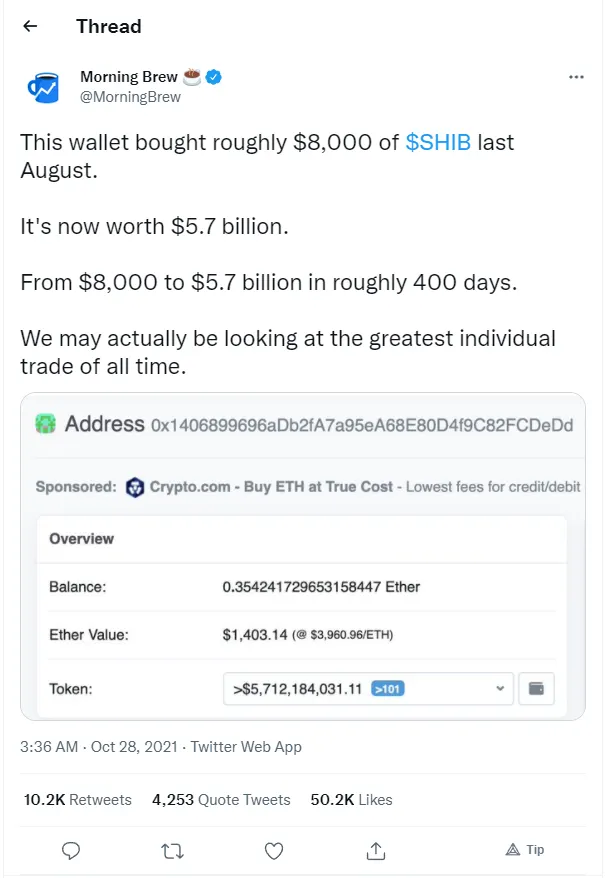
You’ve probably heard about the above crypto-billionaire dream story from one of your very inspired friends or family members getting into crypto. It’s definitely a juicy headliner but what were to happen if the owner of these Shiba Inu tokens were to cash out? Would there really be enough buyers willing to shell out $5.7 billion to get their hands on this shiny meme token? This need to find a market is the crypto-billionaires’ dilemma and it sits at the core of any trade, be it in the defi space or traditional finance.
Ultimately, the goal of a buyer/seller looking for a market for their holdings is the convenience of the trade. This convenience is made out of 3 key factors:
- Price: Am I able to find someone else who is willing to buy/sell at my desired price?
- Quantity: Even if I find someone willing to match my price, do they have enough units of the asset that I’m trading for?
- Time: How fast can the trade be done? Will the price/quantity change while the trade is taking place?
Whichever form the trading venue takes, it is this ease of buying/selling an asset at its current fair market value that draws people to it. This has come to be known as “liquidity” which is a term you will see everywhere in the DeFi space (liquidity pools/tokens/providers, refer here if you want a quick comparison between defi vs traditional finance).
Stepping outside our comfort zones
For the average buyer/seller, the end result is far more important than the means (i.e. I just want to trade with the least amount of pain). To this end, the order book model has become the baseline reference for a trade whereby a buyer/seller need only submit an order with a price, amount, and validity period. To save ourselves from all the forced smiles and awkward handshakes that accompanies a peer-to-peer trade, most trades now go through an intermediary broker/agent who will help to match buy/sell orders. Human progress has taken this a step further by removing the intermediary person therefore allowing us to trade our life savings while in the comfort of our homes through online brokerages.
Consequently, most traders are used to the set and wait model whereby an order is set and the waiting game begins until a corresponding buy/sell order is found. The intermediary sits at the center of this, orchestrating all the orders submitted and settling the matching orders in their books. In exchange for this convenience, the agent will usually charge a percentage of the trade value to both the buyer and seller. In essence, the service that these intermediaries are selling is one of liquidity. Depending on your perspective, this could also be seen as a disservice which brings me to DeFi.
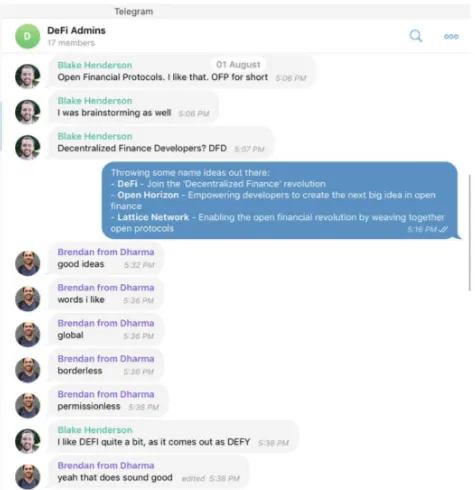
This snapshot of the origins of the term “DeFi” sums up the initial space well, it was about “defying” what people were used to in order to create a system that was more fair, transparent, and equitable. With this goal in mind, there was no space for intermediaries as the incentives for such a function naturally collided with these goals when it came to handling other people’s money (i.e. as an intermediary, you can earn more money if your clients know less and trust you to execute the trade in their best interest). Without an intermediary to conduct the trades, the community could only fall back on good old reliable math and innovative incorruptible code.
Without getting too much into the technicals, this liquidity solution involved the creation of a fundamentally different market via stacking the following concepts:
- Allow users to trade directly with smart contract code with** no intermediaries. The smart contract code will be viewable by anyone and all interactions with the contract will be viewable on a public blockchain (see Uniswap as an example). Additionally, the user never loses custody** of their own assets.
- Create a pool of assets against which trades can be made for a small fee. The composition of this basket of assets will be determined by the trades that are taking place against it. Arbitrageurs will play a key role in rebalancing this pool with the wider market.
- Create a price curve for the pool which ingests price data from a reliable external source. The exact price for a trade being done against the pool will take into account the external price feed, the current pool composition, as well as resulting effect the trade will have on the pools’ liquidity.
- Incentivize asset holders to provide their assets to a pool via a percentage return on their assets. The majority of the trading fee which the pool charges will be accrued to the pool. This is also to sufficiently compensate the asset holder for locking up their asset with the pool and becoming a liquidity provider (LP).
- Mint new derivative tokens to the LPs’ wallet which will allow reclaiming of their assets as well as any fees which have accrued to the pool. These LP tokens represent a proportion of the pooled assets and can themselves be traded.
- Creation of a staking mechanism to incentivize LP token holders to lock their liquidity with the protocol. This provides the LP additional returns on their LP tokens, usually in the form of protocol tokens, instead of just the fees which are passively accumulating in the pool. These LP tokens could also have utility, such as ability to participate in the governance of the protocol.
Taken as a whole, this solution came to be known as the **Automated Market Maker (AMM). **“Automated” because it is always available for trading and does not depend on the traditional interaction between buyers and sellers where orders must first be submitted.
Can you put a price on time?
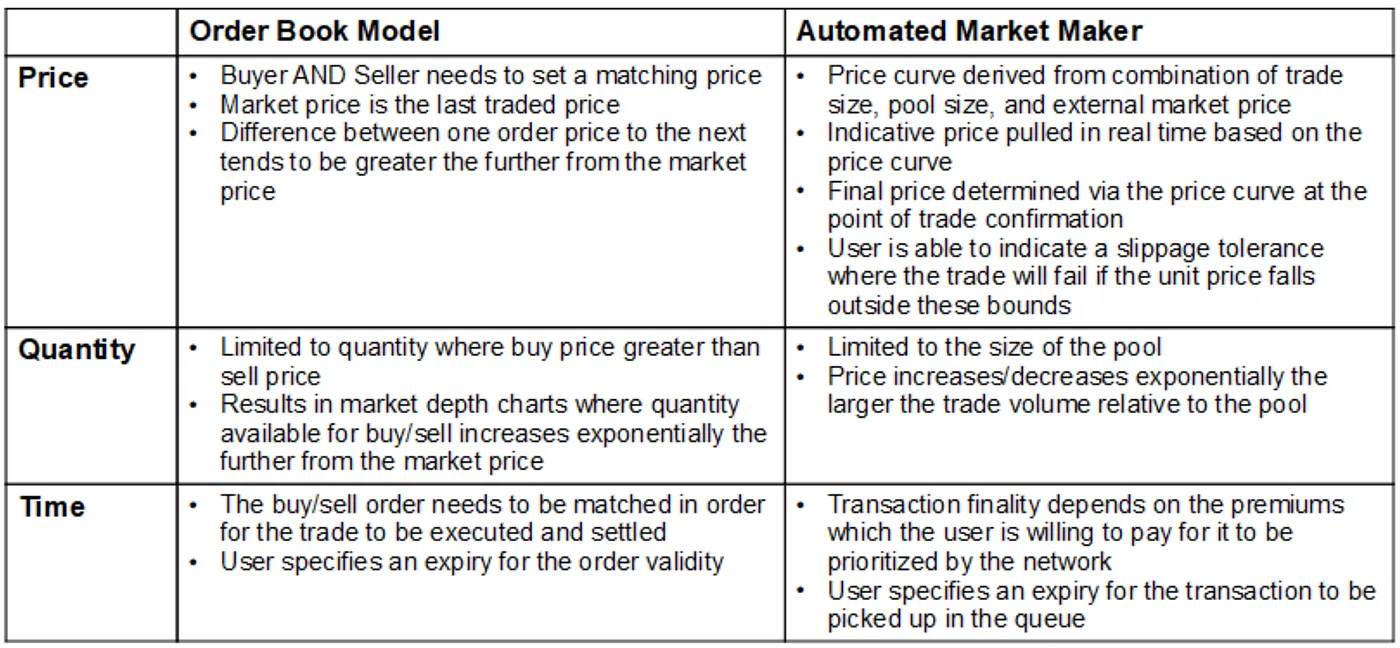
The two models represent two sides of the same coin. Remember that user convenience is made up of 3 factors: Price, Quantity, Time. Keeping the quantity constant, the convenience to the user boils down to the trade offs they are willing to make when it comes to price versus time:
- Price Assurance
Order book model is the better choice as it allows users to set a fixed price which will be completed as long as there is a corresponding matching order. The trade will be completed when there is sufficient quantity to match the trade order.
The trade off here is that the order can take an indefinite amount of time to complete. The larger the trade volume, the longer the waiting time. Users are able to set a validity period for their order. The trade will be cancelled if its parameter falls outside this timing boundary.
- Trade Immediacy
AMM is the better choice as it allows for the trade to take place immediately without having to wait for a counter party. There are also less limits around the trade volume as the trade is against the pools’ total liquidity rather than an aggregation of multiple orders. Consequently, there is also less slippage risk (difference between the expected price of a trade and the price at which the trade is executed) as the price follows a smooth price curve.
The trade off here is that the trade must be executed around the current market price. The larger the trade volume relative to pool size, the further the execution price from the market price. Users are able to set a slippage tolerance but not a fixed price. The trade will be cancelled if its parameters falls outside these price boundaries.
Network Effects: More liquidity, less trade offs

In short, the network effect is a term coined to describe the phenomenon whereby every additional participant in the network provides exponentially more value to the network. Think of social media, every friend added to the network makes it so much easier for you to connect with them. Critically, these relationships tend to favor a monopoly whereby everyone is incentivized to join and contribute further to the value of a single network (i.e. there is no reason for you to join a smaller network with all else being the same).
Liquidity is no different in this aspect as it relies strongly on the network effect. As such, liquidity acts as a panacea for many of the trade offs that were discussed earlier.
- Order Book Model: More buyers/sellers means more orders which likely results in shorter waiting times for an order to be filled.
- Automated Market Maker: The more liquidity locked in the pool, the smaller the size of a trade relative to the pool which results in less divergence from the market price (i.e. slippage).
This is why trading venues, irrespective of the model used, fight tooth-and-nail over liquidity. In the order book model, exchanges are giving away the equivalent of hundreds of dollars to new buyers/sellers as each order you make with them significantly adds to their network value. Likewise, for AMMs, many of the protocols are distributing their own protocol tokens (which can themselves be traded) to liquidity providers who stake their LP token with the protocol.
For those that have caught on, liquidity in the AMM context faces much fiercer competition as involves getting more LP tokens staked in the protocol. It is much easier to move LP tokens (which usually follows the ERC-20 standard) then it is to get new buyer/sellers. Given that LP tokens are the lifeblood of these protocols, there are even terms such as “vampire attack” being used to refer to the siphoning of liquidity from one exchange to the next. In fact, the core concept behind DeFi 2.0 is the protocol owning its own liquidity in order to avoid these issues altogether.
DeFi and AMMs: Match made in code heaven
While both models can exist in the DeFi space, there is a major reason why AMMs took over the DeFi space and that is transaction fees. Recall that every action in the DeFi space requires the user to pay a fee for their transaction to be processed and stored on the public blockchain. If you have ever tried to send crypto from one wallet/exchange to the next, you can see how expensive transactions on certain networks can be.
Transaction fees in both models would be negligible if not for one fact of life: people will always change their minds if they are given options. How many times have you tried changing your orders on an exchange (likely using order book model) just to try to catch the top/bottom. Now imagine that every change incurs a fee and you can see how quickly these fees will balloon. In this model of setting an order and waiting for a confirmation, the waiting aspect of it allows people to change their minds for whichever reason. In a space as volatile as crypto, every additional second spent waiting provides exponentially more reasons.
Herein lies the fundamental reason why the order book model and DeFi space are such an incompatible match. Liquidity in the order book model relies on buyers/sellers constantly updating their orders while buyers/sellers are discouraged from changing their orders due to the fees involved. This is why AMMs have become the de facto standard as the transaction fees are limited to that transaction given that the trade happens immediately.
To $SHIB or not to $SHIB


We’ve now come full circle back to the meme, what would you do if you had $5.7 billion worth of Shiba Inu tokens?
- Put an order for $5.7B knowing that your order will be visible to the world (DeFi doesn’t have the obscurity advantage of dark pools or OTC trades).
- Split your $5.7B into multiple orders so as not to crash the market. This will be a full-time job given how small the orders will have to be. Pay will be much better than the average salary job though.
- Trade as much as you can against an AMM and take the immediate price hit.
- Trade against multiple AMM pairs to diversify your holdings.
- Keep $SHIB until it becomes the one token to rule them all
All very interesting things to think about, but for me, I’m still busy trying to have this problem in the first place.