Societies are built on trust, be it directly through knowing the person or indirectly through a person’s reputation. As communities flourish, the latter becomes increasingly important as time limitations mean that it is impossible for direct relationships to form between every community member. Critically, the type of trust required for society to form comes in various forms and is not limited to just financials:
- Trust in a persons financials (i.e. credit ratings, wealth)
- Trust in a persons abilities (i.e. certifications, degrees, titles)
- Trust in a persons character (i.e. honesty, integrity, responsibility)
Moreover, this trust is heavily dependent on context. For example, the barista doesn’t need to know about my education in order to sell me a cup of coffee (although a bad character could mean no coffee). As such, when assessing whether we can trust another individual, we pick and choose parts of their reputation to fit our needs. This reputation is built through other individuals and organisations vouching for the individual in various ways. In our coffee example, the bank has vouched for my ability to pay for coffee if I choose to use my credit card.
Having covered how DIDs allow us to uniquely identify a digital identity, we can now start attaching a reputation to a particular identity. Much like how a national identity number enables a reputation to be built (ie. credit score, driving license, friendships), DIDs are the building blocks that enable attestations to be made in the form of VCs (verifiable credentials). In layman terms, each VC is what someone else is saying about you.
Verifiable Credentials: A Deeper Look
To get a better understanding of how VCs are able to build trust within a community of digital strangers, we must first define the primary roles:
- Issuer: Issues a VC about a subject.
- Subject: The party which the VC applies towards.
- Holder: The party who holds the VC on behalf of the subject.
- Verifier: The party that validates that the VC is fit-for-purpose.
Taking the simplified example of our coffeeshop, the bank (Issuer) has vouched for my (Subject) creditworthiness by issuing me a credit card. In this case, I’m also the Holder of the card which enables me to swipe my card to pay for coffee. The barista (Verifier) is indirectly assured by the bank (Issuer) that they will receive the payment once the payment terminal accepts my card. Do note that the **Holder **and Subject are not necessarily always the same as I could easily pass my card to my wife (Holder) and she could go on a shopping spree under my name (Subject).
To put in slightly more technical terms, VCs contain a set of claims made by an issuer regarding an individual. These claims can be cryptographically verified using digital signatures (public key cryptography).
How is this better than the current identity infrastructure?
Given that trust relationships are fundamentally a part of how societies function, the difference is really how these new technologies places the power back in the hand of the individual. When moving our credentials to the digital realm, the main issue faced is the ease of credential spoofing as there isn’t a reliable way to guarantee that the person on the other end of the screen is presenting a genuine claim.
The current federated identity model gets around this by getting the verifier to check directly with the issuer of the credential. Coupled with public key cryptography, VCs enable a credential to be signed by the issuer and consequently sent to the holder without fear of the credential being tampered with. This fundamental change results in improvements in:
- Ownership: VCs can be issued to an identity wallet or a particular blockchain address. A users digital relationships no longer sits within an identity providers database but rather on the wallet/blockchain. This means that VCs always follows the user as accounts are replaced in favour of wallets.
- Operation: Once a VC is issued, it can be verified without the need of the Issuer. This means that the operation of your digital identity is not dependent on trusted third parties which face censorship risks.
- Privacy: VCs enable users to selectively disclose their personal information. Coupled with cryptography, a user is able to prove the validity of an issuer’s claim without having to reveal any private information (i.e. Validate user is >18 years old instead of exact age)
- Transparency: The web of relationships are publicly viewable on the blockchain. This means that the richness of our social relationships are no longer constrained to being proprietary data for an identity provider.
- Equality: Claims are no longer limited to institutions as any individual with a wallet can make a claim about another wallet. This sets the stage for tremendous value to be unlocked as relationships are built from the ground up.
What is included in a VC?
Apart from one or more claims made by an Issuer, a VC must also include the metadata contextualising the claims as well as the proof of who issued the VC.
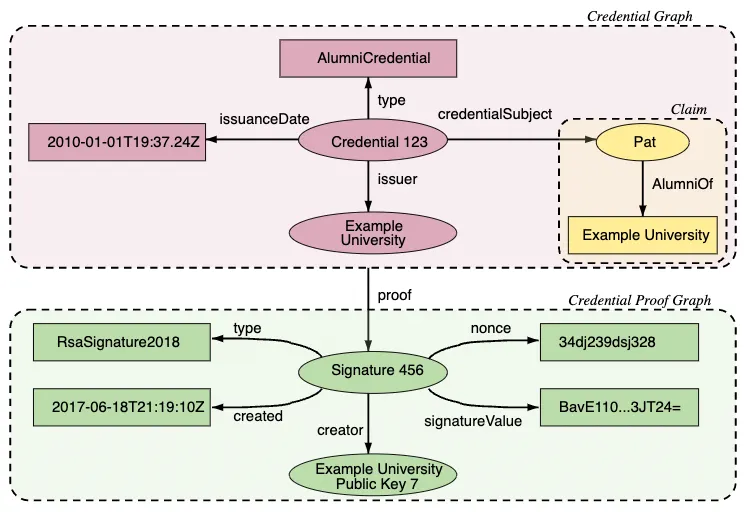
The metadata (in purple) describes the properties of the credentials such as the issuing entity, time of issue/expiry, data model, etc. Additionally, the proof (in green) usually consists of the issuer’s digital signature. Together, the metadata and proof enables the claim to be easily validated by the verifier. By cross-checking the issuer’s public key, a verifier will be able to trust that the VC issued to the subject was indeed generated by the issuer. To aid in this verification process, VCs are usually presented to the verifier in the form of VPs (Verifiable Presentations).
Verifiable Presentations: Improving Privacy
In most cases, a verifier would require multiple VCs to validate that a subject meets their criteria. This verification is heavily context dependent and therefore users need a way to selectively disclose portions of their persona. In order to achieve this, VPs enable multiple VCs, each proving a particular claim, to be packaged into a single message to the verifier.
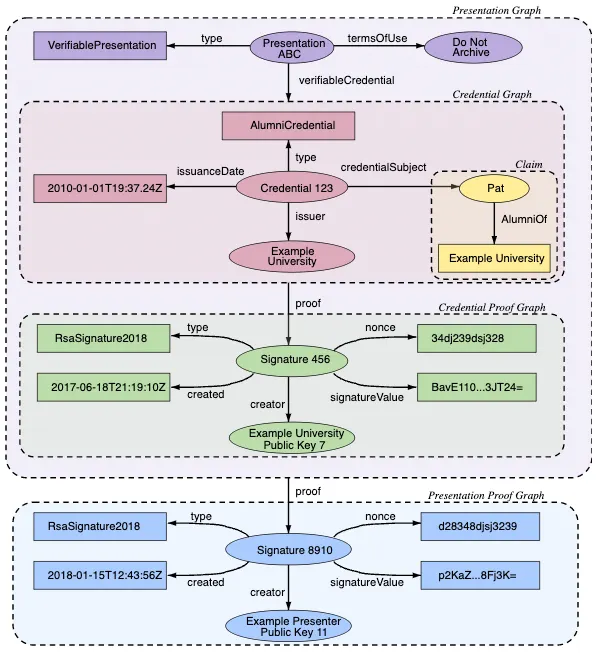
VPs also have their own set of metadata and proof which ensures that the VP is tamper-proof. Of note, the VCs within a VP can originate from multiple issuers and therefore VPs allow the user to have much more fine-grained control over what private information gets shared.
Decentralised Society Building Blocks
As a key specification of the decentralised identity space, VCs are set to redefine the social fabric by enabling claims to be digitally represented and verified without the need for a trusted third party. The interoperability of VCs will not only ensure more individual autonomy but also unlock significant value by enabling the mixing-and-matching of credentials issued by both institutions and individuals.
Given the hyper-commercialisation of our digital identities, VCs will be an important building block towards a digital society where the profit incentive of data harvesting is minimised.
If you would like to dive deeper, I highly recommend checking out the W3C documentation: