Singapore’s banks share one deposit insurance scheme but differ on CPF and SRS accounts, shared ATMs, branches and what stands behind a deposit. How a bank is set up decides those differences, while cards and loans mostly follow what each bank chooses to offer.
MAS’s directory lists 36 banks with a full bank licence, and each is one of the three kinds below. Citibank, HSBC and Maybank each run two separately licensed entities under one name, a Singapore branch of the foreign bank and a subsidiary incorporated in Singapore.
How banks are set up in Singapore
Singapore bank
6
DBS, OCBC, UOB, Bank of Singapore, GXS, MariBank
Set up asA company incorporated in Singapore, with no foreign bank as a parent
What stands behind depositsThe bank's own money to absorb losses, kept above a minimum set in Notice 637
The sections below start with the licence class, which sets what a bank may offer, and who holds each one. They then compare the three kinds of bank on what changes for a customer and what stands behind a deposit, and end with how the rules came about.
30of 36+27
full banks are foreign banks, either as branches or as Singapore subsidiaries
A foreign bank, or its Singapore company, without those privileges.
Privileges
Set by MAS
Local Bank
Never barred
Any number of locations
ATMs and sub-branches
Cash from other banks’ ATMs
Debit payments in shops (EFTPOS)
SRS and CPF Investment Scheme accounts
CPF fixed deposits
Notice 603 limits foreign banks and places none on a bank that is not foreign.
Qualifying full bank
Lifted, with limits
Up to 25 locations
Shared ATMs with other banks that have privileges, and sub-branches that move freely
Card cash advances at local banks’ ATMs, if agreed
Debit payments in shops (EFTPOS)
SRS and CPF Investment Scheme accounts
Fixed deposits under the CPF schemes
A foreign bank is barred from each of these until MAS grants it privileges. A yellow dot marks where it gets less than a Local Bank.
Full bank
Bar stays
A foreign bank without privileges stays barred from all six.
Who holds it
MAS directory, read 17 Nov 2026
Local Bank
+0
6 Singapore banks.
Qualifying full bank
+0
4 are Singapore companies and 6 are branches.
Full bank
+0
1 is a Singapore company and 19 are branches.
Who holds a full bank licence in Singapore
Most full banks are Singapore branches of banks incorporated abroad, not Singapore companies.
The date MAS granted the licence or a licence privilege, or the date the company was incorporated. 1999 is MAS’s list of full banks in April 1999. A dimmed tile has no such date published.
Singapore banks6
Incorporated in Singapore, with no foreign bank as a parent
HSBC moved its personal banking into this company on 9 May 2016, and personal accounts took a new bank code, 9548, while corporate accounts kept 7232 at the branch.
Standard Chartered Bank (Singapore) holds 60% of it, so the Banking Act’s own wording, a parent bank incorporated abroad, does not reach it, while Notice 603’s wording, a holding company incorporated abroad, does.
It holds no privileges, unlike the other four subsidiaries.
What it offers in Singapore
Personal accounts
Business or corporate banking
Loans to individuals
Cards
PayNow and NETS codes in its app
Greyed pills are not named on the bank’s Singapore pages, which is not a statement that the bank lacks them.
Malayan Banking Berhad is Maybank’s parent bank in Malaysia. It has been in Singapore since 1960 and runs Global Banking for corporate and institutional clients here.
Bank of America is a bank in the United States that opened its Singapore office in 1955. It serves corporate and institutional clients, and Merrill Lynch (Singapore) is a separate Singapore company.
JPMorgan Chase’s Singapore office opened in 1964 and is its Southeast Asia headquarters. It covers corporate, commercial and investment banking, asset management and private banking.
Set-up decides CPF and what backs a deposit, while the licence class decides networks and branches.
Singapore bank6 Local BanksForeign bank’s subsidiary4 Qualifying Full Banks, 1 Full BankSingapore branch6 Qualifying Full Banks, 19 Full Banks
The bank
Which licence class does it hold?
Set by MAS
Singapore bank
Local Bank
+0
Foreign bank’s subsidiary
4 of 5 have privileges
+0
Singapore branch
6 of 25 have privileges
+0
Singapore bank
The ruleMAS lists all six as Local Banks, and Notice 603 bars none of them from debit payments in shops, ATM sharing or places of business.
In practiceBank of Singapore, GXS and MariBank hold the same class as DBS, OCBC and UOB.
Foreign bank’s subsidiary
The rulePrivileges lift the foreign-bank bars in Notice 603 on debit payments in shops, ATM sharing and places of business.
In practiceTrust holds a plain full bank licence, with none.
Singapore branch
The ruleA branch can hold the same privileges. Without them, every foreign-bank bar in Notice 603 applies.
In practiceThe other 19 hold plain full bank licences.
Is the deposit insured?
Set by an Act
Singapore bank
Yes, to SGD 100,000
Foreign bank’s subsidiary
Yes, to SGD 100,000
Singapore branch
Yes, to SGD 100,000
Singapore bank
The ruleEvery full bank is an SDIC member, so Singapore dollar deposits are covered up to SGD 100,000 per person.
Foreign bank’s subsidiary
The ruleThe same cover applies, because a subsidiary with a full licence is a member.
Singapore branch
The ruleA branch with a full licence is a member too.
What it sells
Does it offer personal accounts?
Chosen by each bank
Singapore bank
Yes, except Bank of Singapore
+0
Foreign bank’s subsidiary
Yes, all
+0
Singapore branch
Yes, most
+0
What it meansThe licence lets every full bank offer personal accounts, so each bank chooses.
Singapore bank
In practiceBank of Singapore is a private bank.
Foreign bank’s subsidiary
In practiceAll 5 name personal accounts.
Singapore branch
In practiceCitibank, HSBC, Maybank, Bank of America, BNP Paribas and 5 more describe only corporate or institutional clients. Indian Bank and UCO Bank do not name personal accounts.
Does it offer credit and debit cards?
Chosen by each bank
Singapore bank
Yes, except Bank of Singapore
+0
Foreign bank’s subsidiary
Yes, all
+0
Singapore branch
Some do
+0
What it meansThe licence lets every full bank issue cards, so each bank chooses. Debit payments in shops are the exception, and a foreign bank needs privileges for them.
Singapore bank
In practiceBank of Singapore is a private bank.
Foreign bank’s subsidiary
In practiceAll 5 name cards.
Singapore branch
In practiceBangkok Bank, Bank of East Asia, Bank of India, BNI, HL Bank and 7 more do not name cards.
Does it offer home and personal loans?
Chosen by each bank
Singapore bank
Yes, except Bank of Singapore
+0
Foreign bank’s subsidiary
Yes, all
+0
Singapore branch
Some do
+0
What it meansThe licence lets every full bank lend, so each bank chooses.
Singapore bank
In practiceBank of Singapore is a private bank.
Foreign bank’s subsidiary
In practiceAll 5 name loans to individuals.
Singapore branch
In practiceBangkok Bank, Bank of East Asia, Bank of India, BNI, HL Bank and 6 more do not name loans to individuals.
Does it serve businesses as well?
Chosen by each bank
Singapore bank
Yes, most do
+0
Foreign bank’s subsidiary
Some do
+0
Singapore branch
Some do
+0
What it meansThe licence lets every full bank serve businesses, so each bank chooses who it serves.
Singapore bank
In practiceGXS names only personal banking. Bank of Singapore is a private bank.
Foreign bank’s subsidiary
In practiceCitibank, HSBC and Trust Bank name only personal banking.
Singapore branch
In practiceBank of East Asia, ICICI Bank and State Bank of India name only personal banking. Citibank, HSBC, Maybank, Bank of America, BNP Paribas and 5 more name only corporate or institutional clients. Indian Bank and UCO Bank state no audience.
Paying
Can the card pay in shops from the account?
Set by a MAS notice
Singapore bank
Yes
+0
Foreign bank’s subsidiary
Yes, with privileges
+0
Singapore branch
Yes, with privileges
Singapore bank
The ruleNotice 603 bars a foreign bank from debit payments in shops (EFTPOS) and places no such limit on a bank that is not foreign.
In practiceNETS names DBS, OCBC and UOB. Bank of Singapore, GXS and MariBank are not on its list.
Foreign bank’s subsidiary
The ruleThe notice counts a subsidiary with a foreign parent as foreign, so it is barred unless MAS has granted it privileges.
In practiceNETS names HSBC, Maybank and Standard Chartered. Citibank and Trust are not on its list.
Singapore branch
The ruleThe same bar applies to a branch.
In practiceNETS names no branch.
Can customers pay by phone number (PayNow)?
Chosen by each bank
Singapore bank
Yes, except Bank of Singapore
+0
Foreign bank’s subsidiary
Yes, all
+0
Singapore branch
Some do
+0
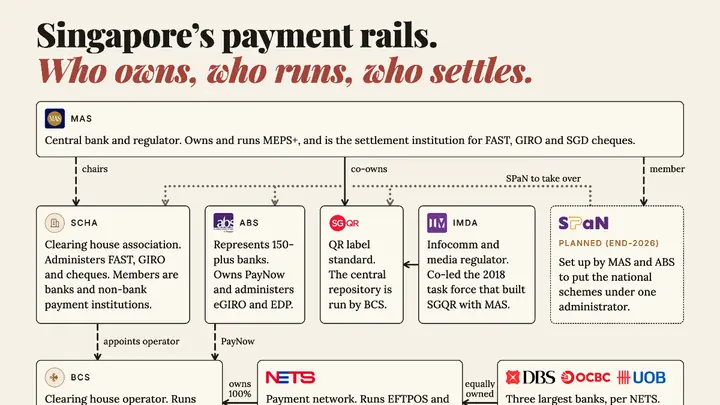
What it meansPayNow sends money to a mobile number, NRIC or UEN in place of an account number. Banks join by choice, so the licence class does not decide it. Who owns and runs PayNow, FAST, GIRO and NETS covers the networks themselves.
Singapore bank
In practiceBank of Singapore is not on the ABS list.
Foreign bank’s subsidiary
In practiceAll 5 are on the ABS list. ABS names brands and not entities, so Citibank, HSBC and Maybank show in both the subsidiary and branch columns.
Singapore branch
In practiceBangkok Bank, Bank of America, Bank of East Asia, Bank of India, BNI and 8 more are not on the ABS list. ABS names brands and not entities, so Citibank, HSBC and Maybank show in both the subsidiary and branch columns.
Can customers make instant transfers (FAST)?
Chosen by each bank
Singapore bank
Yes, except Bank of Singapore
+0
Foreign bank’s subsidiary
Yes, all
+0
Singapore branch
Yes, most
+0
What it meansFAST moves money between bank accounts within seconds. Banks join by choice, so the licence class does not decide it. Who owns and runs PayNow, FAST, GIRO and NETS covers the networks themselves.
Singapore bank
In practiceBank of Singapore is not on the ABS list.
In practiceBangkok Bank, Bank of America, Bank of India, BNI, China Construction Bank and 4 more are not on the ABS list.
Can customers set up GIRO bill payments?
Chosen by each bank
Singapore bank
Yes, except Bank of Singapore
+0
Foreign bank’s subsidiary
Yes, all
+0
Singapore branch
Yes, except China Construction Bank
+0
What it meansGIRO sets up recurring payments such as bills and salaries between bank accounts. Banks join by choice, so the licence class does not decide it. Who owns and runs PayNow, FAST, GIRO and NETS covers the networks themselves.
Singapore bank
In practiceBank of Singapore is not on the ABS list.
The ruleA foreign bank may not use a local bank’s ATM network. One with privileges may share ATMs with others that have them, through a network branded atm5, and a bank without them, such as Trust, has no access. The notice counts a subsidiary with a foreign parent as foreign.
In practiceBank of China lists the atm5 banks as itself, Citibank, HSBC, Maybank, Standard Chartered and State Bank of India. Only the ATMs showing the atm5 logo take the others’ cards.
Singapore branch
The ruleThe same applies to a branch with privileges, and one without has no access.
In practiceBank of China and State Bank of India are on the atm5 list. The other four branches with privileges are not.
How many branches and ATMs can it run?
Set by a MAS notice
Singapore bank
No cap
Foreign bank’s subsidiary
Up to 25, or 50 with MAS’s rating
+0Rated for 50
Singapore branch
Up to 25
Singapore bank
The ruleNotice 603 sets no number for a bank that is not foreign.
Foreign bank’s subsidiary
The ruleA bank with privileges may have up to 25 places of business. The higher figure needs MAS to rate it a significantly rooted foreign bank. One without privileges may not add any.
In practiceStandard Chartered Singapore is the only bank with that rating.
In practiceOnly six of the 25 branches have privileges.
Retirement schemes
Can it hold CPF investment or SRS accounts?
Set by the scheme operator
Singapore bank
Yes, at 3 banks
+0
Foreign bank’s subsidiary
No
Singapore branch
No
Singapore bank
The ruleA CPF member opens an investment account at an agent bank named by the CPF Board and moves Ordinary Account savings into it. IRAS names the SRS operators where a person holds SRS savings.
In practiceBoth name DBS, OCBC and UOB, so the other three Singapore banks do not hold them.
Foreign bank’s subsidiary
The ruleMAS lets a bank with privileges offer both, and the CPF Board and IRAS decide which banks do.
In practiceNo foreign bank’s subsidiary is named, so a member opens these at one of the three.
Singapore branch
The ruleThe same applies to a branch with privileges.
In practiceNo branch is named.
Can CPF savings go into a fixed deposit?
Set by the scheme operator
Singapore bank
Yes, at 3 banks
+0
Foreign bank’s subsidiary
Yes, at Maybank only
+0
Singapore branch
No
Singapore bank
The ruleA CPF member can place Investment Scheme savings in a fixed deposit at the banks on the CPF Board’s list. The criteria admit a bank incorporated in Singapore with SGD 1.5 billion of capital funds and a good credit rating.
In practiceDBS, OCBC and UOB are on the list.
Foreign bank’s subsidiary
The ruleThe same test covers a subsidiary incorporated in Singapore, whoever owns it, or one owned by a bank that passes it.
In practiceMaybank Singapore is the one on the list.
Singapore branch
The ruleA foreign bank must have privileges to be admitted, so a branch without them cannot be.
In practiceNo branch is on the list.
What stands behind a deposit if a bank fails
A Singapore bank or subsidiary rests on its own capital, and a branch on assets kept in Singapore.
Singapore bank6 Local BanksForeign bank’s subsidiary4 Qualifying Full Banks, 1 Full BankSingapore branch6 Qualifying Full Banks, 19 Full Banks
What the bank must hold
Capital
Set by a MAS notice
Singapore bank and foreign bank’s subsidiary
4.5% to 6.5%of risk-weighted assets
Core capital, with the higher figure for a D-SIB, under Notice 637.
Singapore branch
35%of SGD deposits
Kept in Singapore as eligible assets, under Notice 640.
What it meansThe owners’ own money behind a bank, which takes losses before depositors do. A rule sets the least it must hold, as a share of the loans and holdings it carries, weighted by how risky each is.
Singapore bank and foreign bank’s subsidiary
Notice 637 sets capital ratios for a bank incorporated in Singapore. A bank that MAS designates a domestic systemically important bank (D-SIB) must hold 6.5%, 8% and 10% of risk-weighted assets as core, tier 1 and total capital, and any other bank 4.5%, 6% and 8%, plus a conservation buffer.
Singapore branch
The notice does not apply to a branch. Notice 640 makes a foreign full bank keep eligible assets in Singapore worth at least 0.35 of its Singapore dollar deposits from non-bank customers, or SGD 5 million if that is more.
Liquid assets
Set by a MAS notice
All three
16%in liquid assets
Of qualifying liabilities, the same for every bank in Singapore, under Notice 649.
What it meansCash and holdings that can be sold fast without a loss, kept so the bank can pay out withdrawals without selling its loans.
A bank with no foreign parent must also hold 100% in Singapore dollars.
Foreign bank’s subsidiary and branch
50%in all currencies
The Singapore dollar floor is still 100%.
What it meansThe liquidity coverage ratio compares a bank’s liquid assets with the cash that could leave it in 30 days of stress. The floor is the lowest it may fall. It applies to D-SIBs and banks MAS calls internationally active. A foreign bank’s all-currency floor is lower because its parent group would likely also set aside liquid assets for its Singapore operations.
The same notice applies to a branch. Where the liquidity coverage ratio applies, a branch has a 100% Singapore dollar floor and a 50% all-currency floor.
What it meansA recovery and resolution plan, which sets out how the bank would be stabilised or wound down in order, without a bailout.
Singapore bank
A bank headquartered in Singapore plans for the whole group, covering its material subsidiaries and branches in Singapore and overseas.
Foreign bank’s subsidiary
A subsidiary of a foreign group plans for its Singapore operations and the entities it owns, using the group’s plans where they apply.
Singapore branch
A branch may lean on its group’s plan, in whole or in part, if the group plan covers and addresses the Singapore operations. Notice 654 covers branches as well as subsidiaries once MAS has notified them.
What it meansResolution is the set of powers used to stabilise or wind down a failing bank. The leading authority decides which are used and when, and the home resolution authority is the regulator of the country where the group is headquartered.
Section 61: the assets of a bank in Singapore meet its liabilities in Singapore.
What it meansIn a wind-up, what the bank holds in Singapore is used first to meet what it owes in Singapore, before assets or creditors elsewhere.
All three
Section 61 says the assets of a bank in Singapore meet its liabilities in Singapore, and the text covers a company incorporated in Singapore. Section 61 says the same for a branch, and Notice 640 makes the branch keep assets in Singapore worth 0.35 of its Singapore dollar deposits.
Paid by SDIC on the same terms, as a branch with a full licence is a member.
What it meansSDIC, the deposit insurer, pays each depositor up to the limit from a pool the member banks fund, if a member bank fails.
Singapore bank and foreign bank’s subsidiary
SDIC pays Singapore dollar deposits up to SGD 100,000 per person at the bank, the same as for any member.
Singapore branch
SDIC pays on the same terms, since a branch with a full licence is a member. The deposit schemes of the United States, Hong Kong, Malaysia, India and China leave out deposits taken at a bank’s overseas branches, so SDIC is the scheme that pays.
Loss-absorbing capacity (TLAC)
MAS releases
Singapore bank
Proposed
14%external TLAC
Of risk-weighted assets, for a D-SIB with no foreign parent, proposed.
Foreign bank’s subsidiary
Proposed
75% to 90%internal TLAC
Of what it would hold on its own, issued to its parent, proposed.
Singapore branch
Proposed
None proposed
The consultation paper sets TLAC for D-SIB entities and nothing for a branch.
What it meansTotal loss-absorbing capacity is capital and debt that can be written down or turned into shares in a failure, so that depositors are not the first to lose.
The consultation paper sets external TLAC for local bank D-SIBs and internal TLAC for foreign bank D-SIB subsidiaries. It proposes nothing for a branch.
Amounts the trustee claims under the resolution rules.
Not depositor money
Section 62 sets this order, and it is the same for a company incorporated in Singapore and for a branch. These claims rank after the bank’s preferential debts.
How the rules for subsidiaries and branches came about
MAS first widened what some foreign banks may do, then pushed retail into Singapore companies.
1Privileges for someFrom 1999 MAS lets a few foreign banks do more, and widens it in 2002.
2Retail moves into Singapore companiesFrom 2012 important banks incorporate, and MAS gains the power to order it.
3Rooted banks, new rulesStandard Chartered is rated rooted in 2020, and loss-absorbing rules follow in 2026.
Foreign banks
Subsidiaries
Law and rules
1The shift it shows, numbered above
1999
1MAS creates the qualifying full bank
A few foreign banks could have more places of business than the rest.
3MAS proposes a loss-absorbing buffer, and Parliament passes the power
A buffer that absorbs losses in a failure.
Total loss-absorbing capacity (TLAC) is capital and debt that can be written down or turned into shares in a failure, so that depositors are not the first to lose. After a consultation from 13 May to 12 June on requiring it of D-SIBs, the Financial Services and Markets (Amendment) Act 2026 was passed on 6 October and assented to on 29 October, and lets MAS set TLAC by notice.
Sep to Oct 2026
3Liquidity and resolvability rules are updated
Notice 649 changes took effect on 1 September and guidelines followed on 15 October.
Not membersWholesale and merchant banks need not join, and wholesale banks do not do Singapore dollar retail banking.
Home schemeThe deposit schemes of the United States, Hong Kong, Malaysia, India and China leave out deposits taken at a bank’s overseas branches, so the Singapore scheme is the one that applies.
Details
Branches do not get a separate limit. All a person’s insured deposits at one bank are added together.
CPF Investment Scheme and CPF Retirement Sum Scheme money has its own SGD 100,000 limit.
What is the difference between a branch and a subsidiary for a depositor?
A subsidiary is a Singapore company with its own capital, and a branch is part of a foreign bank, backed by assets it must keep in Singapore.
DifferentThe subsidiary must meet the capital ratios in Notice 637. The branch follows Notice 640 instead.
DifferentNeither may use a Singapore bank’s ATM network, because Notice 603 counts both as foreign banks. Those with privileges share ATMs with each other.
Why do Citibank, HSBC and Maybank each appear twice?
Each runs two separately licensed entities, a branch of the foreign bank and a Singapore company. Both are full banks on MAS’s list and deposit insurance members.
Which oneThe legal name in the account terms says which, and the bank codes differ.
LimitThe Act counts deposits placed with the member, and each entity is a member in its own right. The sections on the limit do not combine entities of one group.
Behind itA foreign currency payment settles through an account at another bank, called correspondent banking.
HistoryBanks have kept two units since 1968, one for Singapore dollar and foreign currency business and one for foreign currency only. MAS’s 2019 bill proposed to remove the split.
Not insuredForeign currency deposits are not covered by deposit insurance, so only Singapore dollar deposits at a member bank are.
The list of banks, their kind and where each is incorporated come from each bank’s entry in the MAS directory on 17 Nov 2026. A bank is called a Singapore bank when no foreign bank sits in its parent chain, using the Banking Act’s words parent bank.
PayNow and NETS name brands and not legal entities. Where a brand has two entities, a dashed chip shows that the source names the brand only.
The loss-absorbing capacity figures are from MAS’s May 2026 consultation. The Financial Services and Markets (Amendment) Act 2026 lets MAS set them by notice, and no notice has been published.
The CPF fixed deposit list on CPF Board’s site was last updated in March 2023.
What the sources do not settle
Whether the deposit insurance schemes of Japan, Thailand and Indonesia cover deposits at those banks’ Singapore branches.
How many retail deposits, loans or card payments each kind of bank holds, since MAS publishes no table that splits them.
Whether a person with accounts at two entities of one group has one insured limit or two.
Whether Notice 603’s test of a holding company incorporated outside Singapore reaches GXS and MariBank.