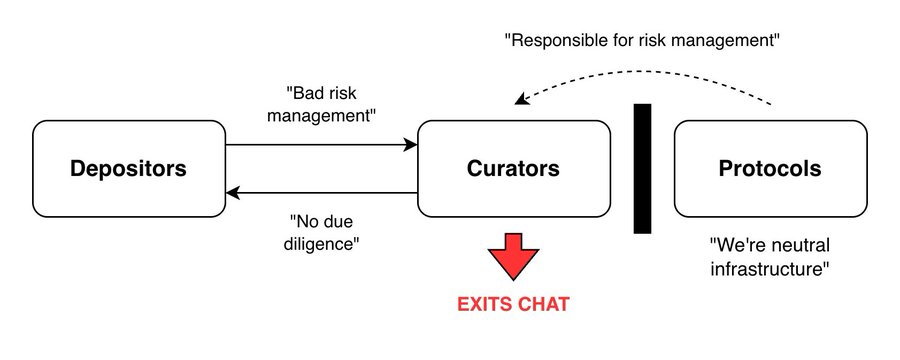
Decentralization when it is convenient, regulation when it is not. Central to this conflict is the need for an identity, someone to hold accountable when things go wrong. The rapid rise of Curators (a.k.a. “Money Managers”) has intensified this debate in response to clear conflicts of interest when it comes to managing other people’s money.
Empowered with Depositor funds, Curators have become a critical variable in the chain of DeFi accountability. A variable with increasing control over liquidity flows while simultaneously being incentivized to take excessive risks. By stacking yields across DeFi protocols, Curators also amplified risks across the ecosystem.
As such, it was only a matter of time before the accumulation of systemic risks resulted in significant losses with Depositors bearing the brunt. The most recent domino started with a single Stream Finance affiliated Curator and ended up setting DeFi back as established Curators and Protocols got caught in the fallout.
If identity disclosures disincentivizes bad behaviour by forcing Curators to have more “skin-in-game” then it is also worth exploring whether such vested interests can be achieved pseudonymously.
We’re actively working on solutions to keep Curators accountable and this post extends the discussion surrounding Curator KYC in a pseudonymous environment. In other words, should Curators be personally identifiable?
When Quitting Is The Easiest Option
Key to this discussion is the fact that Depositors no longer interact directly with Protocols. Before Curators, Depositors were expected to understand or at least sign away T&Cs before providing liquidity to a Protocol. While there were still major instances of financial loss, this more straightforward arrangement allowed for clearer risk boundaries and chain of responsibilities.
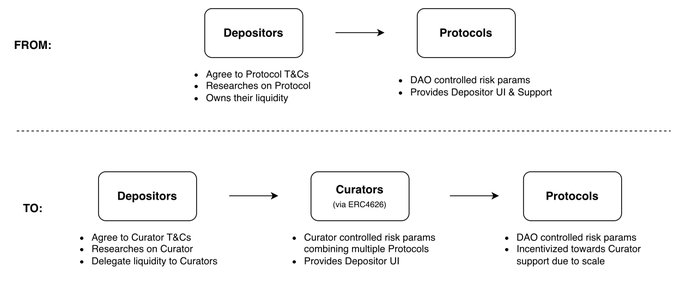
The arrival of ERC4626 vault shares enabled Curators to manage Depositor funds via non-custodial smart contracts. As long as there was an adapter, Curators could easily direct vault liquidity to any combination of Protocols. Consequently, Depositor risks were no longer local to the Protocol but dependent on the Curator’s strategy.
Depositors too eager to earn more with less work fuelled Curators to chase the highest returns else risk losing fees to those that did. Protocols distanced themselves from Curators claiming infrastructural neutrality while collecting upsized fees from higher churn.
When tail end risks materialised, losses were realized by Depositors holding shares worth a fraction of their initial value. Protocols pointed to Curator risk management even when bad practices such as hardcoded oracles were allowed.
Faced with this dilemma, Curators can choose to:
- Work on long term recovery solutions at significant personal costs
- Delete their account and restart the whole process to earn more fees
By requiring Curators to disclose their identities, it removes the second option as Curators can no longer hide behind their pseudonyms. If the Curators’ identity is known, this provides the potential for legal recourse but requires State involvement in what is supposedly a decentralized ecosystem.
The question then becomes whether overlaying the same identity based trust infrastructure advances DeFi or repeats the mistakes of TradFi.
Why Curators Should Be Identified
- Proportional Privacy: The privacy afforded is proportional to responsibility. Curators should disclose their identities while Depositors can remain pseudonymous.
- Cultural Familiarity: We are used to interacting with people and not random addresses. Outside of DeFi, name based social networks provide Depositors another mode to conduct due diligence on the Curator.
- Legal Precedent: Consistency in pursuing recovery based on a comparable system that has been built over centuries of mismanagement in traditional finance.
- TradFi Integrations: More seamless integrations with existing identity based systems (i.e. business incorporation, finance KYC/AML, etc.).
- Direct Social Pressure: Greater peer pressure from the local community which the Curator interacts with daily. Personal ties and relocation costs greatly disincentivizes actions that might cause reputational harm.
Why Curators Should Remain Pseudonymous
- Jurisdictionally Limited: Identity verification and legal enforcement are dependent on a country-based governmental structure. Any conflict resolution requires significant cross-country cooperation. Depositors usually need to undergo KYC if seeking recovery.
- Authoritative Third-Party: Identity verification systems are dependent on national identification registries controlled by Governments. Both parties are authorized to determine eligibility based on opaque criteria.
- Indirect Coercion: Personal circumstances external to management abilities adds an additional risk vector. For example, Curators can only come from jurisdictions that allow such activities with regulations that are liable to change at anytime.
- Curator Targeting: As Curator identities are known, this opens the possibility for personal targeting either through physical threats or psychological intimidation.
- Industry Capture: Traditional Finance dominates distribution and adding a identity layer further expands their competitive moat. Strategy effectiveness takes a backseat to distribution power.
The Curator Masquerade: Opportunity In Pseudonymity
It is important to note that Curator identity requirements are not mutually exclusive as DeFi can simultaneously support vaults operated by pseudonymous or registered Curators. More options allow Depositors to be more selective which encourages markets to self-regulate.
DeFi technology provides another path forward which is not possible in TradFi but only if assets are fully on-chain. By overlaying approaches that were initially created for a fundamentally different tech stack, we might be missing out on the potential benefits - openness, transparency, verifiability.
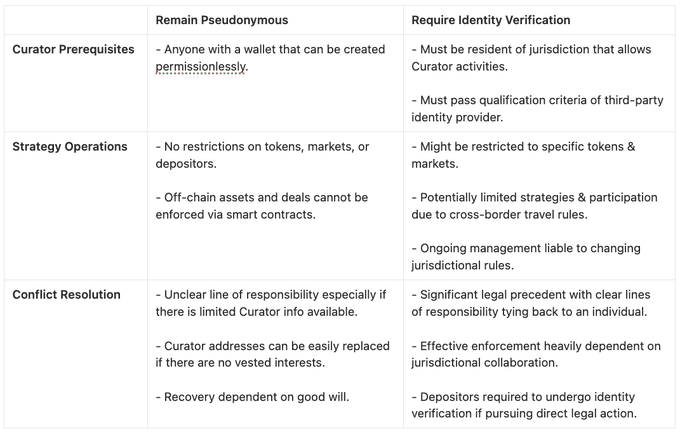
The chain of responsibility is much more direct and familiar when Curators are required to disclose their real identities. However, it must be noted that pseudonyms can sometimes carry even greater weight than the person behind it (e.g. “Satoshi Nakamoto”, “Deep Throat”, “Voltaire”). Nevertheless, it is still exponentially easier to change an alias vs a legal identity.
One solution that is arguably more effective in getting Curators to have more “skin in game” is to get them to have a vested economic interest in their own vaults. That is, Curators should own a portion of vault liquidity to discourage excessive risk taking. This significantly counteracts the conflicts of interest while sidestepping the need for Curator identity disclosures.
Such capital-at-stake models have already been battle-tested in some TradFi jurisdictions with evidence pointing to reduced risk taking. One critical advantage that DeFi has here is the ability to encode such rules thereby blocking execution in real time and eliminating any front-running risks without reliance on an authoritative third-party.
In short, monetary loss provides a more direct incentive for proper risk management versus identity-based alternatives, whether pseudonymous or not. While more capital abundant Curators gain a slight advantage, percentage based thresholds ensures staking risks remain proportional.
As DeFi builders ourselves, we are naturally more optimistic that such economic incentives allow for self-regulation without sacrificing DeFi’s core principle of openness. Nevertheless, such beneficial market forces can only come with proper structural reform and this post is meant to jumpstart such discussions.