
Launched in 2021 after more than 4 years of development by the Rocket Pool team, rETH makes it easy for anyone to earn yields for securing Ethereum without additional overheads. Just by holding rETH, you are participating in Ethereum’s Proof-of-Stake (PoS) consensus mechanism thereby safeguarding the network.
Implemented as an ERC20 token, users can take advantage of native yield-bearing rETH to earn additional ETH yields on their DeFi strategies or vice versa. From collateralized loans to fixed yields, rETH composability has opened up new earning opportunities across DeFi.

tldr:
- Swap idle ETH for rETH to earn yields
- rETH continues to earn when loaned as collateral
- Avoid borrowing rETH as borrow interest stacks with rETH price appreciation
- rETH yields are dynamic but can be converted to fixed via yield tokenisation
- rETH in an AMM pool will always gradually be sold if paired with a non-yield bearing token
What is rETH?
Users receive rETH in exchange for depositing ETH into Rocket Pool. The rETH token represents a share of ETH in the liquid staking pool. By staking their own ETH, Rocket Pool validators can combine personal and pooled ETH to meet the minimum 32 ETH required to qualify as a validator. This greatly lowers the capital requirements which encourages further decentralization.
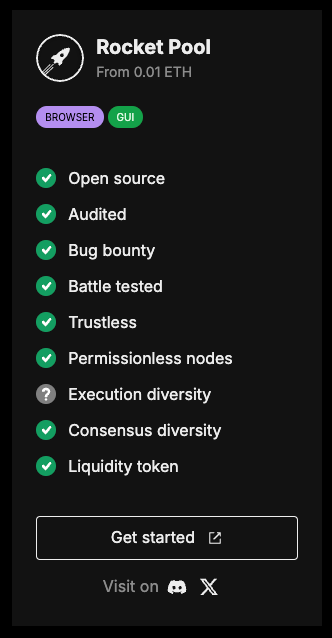
Critically, rETH can be easily unstaked at anytime to receive the corresponding ETH (which includes the accrued yields). This means that you don’t miss out on any earning opportunities while being stuck in the Ethereum withdrawal queue.
Supercharging rETH Liquidity With DeFi
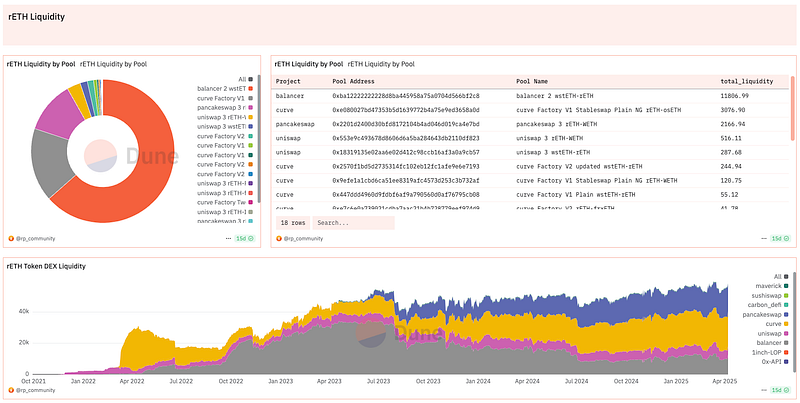
The benefits of rETH is amplified by its extensive use as one of the main DeFi liquidity tokens. Facilitating >$750M in liquidity, rETH can be utilized across many DeFi applications:
- Lent or borrowed via money market protocols
- Bought or sold via DEXs (decentralized exchanges)
- Generate market making fees via AMMs (automated market makers)
- Staked to earn liquidity rewards
Users can gain exposure to rETH for less than a cent through secondary markets. Moreover, deep liquidity in secondary markets provides additional safety guarantees when converting between rETH and ETH.
rETH DeFi Strategies
As a liquid staked version of ETH, all Ethereum PoS consensus rewards automatically accrues to rETH. This means that the price of rETH always appreciates relative to ETH (each rETH represents a share of the liquid staking pool that receives underlying Ethereum staking rewards).
The fact that rETH price is always tightly correlated with ETH price opens up plenty of opportunities across DeFi.
Lending & Borrowing
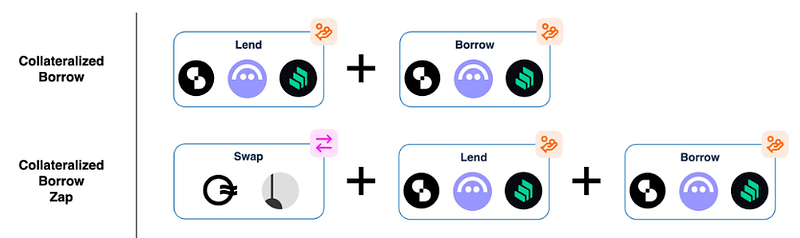
Aside from just holding rETH to earn additional ETH yields, rETH can also be used as collateral on many lending protocols to:
- Earn additional lending interest by supplying rETH
- Access more capital by borrowing various tokens against rETH
Critically, as rETH accrue staking yields even when lent, liquidation risks are reduced as rETH collateral value continues to appreciate. When paired with ETH borrows, users can gain access to significantly more capital with negligible added risks due to the rETH:ETH price correlation.
Carry Trades

The number of earning opportunities expands exponentially by adding swaps into the mix:
- Swap borrowed ETH → rETH to earn interest differentials
- Swap borrowed stables → rETH to gain additional exposure to ETH with rETH yields
- Swap borrowed tokens to utilize the additional capital while earning rETH yields
One of the best risk-adjusted and most consistent earning opportunities is to swap borrowed ETH for rETH. Long term ETH borrow rates across major money markets have generally been lower than rETH yields. Although relatively minor, this additional ETH yields is generated with minimal risks.
Levered Yields

As borrowed tokens can be swapped for more rETH, you can get leveraged exposure to various yield/trading opportunities via repeating the lend → borrow → swap process:
- Loop ETH borrows against rETH lending to amplify interest differentials
- Loop stable borrows against rETH to multiply ETH upside and rETH yields
The availability of DeFi native flash loans allows you to skip this manual looping and create your intended leverage with just a single loop.
Fixed Yields

Dynamic rETH yield creates a market for users looking for guaranteed yields vs users speculating on future yield. Yield tokenisation allows users to trade the yield underlying rETH based on their risk preferences:
- Get fixed yields by holding the principal and selling the yield-bearing portion of rETH (i.e. swap rETH → PT-rETH)
- Multiply your rETH yield exposure by holding the yield-bearing portion of rETH and selling the principal (i.e. swap rETH → YT-rETH)
Depending on the market conditions, yield tokenisation offers another pathway to increase and even guarantee strategy yields.
Market Making

rETH can also be deposited into AMMs to earn a portion of the trading fees for facilitating swaps:
- Add liquidity to rETH:stable pairs to earn from ETH price swings while locking in rETH yields
- Add liquidity to rETH:ETH pair to earn fees for any rETH:ETH price deviations
Note that rETH price gradually increases due to its yield-bearing nature and therefore this will result in more rETH being sold over longer periods. Market making with rETH can generate significantly more returns but also comes with trading risks which includes the automated selling of your rETH.
rETH + DeFi = Boosted Yields
DeFi composability enables rETH to be utilized in various ways thereby creating multiple channels for value accrual. By understanding rETH key value flows, you can easily improve your DeFi returns:
- Native yield generation → rETH automatically accrues ETH staking yields while remaining fully liquid. Any strategy that holds idle ETH can benefit from holding rETH instead. Using rETH as collateral allows you to continue earning ETH staking yields while lowering liquidation risks.
- rETH’s relationship with ETH → The relative stability of ETH staking yields means rETH price always appreciates in roughly the same proportion over time. rETH derives its security from ETH while also making ETH more secure through lowering barriers to entry.
Related DeFi Resources
- DeFi Explainers: Lending/Borrowing, Looping, Yield Farming, AMM, Concentrated Liquidity, DEX Aggregators, Flash Loans
- Strategy Cheatsheets: Lending, Borrowing, Swaps, Liquidity Provision
- Strategy Explainers: Leverage, Yield, Fixed Yield, Delta Neutral
- Factor Operated Strategies: Yield, Trading, Delta Neutral