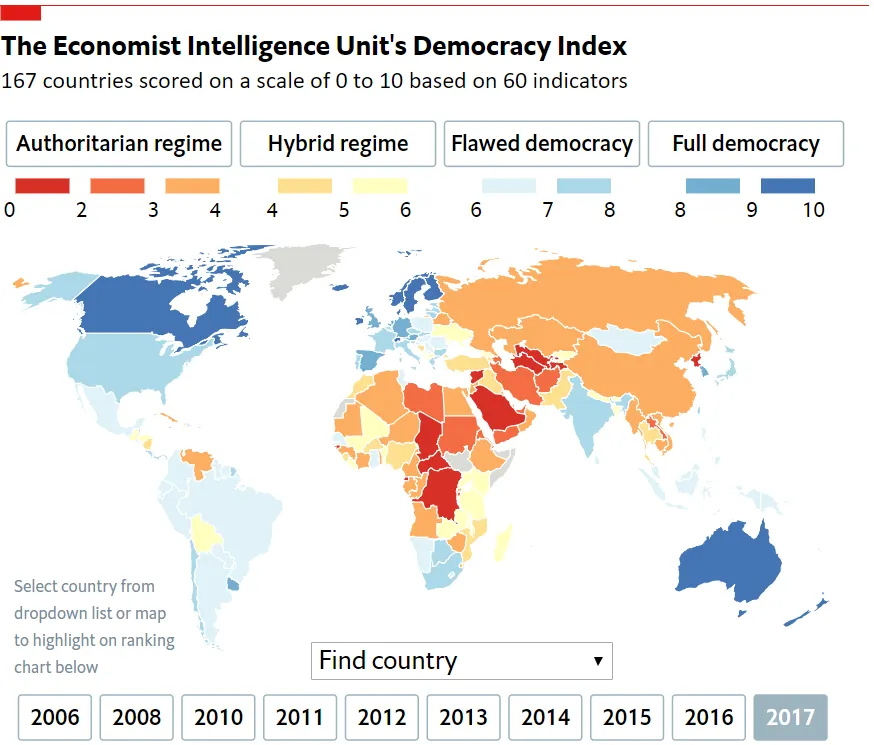
One of the main aspects of blockchain technology which everyone is excited about revolves around the technology’s ability to create and maintain trustless systems. This is especially so in a time when reports such as The Economist’s Democracy Index 2018 highlight the disturbing retreat of democracy globally with 2018 witnessing the largest drop in perception of democracy since the index began in 2010. Decentralization is definitely blockchain’s main selling point but the reason why so many people are enticed by such a proposition in the current climate justifies a deeper dive. At its core, many people conflate decentralization with accountability resulting in tunnel vision when it comes to thinking of real world solutions. Essentially, decentralization is like a hammer: it fixes all problems if you hit it hard enough but it will end up doing more damage if that is the only tool in your toolbox.
Distributed technologies have many promises:
- It promises transparency via tamper-proof databases in a world where the Panama Papers have exposed the extent of systemic manipulation by the rich and powerful
- It promises a safety outlet via uncensorable knowledge in a world which is increasingly leaning towards political extremes even when more than a third of people are still living under authoritarian regimes
- It promises security via distributed databases in a world where big tech has repeatedly shown its inability to keep our information secure
- It promises trustless transactions via digital contracts in a world where the economy is getting gobbled up by middleman surviving on economic rents
- It promises a equality via distributed consensus in a world that is slowly being swallowed by capitalism
To be fair, distributed technologies do provide elegant solutions to counteract the undesirable tendencies of power centralization but such a focus overlooks a fundamental truth of the universe: humans are lazy.
As I argue here, the future which we are barreling towards is one of convenience and comfort at the expense of some vague idea about our rights and freedoms. We lament our lack of privacy but Google our next thought, we complain about fake news but never take the extra effort to step out of our Facebook news bubble, we complain about how politics is broken but continue to vote on populist messages. Much of this is caused by a lack of alternative options but for many of us who are up to date with the latest celebrity gossip, it is because the lowest effort option has become our default option.

Decentralization provides amazing promises but it also brings with it significantly more costs, work and complexity from the perspective of the individual. To be clear, it is unrealistic to expect people to take whole ownership of their lives as it is impossible to keep up to date with the amount of complexity in modern societies. In fact, doing so would bring society to a complete stop as it was specialization and trade which enabled individuals to focus on bringing the greatest good to society based on the skills which they possessed. As such, in most cases, too much decentralization will actually just erase all the societal gains we have obtained via centralized coordination.
Given that **(a) **humans are lazy and **(b) **society is getting increasingly complex, people will happily delegate responsibilities which they are uninterested in as long as it does not infringe upon their ability for self-determination. This leads us to the central point of this article:
Nobody cares about the extent of centralization (or trustlessness) as long as the system works and in the case where it fails, bad actors are held responsible.
The dissatisfaction around our current governance systems and organisational models is that** the** power balance has become so lopsided that those in power are no longer playing by the same set of rules. The Panama Papers exposed the tip of the iceberg but the mere fact that certain countries are widely known as tax heavens highlights the inconsistencies within the system. Critically, power creep is something which usually goes unnoticed until the very people making the rules become one and the same. Not all the rich and powerful are purely self-serving individuals but it is important to note that the checks and balances in our current system are still far from optimal. As such, decentralized technologies are actually one of the more promising solutions to a more deep-seated problem, that of accountability.
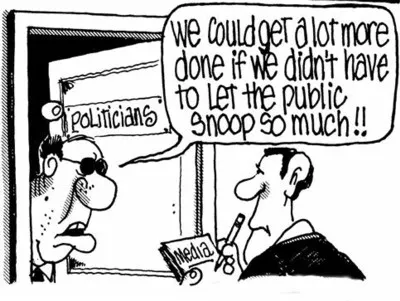
Blockchain has always been described as a trustless technology as cryptoeconomic incentives harnesses self-interest as a public good. It is critical to note that centralisation in blockchain systems is not an impossibility but rather relatively much less probable when compared to existing systems. In fact, it could be argued that most cryptocurrencies are actually very much centralized but this in itself is not an issue as long as those in power are disincentivized from going against the interest of the majority. As such, the power of the blockchain is not in trust through decentralization but rather accountability through personal ruin of bad actors.
The differences are subtle but it essentially forces us to think of decentralization as one of the puzzle pieces to creating an optimal system rather than a silver bullet for all problems. Whether the system has a single centralized supernode or consists of non-hierarchical swarms, people will only continue using the system/product if it provides them the best cost to benefit ratio. It is important to note that this cost/benefit analysis is not limited to monetary costs as consumers are increasingly weighing in the ethical and moral implications of their actions. Decentralized technologies will expose all the hidden business costs so the question then becomes which option provides the consumer with the best value proposition. When trying to disrupt traditional industries, it might pay to learn from companies like Tesla: build a product which matches or outperforms your competitor and make it trendy by gaining the ideological high-ground.

With that being said, the extent of decentralization would generally be very closely related to aspects of fundamental rights. Of course, what constitutes fundamental rights differs from one culture to the next but I would argue that there are certain aspects of society that do not lend itself well to centralization. Centralization of the following factors tends to enable parties to change the rules of the game in their favor.
- Money: It is how we quantify the world around us and therefore acts as a proxy of value. Alternative options for a store of value or a medium of exchange are hard to come by due to the monopolistic tendencies of network effects. Having a controlling stake here significantly increases the risk of systemic corruption as those with power could easily force the other into submission.
- Identity: Identity is an increasingly complex topic as we move into the digital age but what the big tech scandals have shown us is that the companies who own our identity are increasingly controlling different aspects of our lives with little worry about competition. Whoever controls out identity has an increasing say in how we live our lives.
- Media: Our perspective is informed by the media that we are exposed to. History has shown us whoever owns the knowledge pipeline (printing presses, radio channels, or news feed) are able to manipulate the rest of society. Of course, the fake news scandal has shown just how complicated a topic this is but what is clear is that people’s thoughts are easily censored by whoever owns the media pipeline and its algorithms.
“Move fast and break things” did not work out well for Facebook in the long run. When you are a platform with 2.2 billion users, making a wrong move that affects even just 0.1% of your users will affect a population equal to that of Paris. At the same time, Google is having an increasingly hard time keeping to their “Don’t be evil” motto. Selling ads against user-generated content was always going to be a risky proposition due to the blurred lines between privacy and data ownership. The natural monopolistic effects of such networks also raises trust issues due to capitalistic controls on data which is made worse given the ‘tax optimization’ practices of such companies.
Critically, it is not that the above factors must be decentralized but rather that power tends to accrue to a single party in the current paradigm. Within the current ecosystem, opportunities for corruption tends to grow disproportionately faster for those in power as social coordination between individuals becomes exponentially more difficult with network growth. As such, individuals are left with fewer and fewer chips on the negotiating table with the house getting to decide more and more of the rules. All of this is happening without individuals getting a say of whether they want to be included in the draw in the first place.
As part of the social contract, the default option is that everyone who wants to be a part of society will have to participate in such systems not only due to the lack of alternatives but also because of the benefits at an individual level.
- Facebook helps you create your online identity to make connecting with people much easier
- Google analyzes your searches to deliver more personalized and relevant services
- Governments document every stage of your life so that you don’t have to bother about society suddenly crumbling
As such, it is not centralization that we fear but rather the breaching of this social contract. Accountability after all is a matter of expectations and what is actually delivered. We initially provided such organisations faculty over different aspects of our lives as we stood to benefit from it. The services/products that they provided were best delivered through centralized systems due to its ability to coordinate what needs to be done at a much faster speed. This will always be true as not having to worry about the complexities of obtaining consensus frees up a significant amount of resources. The question then becomes how do we ensure that the spirit of the contract continues to be kept.
The history of human society have been a case of unending conflict as it swings between autocracy and socialism. Decentralized technologies are a promising solution to the above not because of decentralization but because it provides an alternative way to hold parties accountable without resorting to whole-scale rebellion as a trump card. Rather than working on the assumption that centralization is inherently corruptible, the extent of centralization should instead be informed by the checks and balances required to create a system which does not disproportionately empower one party over the other.
Technology will only ever reflect the complicated reality we live in hence there will never be a perfect solution. As such, aspects of system design should always be informed by evolving human concepts (justice, fairness, or whatever the leading thought is) rather than designing a system around a technology just because of its theoretical promises. In this case, accountability (and consequently justice and fairness) is what everyone understands while decentralization is just one way of achieving that goal.
Thanks for staying till the end. Would love to hear your thought/comments so do drop a comment. I’m active on twitter *@*AwKaiShin if you would like to receive more digestible tidbits of crypto-related info or visit my personal website if you would like my services :)