Before we even begin, those that have been following the media circus which is the world news would rightly point out that the majority of governments are already largely driven by capitalism. This is especially so in resource rich but less mature democracies as incompetent leaders are able to appease their cronies through exploiting their natural resources. One does not have to look far to find instances of kleptocracy as, for the majority, it wouldn’t be hard to recall instances of such cronyism or nepotism in your local government. In fact, the Economist actually produces a Crony-Capitalism Index. I would definitely recommend finding out more about 1MDB (and this interview) if you are interested in seeing how a real-life Hollywood drama plays out.
Private companies are also complicit in capitalism’s increasing influence over governance processes. A prime example of this is the lengths which companies, especially tech companies whose businesses are more intangible, go to avoid corporate taxes. Though almost forgotten in mainstream news, the Panama Papers shows the extent to which such companies and their respective representatives are intertwined with government leaders worldwide. It isn’t a stretch to say that a number of government policies are inevitably driven by such relationships, whether intended or not.
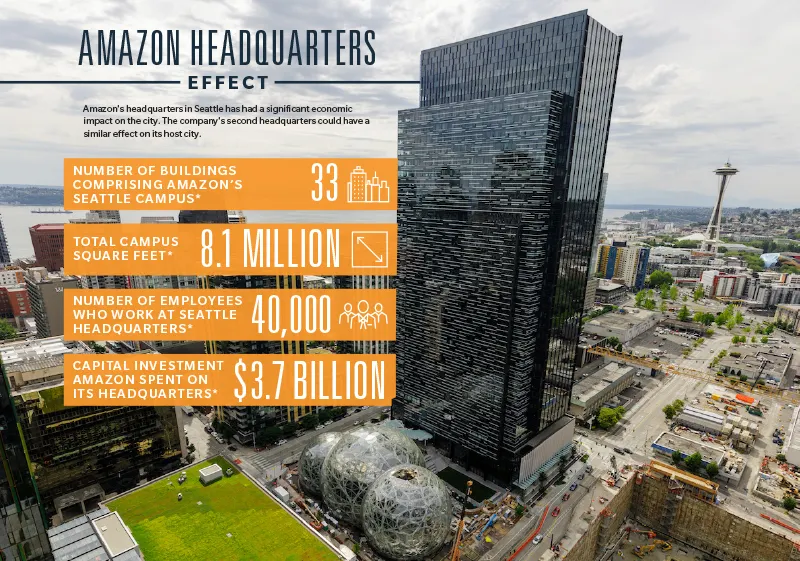
Setting aside the lives of the rich and powerful, such structures are essentially an outcome of our choices as well. Many populist leaders have been elected based on appealing and simplistic promises which always results in disastrous consequences in the long run. Even our consumption preferences, specifically the thrill of bargain hunting, indirectly contributes to money’s increasing influence in politics as it empowers the companies we support. Amazon’s recent bid for a new HQ location shows the lengths which local governments are willing to go to in order to be considered in the bid, with many of them considering incentives in the hundreds of millions even though the firm as a whole is already paying lower corporate taxes then its brick-and-mortar competitors.
As always, reality is always much more complicated as no single party is blameless in this capitalist dystopia that we are barreling towards. Even more pressing is that many don’t even have the resources nor the time to really understand how their choices are contributing to this cycle as they are too busy trying to survive. The incentives inherent in the current system seems to be pushing people into increasingly polarized extremes as the middle-ground is both not as profitable and much less emotionally engaging. As such, setting aside the actors in a system, it might be time to take a step back and rethink the rules of the game itself to see whether there are better approaches to governance. Ironically, new market systems might be a solution to controlling the excesses of capitalism while still enjoying the benefits it brings.
tldr: For those familiar with such concepts, a summary can be found in the last section.
Social Scalability
“In individuals, insanity is rare; but in groups, parties, nations and epochs, it is the rule.” — Nietzsche
Apart from quoting Nietzsche above to appear intelligent, his quote above strikes at the core of the biggest problem in governance: how do you coordinate an increasingly large number of individuals when for most, deciding on where to have a family dinner is already difficult enough. Interestingly, as society has gotten significantly larger and exponentially more complex, power has been increasingly centralized in the hands of a few. Is such centralization a natural order of things or could it be that our governance systems have failed to evolve accordingly?
In retrospect, it does seem like centralization was a natural outcome as cities grew; consensus is after all much easier to achieve in a smaller group. Many aspects of daily life are essentially mundane and could practically be seen as admin work which many people would much rather avoid. As long as I can get reliable electricity, water, and YouTube, I don’t really care about how it’s being delivered. We are all lazy people and as long as something works and does not cost us a kidney, we will be happy in our own bubble while leaving the decisions to the people actually interested in those matters.
Though I argue here that we need to be more proactive, there are only so many minutes in a day. Forcing people to think about all aspects of their survival would essentially bring us back to a free-for-all hunter-gatherer society. In fact, it was during the agrarian revolution when an individual was consistently able to produce surplus food that small sectors of the society could stop worrying about daily survival and instead dedicate their time to enriching or controlling society. This slowly evolved into a form of tax on the farmer so that the farmer could focus solely on increasing his crop yield without having to worry about his stores being raided illegally. The farmer could rest assured that his stores would only be raided regularly through legal means but at least there was less likelihood of violence and starvation.
As such, individuals ceded autonomy and power to institutions which promised greater security and convenience. For many individuals, the real cost of this trade off was highly dependent on the power dynamics between institutions and individuals; in other words, the extent of centralization. The more power one party had, the less negotiating power the other one had. Making things worse is that once such power is obtained, the fear of losing it tends to corrupt even the most well-meaning people. It is therefore apt to remember the words of one of modern society’s most well-known matyrs:
“With great power comes greater responsibility” — Uncle Ben (RIP Stan Lee)
From the perspective of an individual in a democracy, this power dynamic becomes progressively worse as society grows due to the fact that their voice becomes increasingly drowned out among the noise. This sense of powerlessness and lack of representation is a big reason why political votes are taken for granted in many modern democracies.

To make things worse, this lack of representation is ironically exacerbated in the representative democracy model which many countries utilize. Citizens in such models will essentially have to elect a representative from a restricted set of candidates with the hope that their ideological views aligns as closely as possible. This is of course impossible and the result of this is that people tend to vote based on a few key promises. Subsequently, candidates are incentivized to run on populist promises which usually appeals to voters emotionally. The more disenfranchised an individual feels, the more likely that she will vote against the system by bringing in someone that will destabilize the status quo.
“It is much easier to sell a fake art piece to someone who believes it is genuine rather than to sell a genuine piece to someone who believes it is a fake” — read somewhere on the internet
Another outcome of this model is that because the elected representative will have to appeal to the masses, soft skills are placed at a much higher premium rather than job-specific skills. They might not have the best technical knowledge to get the job done but then again what percentage of the population has even a grasp of the technical aspects. The problem arises as these representatives will then have to vote on the policy initiatives with at best, a sub-optimal understanding (relative to professionals) of the policy implications. This is not to say the best person for the job has horrible communication skills but when coupled with the fact that the official is supposed to represent voters across a multitude of issues, there are definitely more experienced specialists for each individual issue.
As such, a myriad of factors have pushed the current system to its limits:
- Citizens can’t be expected to manage every aspect of their relationship with society. As long as it works, most will be happy delegating their autonomy so that they can concentrate on their own area of expertise.
- Officials tend to run on populist promises as it is impossible to represent the views of so many individuals. Such issues will therefore overshadow other policy decisions as the elected official also has a vote over it.
- Subject specialists are sidelined as soft skills and, to a certain extent, breadth of knowledge is key to obtaining influence over policy decisions. Depth of knowledge plays second fiddle to appearances and networks.
What we end up with is a policy making machine which sets aside boring and multifaceted long term planning with controversial and single-dimensional short term promises. Moreover, simplifying an individuals preferences into a single vote tends to result in centralization of power as the reduced resolution places elected officials in charge of decisions outside their space of expertise. Elected officials will also have the tendency (whether intentional or not) to surround themselves with subject experts who pander to them resulting in the elevation of social networking over unbiased expert opinion.
Therefore, in order for the system to evolve, it needs to address the following:
- Increased voting resolution on the topics which individuals care about
- Elimination of the policy making echo chambers
- Increased accountability for policy decisions
It is important to note that though the above are mainly governance problems, new technology might be able to offer alternative approaches to solving this issue. Also of note, the ideas proposed below are just that, untested but nonetheless promising ideas. As such, look at it as a starting point to get this conversation going.
Liquid Democracy: Middle-ground between representation and self-determination?
One of the most promising governance structures which have only just become feasible is that of liquid democracy. I highly recommend this article written by the co-founder of IOTA for those who are interested in a deep dive. In summary, liquid democracy enables voters to vote directly on an issue, or they can delegate their voting power to delegates who would then vote or delegate that vote further on their behalf. This can be done throughout the year without depending on election cycles therefore aligning better with reality. In essence, liquid democracy addresses the issue of voter misrepresentation while also enabling the voter to decide the extent of self-determination that she is willing to forgo.
The main reason why such a model is only just starting to gain traction is a technical one: prior to smart devices and internet, there was no easy way to manage the exponential growth of such a network.
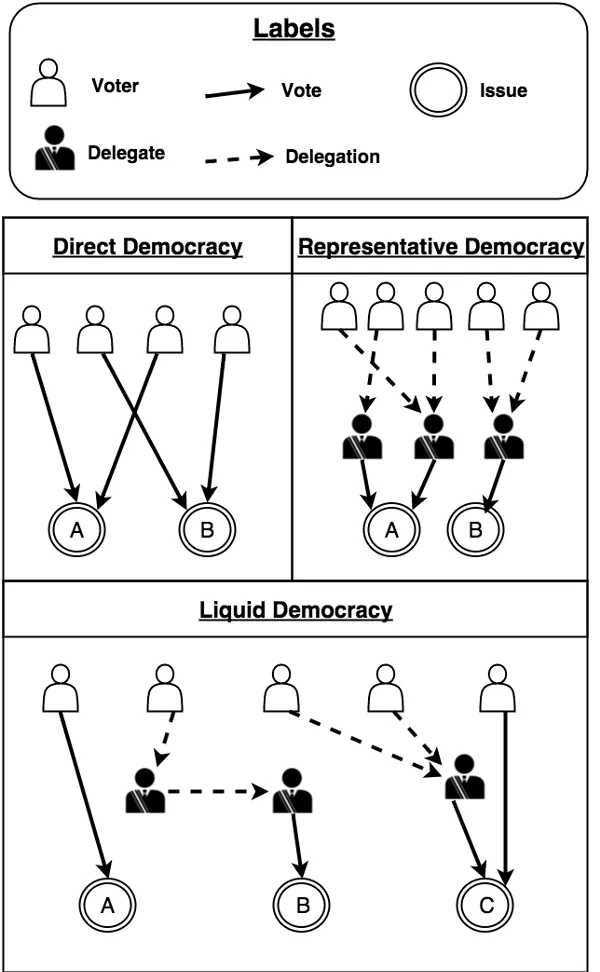
Without smart devices, keeping track of all these relationships and the weightage of each vote would have been an impractical ask. Without the internet, transitory voting would be impossible. Lastly and probably the largest technical question mark, without blockchain, digital identity verification would have seemed inconceivable. Assuming the good folks currently involved in identity management on the blockchain manages to prove the feasibility and benefits of such technology, liquid democracy is promising for a few reasons:
- Individuals have better decisional control over their votes as well as the freedom to decide their own level of involvement. An individuals vote on a certain issue is no longer purely dependent on a proxy vote done via a delegate as there is an option to vote directly on such issues. In cases where the individual is indifferent or less knowledgeable, his vote could be delegated to someone who he trusts on this issue. Unlike in a representative democracy, this voting delegation is not restricted to a list of people who they only know by name but could be someone in their personal network who is particularly knowledgeable. This also means lower barriers of entry to become a representative.
- Provides an alternative to centralized solutions. Notice that such a solution does not eliminate the possibility of centralization as delegation of votes could still ultimately roll up to a particularly popular individual. However, it introduces checks on such centralization tendencies as competition for votes is more closely aligned with the ability to deliver on specific issues therefore elevating the status of specialists relative to generalists. As such, extreme polarization based on political party affiliation is likely to diminish as the parties themselves plays a declining role in winning over voters and influencing policy decisions.
- It ties the elected representative more closely with their policy decisions. The fact that delegated voting power can be moved at any time means that the elected representatives have increased responsibility and accountability. Failure to deliver on the trust which voters have placed in them could lead to a relatively quick loss of power. It must be noted that part of the reason why election cycles were implemented was also to provide a sufficient window for policies to be realized so a balance will likely have to be sought. Nonetheless, such changes will have less of a disruptive effect on society as a whole due to the fact that elected representatives are limited to their specific domain.
In theory, liquid democracy seems like the way forward as it balances out the playing field when it comes to self-determination and convenience. It enables individuals to adjust their level of involvement based on their comfort levels. Critically, votes in such a system are indeed a reflection of trust as the possible candidates if a voter does decide to delegate could literally be anyone. This could be the spark needed to get voters to feel a greater sense of social responsibility as they do have the opportunity to influence an outcome that they are really passionate about. Consequently, this is the starting point for a true meritocracy.
As such, it will be interesting to start prototyping such models in the real world as it enables a more fine-grained and rational mapping of a society’s agreed future road-map. To take things a step further, liquid democracy could even be paired with principles from a futarchy in order to ensure the most efficient use of shared resources and minimize the influence of cronyism.
Futarchy: Solving money in politics with more money?
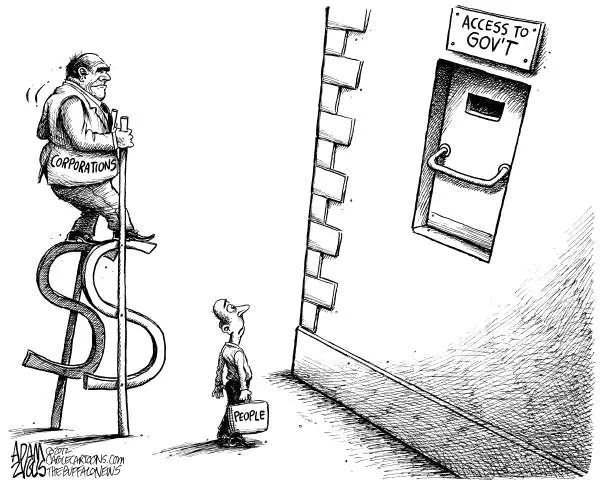
The one major thing that we have yet to address directly is the influence of money in politics. The liquid democracy model above does keep it in check by minimizing the need for campaign financing as well as reducing the opportunities for corruption that tends to accompany centralization of power. However, the one thing that has yet to be addressed is that the elected representative does not have any checks with regards to how policies will be implemented. Given their authoritative position, they are in the position where they could favor people in their own network for contracts paid for by the public coffers. Although the transitory nature of votes in a liquid democracy indirectly addresses such risks, the problem is that such cases will only be known post-fact resulting in wasted resources and less than ideal accountability. As such, a futarchy tries to address this issue by differentiating between policies that we want and ways of achieving said policy.
Essentially, in a futarchy, the idea is that values should reflect the subjective goals and preferences of the group sharing the resource being governed while determining the policies best suited to achieving those goals is best left to a more “objective” prediction market. Policies are determined via open market values and implemented either through bonded delegates or an automated process.
As a side note, the introduction of decentralized prediction markets via blockchains in a futarchy might actually be one of the better use cases of decentralized technologies as centralized prediction markets relies on a completely trustworthy entity that can effectively and securely manage the ledger and consistently report the correct outcome of events. Effectively, the presence of a central administrative figure requires prediction markets to abide by governing bodies which allows outside interests to put pressure on or close down these markets.
Futarchy is an idea first proposed in 2000 by Robin Hanson. As summarized by Hanson, a futarchy makes 3 key assumptions:
- Democracies fail largely by not aggregating available information.
- It is not that hard to tell rich happy nations from poor miserable ones.
- Betting markets are our best known institution for aggregating information
In the initial formulation of a futarchy, there was a need to define a formal measure of “national welfare” so as to be able to manage its measurement after the fact. As such, the basic rule of government would be:
“ When a betting market clearly estimates that a proposed policy would increase expected national welfare, that proposal becomes law” — Hanson
The existence of a “welfare metric” is a crucial assumption as the notion of utility is inherently subjective. However, as Buterin points out in his dive on futarchy (which i highly recommend), human values are complex making it impossible to be condensed into a single numeric metric. Nonetheless, this does not nullify it as in any government, the existence of welfare indicators is an inescapable part of performance measurement. In fact, it is here where the merging with liquid democracy might provide a more optimal outcome.
Market-driven Democracy?
Given that many of the core goals of both a liquid democracy and a futarchy are closely aligned, a hybrid model of the two might prove to be valuable as they are essentially complimentary in implementation.
- **Voter apathy: **Voters in a liquid democracy are given the option to choose their level of involvement. They can vote directly and even be delegated votes if they are really passionate about a topic whereas if a topic does not interest them, they can entrust their vote to someone they know will vote in their interest. Futarchy streamlines this process by only requiring widespread input for determination of the welfare index to be improved.
- Knowledge aggregation: As a result of the above, liquid democracy encourages well-informed discussions by interested parties in the specific domains. Moreover, the more fine-grained selection of policy goals in a liquid democracy clearly defines the problem set. Futarchy takes this a step further and enables individuals to incorporate their findings into the policy decision process by buying and selling on the market in order to make a profit from their superior information differential.
- **Limiting influence of networks: **Liquid democracy minimizes the influence of political alliances in winning over voters. Low barriers to entry and transitory nature of votes pushes the focus more towards effective policy implementation. Futarchy acts as a check on an elected representatives decisions as the market has the final say as to which policy is implemented. As such, conflicts of interests are minimized.
- **Increased accountability: **The transitory nature of votes in a liquid democracy ties the elected representative more closely to the outcomes of their policy goals. A futarchy doubles down on this by forcing the stakeholders in the policy decision process to put their money where their mouth is. Only individuals who believe strongly in the effectiveness of their policy will be willing to place their money at stake in order to drive their desired outcome.
- Proposals over personalities: Policy making in a liquid democracy becomes less a competition for votes and more about earning a voter’s trust as there are no restriction to who can be elected. Futarchy eliminates the influence of personality as financial rewards are ultimately determined by poring over models, statistical analyses and trading charts.
Of course the introduction of market-based governance also exposes the policy making process to the excesses of capitalism. Foremost among this concern is that financially-abled parties would be able to manipulate the policy making market by buying their desired outcome. Making things worst, if a breaking point is reached, financially-rational investors might join in based on noise. This is definitely a valid concern but in so far as comparing it with the current system, I believe there are two main advantages to be had:
- Transparency: The move towards an open market will force the policy decision process to be radically more transparent. Individuals will be tied directly to their policy decision preferences through a publicly searchable ledger. Proxy market manipulation is still possible but this will likely still have advantages over the current political lobbying system where funds go to influence executive decision rather than staking directly in the policy.
- Costs: In order to manipulate the market, the manipulator will need to have funds in excess of the ‘best’ policy as determined by the market. The likelihood of this happening will be dependent on the specific issue. Nonetheless, if it is a particularly controversial or important issue, it is expected that such costs will be significantly higher than the costs of bribing a few representatives. Moreover, as long as the market power of people willing to earn a profit by counteracting manipulation exceeds the market power of the manipulator, the honest participants will win and extract a large quantity of funds from the manipulator in the process.
Ultimately, such a model is still very much theoretical but it addresses a core issue when it comes to effective governance which is trust. Liquid democracy ensures that delegation of votes is a sign of trust while a futarchy makes the system as a whole more trustworthy as there are less opportunities for manipulation. Critically, such systems acknowledges that knowledge is essentially distributed hence no one party should have an executive decision when it comes to creating policies which will affect society as a whole.