Debit vs credit card in Singapore: What you pay, what shops pay
The price you see in the shop already includes card fees, no matter what you pay with. Every time you tap,
the shop is charged a fee, up to 3.5% of the sale on one UOB plan. Its card contracts forbid it from
adding a surcharge for paying by card, so it recovers the cost in its prices, and cash shoppers pay a share too.
Paying by card can cost you in a second way. A credit card gets expensive fast if you do not repay
in full. It charges 27.8% a year on any unpaid balance, which rises to 30.8% if you miss a payment.
Paying only the minimum avoids the late fee, not the interest.
This piece compares debit, credit and prepaid cards on what you pay, what the shop pays, who earns
the fee, and who takes the loss when a charge is not yours. Start with the comparison below, then
step through how a payment moves on each card.
Paying vs earning interest
You payYou earn
27.8%Credita year on any balance not paid in full
30.8% if you miss the minimum
4.70%Debita year at most to 31 Dec 2026, with conditions
Paying only the minimum avoids the late fee, not the interest. Missing it adds SGD 100 and a higher rate, 30.8%.
All three carry the same logos. They differ in whose money you spend, what it costs and who pays when it goes wrong.
Row
Credit cardBorrow now, repay later
Debit cardSpend your bank balance
Prepaid cardSpend a balance you loaded
Getting and using a card
SGD 30,000a year, the income floor
Apply and meet an income rule set by law
Linked to a savings account at the bank
Sign up in an app and get a card delivered
The law sets the income floor (aged 55 or younger), or SGD 1 million in financial assets or SGD 2 million in net personal assets, under the card regulations. It sets no minimum age, but DBS, OCBC and UOB all require 21.
POSB packages an eSavings Account with a debit card. UOB gives a One Debit Card with a One Account. OCBC links its debit card to a savings account such as the 360 Account, from age 16 and with no annual fee.
YouTrip lets you register with MyInfo or identity documents and delivers a free card. Wise lists ordering a card as free, with express delivery from SGD 16.
Borrowed from the bank
Your savings account
Money you loaded in advance
The bank pays the shop and bills you later. Because it is a loan, the credit limit and the other card regulations apply.
The money comes out of your own bank account, after a hold that DBS says is an estimate and may last up to 10 days.
The money is a balance you loaded with an e-money issuer, not a bank deposit. Spending draws the balance down.
4xmonthly income
SGD 5,000 a month allows SGD 20,000
Your balance, or a limit you set
What you have loaded
The ABS code sets four times monthly income, for an annual income of SGD 30,000 to 120,000. MAS rules stop new charges once interest-bearing debt passes a year's income for 3 months, below SGD 120,000 a year.
Your balance is the ceiling. DBS and OCBC also let you set a card limit in the app.
You can spend only what you have loaded, so you top up before you spend. Any further limit is set by each provider in its app.
Monthly limit, lock and overseas switches
Lock, limit and overseas switches
Freeze the card or suspend the account
DBS sets a monthly spend limit, locks the card, switches online, overseas and contactless use, and blocks cash advances. OCBC has a lock, overseas settings and limits. UOB keeps the magnetic stripe off overseas until you switch it on.
DBS applies them to debit cards too, with a monthly limit. OCBC locks debit cards in the same way. UOB switches the stripe off overseas on debit and ATM cards too.
Wise lets you freeze the card from the Card tab of its app. YouTrip has a kill switch, started by phone, that suspends the account and both its cards.
6%capped at SGD 160 a month
Top cashback rate, or miles
4%capped at SGD 20 a month
Top cashback rate on selected spend
Variesby merchant, no single rate
Perks cashback at set merchants
OCBC 365 pays up to 6% on fuel and 5% on dining, with a cap of SGD 80 a month on SGD 800 of spend and SGD 160 on SGD 1,600. UOB also sells miles cards. The competition regulator found the evidence consistent with interchange paying for rewards.
DBS Visa Debit pays 4% on online food delivery until 31 December 2026, 3% on local transport and 2% on foreign currency, capped at SGD 20 a month on SGD 500 of spend. OCBC's debit card pays 1% on selected categories, and UOB One advertises up to 4%.
YouTrip Perks pays cashback by merchant, and the rate, cap and timing are set in each deal. Wise's card pricing page lists no rewards.
What it costs
27.8%a year, you pay
Charged on any unpaid balance, even if you pay the minimum
4.70%a year at most, you earn
Earned on the first SGD 100,000, with conditions
1.05%a year, you earn
Only if the provider offers it
At DBS and UOB, and 27.78% at OCBC. It is charged from each purchase date until the balance is paid in full.
OCBC 360 up to 4.70% until 31 December 2026 and 4.45% after, DBS Multiplier up to 4.10%, UOB One up to 3.4% on one band. Each needs salary credit and more. The base rate is 0.05% on the whole balance, with no cap.
A separate fund, not the card. Wise invests the balance in a money market fund, after a 0.68% fee. It is not guaranteed.
Pay in full0%interest
Nothing to pay if the whole bill arrives on time
OCBC says interest is calculated from the transaction date only if it does not receive full payment by the due date. The repayment period is 23 days from the statement date at OCBC and 25 days at DBS. UOB's sheet states none.
Pay only the minimumSGD 50or 3% of the balance
No late fee, but interest keeps running
The minimum is the same at DBS, OCBC and UOB, SGD 50 or 3% of the balance if that is more. It is an amount to pay, not a rate. It avoids the SGD 100 charge, but interest runs from each purchase date on what is left, at the rate in the row above. On SGD 1,000 at SGD 50 a month, that is about 27 to 28 months and SGD 300 to 360 of interest.
Miss the minimumSGD 100late fee30.8%interest, up from 27.8%
A late fee, then a higher rate until you catch up
DBS, OCBC and UOB keep the higher rate until the minimum is paid on time for two or three months. The account is also late, which can mean a past due mark at the credit bureau (regulations).
Keep the account above its minimum balance
Falling below it costs a monthly fee, SGD 2 to 5 at DBS Multiplier, OCBC 360 and UOB One. It is counted in the yearly fees.
Top up before you spend
You can spend only what you have loaded, so nothing is borrowed and there is no bill to pay.
SGD 196.20a year, GST included
Waived at first, then for spend or points
SGD 24 to 60a year, if under the minimum
Avoided by keeping a minimum balance
Freeat Wise and YouTrip
No subscription fee, and a free card
DBS waives year one, and some cards waive later years at SGD 15,000 to 60,000 of spend, an option it ends on several cards from 1 August 2026. OCBC 365 waives it at SGD 10,000 of spend. UOB mostly waives it for redeemed points.
Twelve months of the monthly charge. DBS Multiplier charges SGD 5 a month under an average of SGD 3,000. OCBC 360 charges SGD 2 under SGD 3,000, free in year one. UOB One charges SGD 5 under SGD 1,000, free for six months if opened online.
Wise lists no subscription fee and YouTrip delivers the card free. Neither page names a yearly charge, and MAS's conduct notice requires e-money firms to display their fees before you use the service.
For the shop
0.8% to 3.5%of each sale, UOB plan
Plus SGD 12 a month to take credit cards
0.8%of each sale, NETS debit
Visa and Mastercard debit is not priced
As creditinferred, not published
Likely charged the credit card rate
The UOB plan charges SGD 38 a month for the terminal and SGD 12 a month more to take credit cards, at up to 3.5% of a sale. The shop cannot add this to your bill, so it sits in the sticker price no matter what you pay with.
The 2013 competition regulator found that most Singapore acquirers charged one blended rate for debit and credit, and MAS said in 2021 that disclosing the merchant fee need not be mandated. That finding dates from 2013.
An inference, not a published rate. YouTrip and Wise cards run on Mastercard or Visa, and DBS's 2017 price sheet set one rate for those networks whatever the card type, so the shop is likely charged its rate for that network.
3 days lateron that plan
Within 7 banking days at DBS
Next dayNETS debit on that plan
Credit waits two days longer
3 days laterinferred, with Visa and Mastercard
Settled with every other Visa or Mastercard card
The UOB plan settles credit cards three days after the sale. DBS pays within 7 banking days, may hold the money for up to 7 months by notice, and adds 0.60% to a sale sent in late.
The UOB plan settles NETS debit the day after the sale. MAS's conduct notice sets 3 business days for licensed non-bank acquirers unless the shop agrees longer, and as the Act reads it does not reach a bank's own acquiring.
Neither contract read splits timing by card type. DBS pays any card bearing a network logo within 7 banking days, and Fiserv counts prepaid as a card and starts the transfer no earlier than 2 banking days after the sale. The UOB plan splits by route, NETS debit the next day and Visa and Mastercard cards after 3 days, so a YouTrip or Wise card falls on the 3 day side. UOB's page never mentions prepaid, so that last step is an inference.
When something goes wrong
A loan, so there is nothing to insure
SGD 100,000
Insured as a Singapore dollar deposit
Not insured
The card is a loan from the bank, so there is no deposit to insure. SDIC insures deposits only, and what you owe on the card is a debt.
The money is a deposit, insured by SDIC up to SGD 100,000 per depositor per bank for Singapore dollar deposits.
MAS says e-money is not covered by deposit insurance. Providers must safeguard the float, but the balance is not a bank deposit.
SGD 100
Your loss is capped, with conditions
SGD 100
Capped, but each bank adds conditions
No cap stated in their terms
ABS code, dated 2009. OCBC and UOB state SGD 100 in their fee sheets. No liability for card details used online or by phone, or an unauthorised PIN, absent fraud or gross negligence.
The ABS code applies the cap to debit cards that work like credit cards, then each bank adds conditions. UOB limits it to in-person use, DBS leaves you liable for contactless and online payments, and OCBC states no cap.
YouTrip disclaims lost card losses. Wise states no cap. MAS's guidelines reach only e-money accounts that can hold over SGD 500, so a card counts if its balance limit does.
Dispute it with your bank
Dispute it the same way
The provider files the dispute for you
The bank asks the card network to reverse the payment. ABS says most banks want the dispute form within 14 days of the statement date. No law gives you this claim, so it rests on the card network's own rules.
The ABS guidance names debit cards among those that can be disputed. It names six card brands and not NETS, so NETS PIN debit is not stated.
YouTrip lists goods or services not received as a chargeback reason, filed under Mastercard's rules. Wise asks you to contact the merchant first, then dispute with evidence.
No interest or late fees
4 to 12 weeksfor a case to end
The money stays out of your account
9 to 12 weeksfor a YouTrip chargeback
Credited back if the merchant accepts
The charge stays on the bill, and the ABS code says interest and late fees are not levied while the bank investigates.
ABS says a case takes about 4 to 12 weeks. For an unauthorised online payment made without a one-time password, banks usually give a temporary credit. DBS says refunds above the cap come within 14 working days.
YouTrip says 9 to 12 weeks, longer if the merchant contests. Wise says up to 30 business days to look, 30 to 45 days for the merchant, and 6 months or more for a Mastercard escalation. Neither describes a temporary credit.
What happens after you tap, debit against credit
The tap looks the same. Pick a card to follow one SGD 100 payment, and see where the approval, the bill and
your money differ.
ACredit card
Swipe sideways to see every party
Expand to read the labels.
What to know
Credit card
Your bank lends the money for the sale and you repay it on a bill, so your own cash stays in your account until the due date.
What the merchant pays
Merchant
Up to 3.5%of the sale on one UOB plan, the top of the range it lists for credit cards
Paid
3 dayson the same plan, against 1 day on NETS debit
When you pay
Bill
At the due date25 days after the statement date at DBS, so about 25 to 55 days after the tap on a monthly cycle
If a charge is not yours
Cap
SGD 100before it is reported, with conditions, under the ABS code
Online or phone
Noneno liability for card details alone, absent fraud or gross negligence
While a dispute runs
Interest
Not chargedand no late fees while the bank investigates, per the ABS code
Key facts
Pay the whole bill by the due date and there is no interest. Pay only the minimum and there is no late fee, but interest runs on the rest. Miss it and DBS, OCBC and UOB each charge SGD 100 and move the rate to 30.8 percent.
DBS's terms give 25 days interest free from the statement date and OCBC's fee sheet gives 23. A DBS article says about 20 to 25 days from the date of spend, and neither DBS source says which applies.
A balance not paid in full costs 27.8 percent a year at DBS and UOB, and 27.78 percent at OCBC, from each purchase date. At 27.8 percent, SGD 100 costs about SGD 2.29 in its first 30 days, before compounding and late charges.
The ABS code caps a credit limit at four times monthly income, so SGD 5,000 a month (SGD 60,000 a year) allows up to SGD 20,000. It applies from an annual income of SGD 30,000 (SGD 2,500 a month) up to SGD 120,000, and sets no cap above that.
MAS stops new credit when interest-bearing unsecured debt exceeds 12 times monthly income for three months, for anyone earning under SGD 120,000 a year.
UOB's FAQ says there is no set reporting period, and that you are deemed negligent if you do not report at the first opportunity.
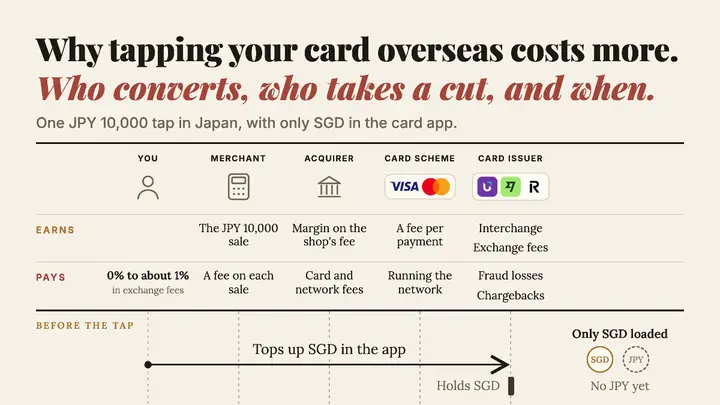
The parties follow the card payments piece. The order of the cuts of the merchant's fee is Australia's, the one place that publishes them for both cards, and Singapore publishes none. The DBS interest rate is from its card terms. The merchant fee is the top of the credit card rate on one UOB plan, which also charges SGD 38 a month for the terminal and SGD 12 a month more to take credit cards. Singapore interchange by card type is not published.
SGD 100for in-person use of a lost or stolen card only, by its agreement
OCBC
Not statedits terms state no cap, and debit every transaction made before you tell it
While a dispute runs
Cash
Out of the accounta temporary credit is usual for an online payment made without a one-time password, says ABS
Case
4 to 12 weeksa simple dispute against a complex one
Key facts
DBS says purchases are deducted directly from the account. UOB's agreement says it may place a hold or debit the account, whichever comes first.
DBS's agreement says a held sum is only an estimate, cannot be stopped or used, and may be held up to 10 days. UOB leaves the period to its discretion, and OCBC's pages give none.
DBS sets a default limit of SGD 2,000 across signature, contactless and online payments, subject to the available balance.
Not in the public record How DBS's SGD 100 cap in clause 6.2 fits with clauses 3.13 and 6.8, which make the holder liable for contactless and card-not-present payments, is not stated in the text.
Notes on the earns and pays rows
The parties follow the card payments piece. The order of the cuts of the merchant's fee is Australia's, the one place that publishes them for both cards, and Singapore publishes none. The merchant fee for Visa and Mastercard debit is not split out in any published Singapore source.
NETS is also an acquirer for credit cards. Since March 2023 it signs merchants directly for Mastercard and Visa, and it already did for AMEX, Diners, Discover, JCB and UnionPay. A NETS terminal takes credit cards through a paid add-on, and those payments follow the credit route, not this PIN route.
The single message mechanism comes from the 2011 Red Book, so it is dated. It describes no hold stage and no later change to the amount.
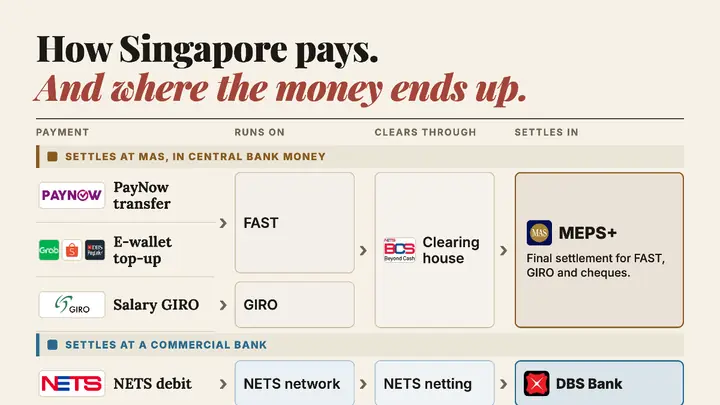
MAS's directory lists DBS Bank as the settlement institution for NETS EFTPOS. The 2011 text says NETS works out bilateral net positions, DBS debits or credits each member bank, and banks manage their DBS accounts through MEPS+.
Not in the public record How NETS funds merchant payouts, how a refund posts and whether a NETS payment has a chargeback route are not published. The 2011 text says bilateral netting, an earlier edition says multilateral, and no current document says which.
Notes on the earns and pays rows
The parties follow the card payments piece. The order of the cuts of the merchant's fee is Australia's, the one place that publishes them for both cards, and Singapore publishes none. The 0.8 percent is the NETS debit rate on one UOB plan, and NETS does not publish how it splits the fee with the banks.
How other places publish the split of the shop's fee
Singapore publishes neither interchange nor how the shop's fee is split. Where a regulator publishes interchange,
debit costs less than credit, and Australia is the one place that splits the fee between the card bank, the
card network and the shop's bank for both cards. How the fee reaches the price is covered in the piece on
how a card payment settles. What a card costs abroad is
covered in why your card costs more abroad.
Interchange is only the card bank's part. The shop also pays the network's fees and its own bank's margin, so the whole fee is higher. MAS does not cap interchange and Singapore does not publish it, so Singapore is not on this chart. A cap does not always reach the shop. In the UK the cap cut interchange by about 0.19 points for shops with under GBP 15,000 a year in card sales, but their whole fee fell by only 0.03. Shops with under GBP 380,000 paid about 1.85 percent in 2018, against about 0.6 percent on average. Scheme and processing fees then rose at least 25 percent in real terms from 2017 to 2023. Malaysia's figures are the rates Visa publishes under the central bank's framework. The UK cap covers domestic consumer cards.
Who gets the shop's fee, debit against credit
Debit card
Australia, shop's fee
Your bank 30%
Card network 21.5%
Shop's bank 48.5%
Credit card
Australia, shop's fee
Your bank 65%
Card network 14.8%
Shop's bank 20.2%
Your bank
The bank that issued your card, called the issuer. It earns interchange, and on credit it earns interest and fees as well.
Card network
Visa or Mastercard. It charges scheme fees on each payment.
Shop's bank
The shop's bank or processor, called the acquirer, which keeps what is left after the other two are paid.
On a debit payment your bank takes about three tenths of the shop's fee and the shop's own bank keeps nearly half. On credit your bank takes about two thirds. Interchange is from 2023/24, scheme fees from 2024/25, and the shop's bank share is the remainder, so it is approximate (RBA consultation, RBA scheme fees).
What your bank spends and what it earns
Debit, Australia
Costs your bank
7 centsa payment, 0.13% of its value
Interchange it earns
6 centsa payment on average
Interchange sits just under cost, and debit has no interest revenue to make up the gap (RBA).
Credit, Australia
Costs your bank
0.20%of the payment
Interchange it earns
0.47%of the payment on average
Interchange is more than double the cost, and the interest and fees you pay come on top (RBA paper).
NETS debit. NETS does not publish how it divides the 0.8% with the banks, so it cannot sit beside the Visa and Mastercard shares (UOB plan).
Place
Debit
Credit
Source
European Union
Interchange capped at 0.2 percent of the value, for consumer cards.
Interchange capped at 0.3 percent, for consumer cards.
Scheme and processing fees were about 14% of the merchant service charge in 2018 and are unlikely to exceed 25% now. The rest is not split between card bank and shop's bank (PSR).
United States, debit
Regulated interchange averaged 22 to 24 cents against a processing cost of 4.1 cents. Network fees averaged 12.9 cents a payment, 64.9% paid by shops and their banks (Federal Reserve, 2023).
United States, debit fraud
Fraud losses were 17.6 basis points of value, borne 49.9% by shops, 28.3% by banks and 21.8% by cardholders (Federal Reserve, 2023).
Australia, debit scheme fees
AUD 776.5 million in all, paid 79% by shops' banks and 21% by the banks that issued the cards (RBA).
Australia, debit costs
0.13% of value, made up of processing 0.06, scheme fees 0.03, fraud 0.02, wallet fees 0.01 and disputes 0.01 (RBA).
Where Singapore's rules differ, and who sets them
Singapore sets lending limits in law and leaves prices, fraud losses and merchant terms to codes and contracts.
Charged on any balance not paid in full, even when the minimum is paid on time.
Missing the minimum payment
No cap on the charge. The law only makes banks show it. Paying the minimum on time avoids it.
No rule, banks decide
Elsewhere
MalaysiaThe late charge is the lower of 1% of the balance or RM100, and it cannot be added to the balance that earns interest (BNM, 2025).
United StatesPenalty fees must be reasonable and proportional (15 USC 1665d). A rate rise on an existing balance waits until a payment is 60 days late, and ends after 6 months of on-time minimums (15 USC 1666i-1).
Paying it is not a missed payment, so there is no SGD 100 charge and no higher rate. Interest still runs on what is left.
Who can get a credit card, and how much
Lending limits are written into law.
Set by law
Elsewhere
MalaysiaAge 21 and income of RM24,000. At RM36,000 or less, two issuers at most and a limit of 2 times monthly income each (BNM, 2025).
United StatesUnder 21s need a cosigner or means of their own (15 USC 1637). Issuers must consider ability to repay, with no set multiple (15 USC 1665e).
So a shop recovers the cost in its prices for every shopper, cash and PayNow shoppers included. That is an inference from these terms, not a measured figure.
What the shop is told about its fee
No duty to show the fee was found. The terms sit in the contract the shop signs.
Set by contract
Elsewhere
European UnionA price split by card type, and the service charge and interchange fee shown after each payment (articles 9 and 12).
United KingdomA summary box of key prices and terms for each small shop, and terminal contracts capped at 18 months (PSR, 2022).
CanadaThe effective rate by card type each month, 30 to 60 days' notice of fee rises, and cancellation without penalty (FCAC code, 2024).
Singapore law
MAS said in 2021 that merchants can ask their provider, and that disclosure of the merchant fee need not be mandated.
MAS's conduct notice makes licensed money transfer, e-money, digital token and money-changing firms display their fees before use. It does not list merchant acquirers, and its disclosure notice does not mention them.
For licensed non-bank acquirers it sets a baseline of 3 business days to pay a shop, which the two can change in writing. MAS says the baseline is meant for private individuals, and that businesses can set their own timelines.
On the Act's list, merchant acquisition is a regulated service for non-bank card issuers and not for banks, so as the text reads these notices do not reach DBS, OCBC or UOB's own acquiring.
The banks
The rate sits in an application form or price guide, not the public terms.
DBS can revise the rate on 30 days' notice, and either side can end the agreement on 30 days' notice.
NETS gives its price guide after approval, can change it at its sole discretion, and can debit fees without prior notice.
Fiserv lets the shop leave on 30 days' notice if fees rise.
DBS pays within 7 banking days, may hold the money for up to 7 months by notice, and adds 0.60% to a sale sent in late.
Frequently asked questions
Is credit card interest capped in Singapore?
No. Banks set their own card interest. DBS, OCBC and UOB charge about 27.8 percent a year, or 30.8 percent after a missed minimum.
The lawMAS says it does not propose a cap, that rates are set commercially, and that it relies on disclosure and borrowing limits instead.
MoneylendersLicensed moneylenders may charge at most 4 percent a month, or 48 percent a year, and a late fee of at most SGD 60 a month. Banks are excluded because MAS regulates them.
The banksDBS and UOB charge 27.8 percent and OCBC 27.78 percent, from the purchase date. All three charge SGD 100 and add 3% to the rate, making it 30.8 percent, after a missed minimum.
What the law does requireA cap on how much you can borrow, a bill that shows the charges and how long the minimum takes, and card suspension when debt passes set limits (card regulations).
Details
The moneylender limit is the nearest interest cap in Singapore law, and it does not reach banks. A card at 27.8 percent sits below it, but the SGD 100 late charge is above the SGD 60 a moneylender may charge, and a bank's total charges have no ceiling.
MAS says credit cards are not meant as a long-term credit facility. Its tools are disclosure, the borrowing limits and card suspension, plus referral to Credit Counselling Singapore for people who cannot keep up (MAS).
How many people in Singapore carry credit card debt?
Nobody publishes the share of cardholders in debt. Balances carried over unpaid reached SGD 9.4 billion in 2025, the highest since the series began in 2014.
The totalSingStat's table shows SGD 9,400.2 million carried over unpaid in 2025, and SGD 519.8 million of bad debts written off.
The cardholdersThe same table counts 6,135,494 principal cardholders. It counts credit and charge cards together.
The averageSGD 9.4 billion over 6.1 million principal cardholders is about SGD 1,500 each. That is a simple average, not what a borrower owes, since not every cardholder carries a balance.
Details
MAS and SingStat publish aggregates. No recent published figure gives the share of cardholders who roll over a balance, and neither MoneySense nor the credit bureau publishes a survey that does.
What happens if you pay only the minimum on a credit card?
It avoids the late fee, but not the interest. The rest of the balance still charges about 27.8 percent a year.
Three outcomesPay in full and there is no interest. Pay only the minimum and there is no late fee, but interest runs on the rest. Miss it and the late fee and the higher rate apply.
The ruleDBS sets the minimum at SGD 50, or 3 percent of the statement balance if that is more, plus anything overdue. It is an amount to pay, not an interest rate.
The interestInterest runs daily at 27.8 percent from each purchase date until you pay in full, even when every minimum is on time.
The exampleOn SGD 1,000 at SGD 50 a month, about 27 to 28 months and SGD 300 to 360 of interest, a range because banks do not say whether the rate is nominal or effective.
Miss itDBS, OCBC and UOB each charge SGD 100 and add 3% to the rate, making it 30.8 percent, until the minimum is paid on time for two or three months.
Details
The minimum avoids the late charge. It does not avoid interest. A bill that is not paid in full charges interest from the purchase date, and it keeps charging on what is left each month.
More examples, worked out at 27.8 percent a year with no new spending. Banks do not say whether 27.8 percent is a nominal or an effective rate, so each is a range. SGD 1,000 takes about 27 to 28 months and SGD 303 to 359 in interest. SGD 2,000 takes about 6.3 to 7.4 years and SGD 1,873 to 2,581. SGD 5,000 takes about 14 to 17.5 years and SGD 8,088 to 11,813.
The minimum is the least that keeps the account current. It is not a plan to repay. Pay less and the account is late, which carries the charge above, a past due mark in your credit bureau report and, in the end, possible legal action (Second Schedule of the card regulations).
The law makes banks show the cost. Each bill that is not paid in full must say how long it takes and how much it costs to clear the debt at the minimum, and what the balance becomes after 6 months with no payment (regulation 18).
Falling far behind has a harder edge. Once an amount is 60 days late, the bank must stop new charges on your cards, and no bank may raise your limit or issue you a new card (MAS rules, rule 2).
Do credit cards in Singapore charge an annual fee?
Many do, around SGD 196.20 a year. It is often waived at first, then needs enough spend or points.
DBSSGD 196.20 on most cards, with year one waived. Some cards waive later years at SGD 15,000 to 60,000 of spend, which DBS ends on several cards from 1 August 2026.
OCBCThe 365 card charges SGD 196.20, lists two years waived, and waives any year at SGD 10,000 of spend. The two-year waiver also sits in a welcome offer needing SGD 800 of spend in 60 days, to 31 December 2026.
UOBSGD 196.20 on the Preferred Visa, year one waived. The fee table mostly waives later years for redeemed points, and lists none on some cards, such as the One Card. EVOL and Singtel list no fee.
On debitThe matching cost sits on the account. DBS Multiplier charges SGD 5 a month under an average SGD 3,000, OCBC 360 SGD 2 under SGD 3,000 and UOB One SGD 5 under SGD 1,000.
Details
A waived fee is not a free card. On the cards compared here, all three banks waive the first year or two, and keeping it waived later takes a condition. For credit that is spend or points, where a route exists. For debit it is a balance.
At OCBC the two-year waiver comes with a welcome offer that needs SGD 800 of spend within 60 days. The EVOL and Singtel cards list no annual fee.
The two costs do not compare cleanly. The credit fee is per card and per year, and the debit fee is per account and per month, so the grid above puts both on a yearly footing. Twelve months of the debit charges come to SGD 24 to 60, and they apply only while the balance stays under the minimum.
How do banks make money from debit and credit cards?
From a fee on every card payment, plus interest and fees on credit. Debit has no interest, so the fee is nearly all it earns.
DebitThe RBA found debit interchange averaging about 6 cents against about 7 cents of cost per payment in Australia. Singapore does not publish it.
CreditThe RBA's figures put credit interchange at 0.47 percent against 0.20 percent in costs, and credit earns interest and fees from the holder as well.
CostsRewards cost the bank too, up to SGD 160 a month on OCBC 365 against SGD 20 on DBS Visa Debit, and the bank carries fraud and dispute losses.
Details
The RBA says debit cards do not generate interest revenue as credit cards do, and that issuers have fewer other ways to recover their costs. Its figures put the cost of a debit payment to the bank at 0.13 percent of the value, against 0.20 percent for a consumer credit card, whose average interchange is 0.47 percent (RBA paper).
In the United States the Federal Reserve reports average interchange of 22 to 24 cents on regulated debit payments against a processing cost of 4.1 cents. Which of those patterns Singapore follows is not published. Fees for spending abroad, and who earns on the currency conversion, are covered in the piece on card costs overseas.
Is a debit card safer than a credit card?
Not by default. The ABS code limits your loss to SGD 100 on both, then each bank's debit terms add conditions.
One capSGD 100 for a lost or stolen card, the same for debit and credit under the ABS code.
The cashOn debit the money has already left the account, though ABS says banks usually give a temporary credit for some unauthorised online payments. On credit it sits on a bill that is not yet due.
The fine printUOB limits its cap to in-person use of a lost or stolen card. DBS also leaves you liable for contactless and online payments, and OCBC states no cap.
Details
The text of the rules is closer than most comparison pages suggest. One local comparison table shows fraud protection as yes for credit and no for debit. The ABS credit card code says its SGD 100 limit also applies to all debit cards that function like credit cards. MoneySense, a government site, says the cap applies to debit cards too, and MAS's e-payments guidelines say credit, charge and debit cards issued in Singapore benefit from that apportionment.
The difference sits in the contract and in cash flow. UOB's debit agreement excludes mobile wallet and online payments from its cap. DBS's agreement caps liability at SGD 100 for a reported loss, theft or unauthorised disclosure of card details, and also says the holder is liable for all contactless transactions, authorised or not, and for the card-not-present transactions it approves. The ABS code is dated, in effect from 2009 and last revised in 2006, and banks write their own terms. Both cards lose the cap if the holder authenticates a fraudulent 3-D Secure payment, which MAS treats as negligence.
For credit cards, the ABS code says cardholders are not liable for card details used by phone or online, absent fraud or gross negligence (ABS credit card code, paragraph 6). UOB's debit agreement says its SGD 100 cap does not apply to online or mobile wallet payments, and the clause read does not say what applies instead. That is the sharper gap between the two cards, and it depends on each bank's terms.
Can you dispute a debit card charge in Singapore?
Yes for Visa and Mastercard debit. NETS PIN debit is not named in the dispute guidance.
DeadlineABS says most banks want the dispute form within 14 days of the statement date.
How longAbout 4 weeks for a simple case and about 12 for a complex one.
NETSNot stated. The guidance covers six international card brands, and NETS is not one.
PrepaidYouTrip says a chargeback takes 9 to 12 weeks. Wise says up to 30 business days to look, then 30 to 45 days for the merchant.
Details
A dispute goes to the card-issuing bank, which can raise a chargeback through the card scheme. ABS's guidance covers unauthorised payments and goods or services that were not delivered or not as described.
For an unauthorised online payment without a one-time password, ABS says banks usually give a temporary credit or refund so the spending balance is not affected. For a payment authenticated with an OTP, the bank may withhold the temporary credit until the investigation ends and can hold the cardholder liable if negligence contributed.
What is a prepaid card, and how is it different from a debit card?
A prepaid card spends money you loaded in advance. A debit card spends money in your bank account.
Where it sitsWith the e-money issuer, which must safeguard the float.
InsuranceMAS says e-money is not a bank deposit and is not covered by deposit insurance.
Fraud termsYouTrip's terms say it is not responsible for losses from a lost or stolen card. Wise's card supplement states no cap in the clauses read.
Getting oneYouTrip lets you register in the app with MyInfo or identity documents and delivers a free card. Wise lists ordering a card as free.
DisputesBoth file a chargeback for you. YouTrip says it can take 9 to 12 weeks, and neither describes a temporary credit.
Details
A debit card's funds are a bank deposit. SDIC insures Singapore dollar savings, current and fixed deposits, and not foreign currency deposits. A prepaid card's funds are e-money.
MAS's e-payments guidelines carve credit, charge and debit cards out of their own liability section. They apply to payment accounts that can hold more than SGD 500, including accounts that store e-money. Whether a given prepaid card counts depends on its balance limit, so check your provider's limit.
Why does a debit card show a pending charge?
The bank holds the amount against the available balance until the sale clears or the hold lapses.
The holdUOB's agreement says it may hold the amount, and the held amount cannot be used.
The amountVisa allows a final amount up to 15 percent above the authorised one at lodging, and up to 20 percent at taxis, bars and salons.
Details
Hotels, car rental and some restaurants authorise an estimate. Visa's rules set how far the cleared amount may differ from the authorised one, up to 15 percent for lodging and cruise lines, up to 20 percent for taxis, bars and salons, the greater of 15 percent or USD 75 for vehicle rental, and up to 15 percent for other card-absent sales. Restaurants in Asia-Pacific sit at 20 percent.
On a credit card the same estimate cuts available credit, so the holder's own cash is not tied up.
Does a credit card build a credit history in Singapore?
Credit Bureau Singapore names credit card accounts in its report. Its pages do not mention debit cards.
What it holdsThe bureau says its report is a record of credit payment history from banks and major financial institutions.
DebitNot mentioned by the bureau. The Credit Bureau Act defines a credit facility as an advance, loan or similar access to funds.
The scoreThe bureau's score runs from 1000 to 2000 and uses 12 months of repayment conduct, utilisation and enquiries.
Details
The bureau's FAQ refers to credit card and loan accounts appearing in a report, and says it collates data mainly from approved members (FAQs). The Credit Bureau Act defines a credit facility as an advance, a loan or other facility that gives a person access to funds or financial guarantees. A debit card payment draws on the holder's own deposit and is not an advance or a loan. Whether banks still upload debit accounts is not stated by the bureau.
Comparison pages commonly say a credit card helps build a credit score. The bureau does not say whether a debit card does, so that point is left open.
Does the shop pay less when you pay by debit card?
On one NETS plan, yes. In 2013 the competition regulator found most shops' banks charged one rate for both.
Who paysA shop cannot add a card surcharge under its DBS or NETS terms, so the fee is already in the sticker price for every shopper, cash included. That is an inference from the terms, not a measured figure.
NETS plan0.8 percent on NETS debit, against up to 3.5 percent for credit cards on the same plan (UOB).
2013 findingCCS found that merchant fees in Singapore generally do not vary by card type, and that most acquirers offer a blended rate. That finding dates from 2013.
InterchangeNot published for Singapore.
ElsewhereThe EU and the UK cap debit at 0.2 percent and credit at 0.3 percent (EU, UK). Malaysia's Visa rates run to 0.27 percent on debit and 0.40 to 0.55 percent on credit (Visa).
Details
MAS said in 2021 that the merchant fee includes an interchange fee set by card schemes such as Visa and Mastercard, and that there was no need to mandate disclosure of the merchant fee. No Singapore source gives interchange by card type.
Do shops in Singapore add a surcharge for paying by card?
Not under the DBS and NETS card contracts, so the card cost is built into the sticker price.
The contractsDBS allows no extra charge or condition for accepting a card, and NETS bars surcharges and passing its fees to cardholders.
VisaVisa's rules bar any added amount unless a law requires merchants to be allowed to (rule 1.5.5.2).
The lawNo Singapore law was found that allows or bans a card surcharge. MAS says even the PayNow ban is an industry rule.
Who paysBecause the shop cannot add the fee, it recovers it in its prices, so cash and PayNow shoppers pay a share too. That is an inference from these terms, not a measured figure.
Details
The legal point is secondary. The useful point is that the sticker price already contains what the shop pays to accept cards, so on these terms paying by card costs no more at the till, and paying by cash costs no less.
Elsewhere it differs. The UK and the EU ban surcharges in law, while Australia and the United States allow them, so card users there can pay more than the shown price.
How old do you have to be to get a credit card in Singapore?
21 at DBS, OCBC and UOB. The card regulations set no minimum age, so it is the banks' rule.
The lawThe card regulations set an income floor, with ages in them only for the over 55 thresholds. They name no minimum age.
The banksDBS takes main cardholders from 21 to 75, and OCBC and UOB from 21.
DebitOCBC's debit card is open from age 16, with no annual income required.
The add-onOn one UOB plan a NETS terminal costs SGD 38 a month, and taking credit cards costs SGD 12 a month more, at 0.8% to 3.5% of each sale.
PaidThe same plan pays the shop the next day for NETS debit and three days later for credit cards.
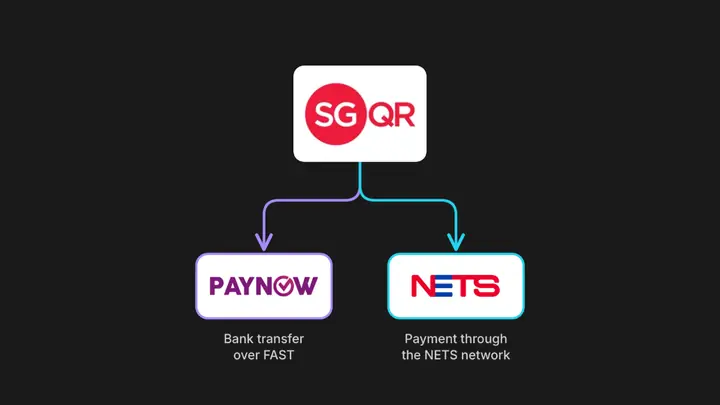
Not the same routeA credit card on a NETS terminal follows the credit route in the diagram. The NETS PIN debit route is the NETS scheme itself, for debit and ATM cards.
Details
NETS is a payment scheme and an acquirer at once. As a scheme it runs PIN debit, and it is owned equally by DBS, OCBC and UOB. As an acquirer it signs shops up for the international card brands, so one terminal and one settlement can cover both.
The UOB page gives the credit rate as up to 2.99% in one place and 0.8% to 3.5% in another, so the safe ceiling is 3.5%. Whether Visa or Mastercard debit is priced like NETS debit or like credit is not stated.
How long is the interest-free period on a credit card?
About 23 to 25 days from the statement date at OCBC and DBS. UOB's sheet does not say.
The catchInterest counts from each purchase date once the full balance is not paid (DBS, OCBC).
Details
Counted from the statement date, a purchase made just before the statement reaches its due date in about 25 days, and one made just after it in about 55, on a monthly cycle. Counted from the day of spend, the window is about 20 to 25 days. DBS does not say on either page which one applies to a given card, so the card's own terms and statement decide.
Paying less than the full balance removes the benefit. DBS's terms charge interest on each transaction from the date it was made, and on new transactions from their date until full payment.