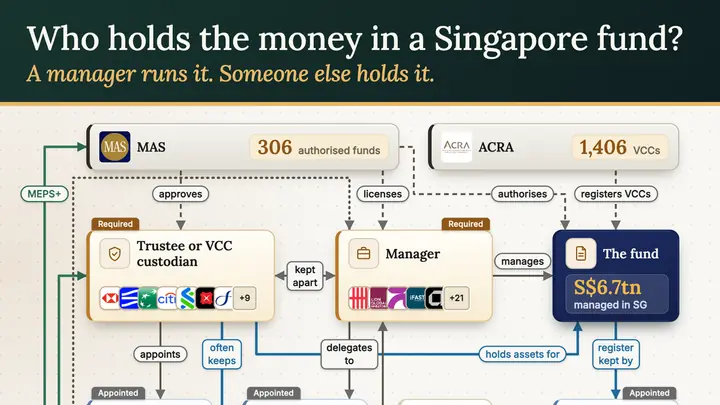
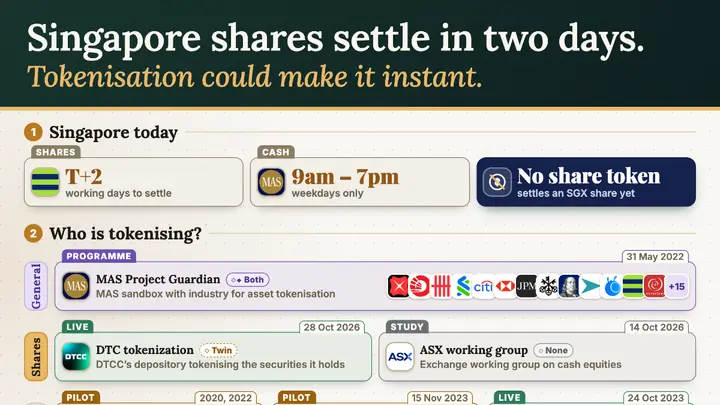
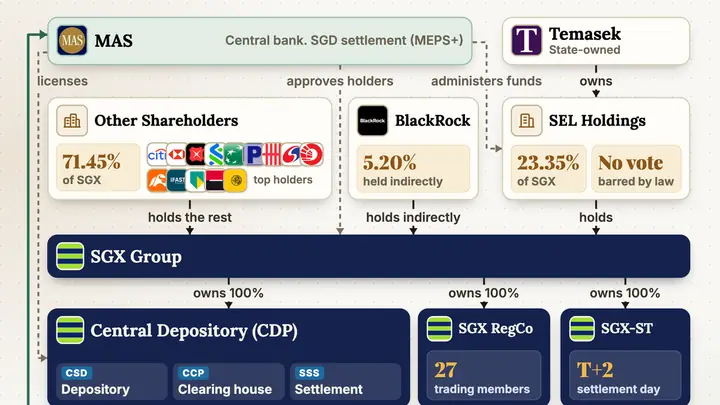
Buying a fund looks like one tap. Behind it, the order reaches the manager by its dealing deadline, the money reaches the trustee in cleared funds, and the manager issues units at that day’s price. A listed ETF trades on SGX like a share and settles two business days later.

Whose name is on the record decides who the fund recognises, who gets the notices and who you claim through. A direct buyer is named on the fund’s register. A platform’s customer is not, because the register names the platform’s custodian. In your own CDP account on SGX, you are the holder. In a broker’s custody account, the broker is, and you hold a pro rata share of what it keeps for clients, so your claim runs through it.

The route also decides what you pay and who gets paid. Sales charges run from none at FSM Global to up to 2% at United SGD through an adviser, and managers pay distributors a trailer fee out of the management fee, 20% to 60% of it by MoneySense’s range. An ETF buyer pays a broker’s commission and SGX fees instead. Who owns and runs a Singapore fund maps the firms behind each role.

  • S$270.5bn

    Held in unit trusts for sale in Singapore, the pool these routes buy into

    IMAS 31 Mar 2026

  • 306funds

    Authorised funds across 118 registered prospectuses on the MAS list for the last 12 months

    MAS OPERA list 8 Nov 2026

  • Up to 60%fee

    Of the management fee goes from the manager to the distributor each year as a trailer fee

    Sources MoneySenseFullerton

  • 1–2days

    Until you learn the price you paid. Most unit trusts are forward priced, so it is set after you order

    FSM Global 10 Nov 2026

How each route processes a purchase

Every route is an order, a price and a record, with different parties in between.

1Order2Price and clear3Record and settle

Unlisted fundscompared with A

Listed ETFscompared with G

ABuy direct from the manager

1 Order (by the dealing deadline) The investor applies to the manager and sends the payment, or an instruction to the SRS operator bank. Application Form 2 Price and clear (the same dealing day) The manager takes the order, and the money reaches the trustee by cheque or transfer. Takes the order by the dealing deadline Cheque, or transfer to the account on the form 3 Record and settle (units issued, then registered) The trustee receives cleared funds and the manager issues units. The confirmation note runs from the date of issue. Receives the money in cleared funds Reports the money has cleared (inferred) Issues units once the money has cleared, or earlier at its discretion Units to be entered on the register Enters the investor on the register Confirms the register is updated (inferred) Confirmation note, within 5 to 14 business days of issue Earns Pays –Management feeClass A 0.25% a year, 0.16%after a waiver. Keeps 40%to 100%Realisation chargeCurrently 0%, maximum 2%Trustee, registrar andvaluation feesTrustee fee currently notmore than 0.1% a yearPreliminary chargeCurrently up to 0.5%,maximum 5%Fund’s fees, through thepriceExpense ratio 0.21% a yearTrailer feeOut of the management fee,0% to 60%, to agents ordistributors– Investor Manager Fund managementcompany Trustee and registrar Keeps the register

Expand to read the labels.

The baseline

Buy direct from the manager

The investor deals with the fund’s manager, and the trustee or registrar enters the investor on the fund’s own register.

When it happens
Dealing deadline
5.00 p.m. at Fullerton, for orders by Calastone, SWIFT or fax
Price
Forward the issue price is not ascertainable until after the dealing deadline, at that day’s net asset value. The SGD Cash Fund prices on a historical basis
Redemption
T+7 proceeds should be paid within seven business days
Confirmation note, from the date of issue
United SGD, cash
5 days business days
United SGD, SRS or CPF
11 days business days

The ETF prospectus runs its note from the date of issue of units too, so the clock starts at issue and not at the register update.

The register
Transfer agency
Administrator the manager delegates it to State Street Bank and Trust, so it is a function of the registrar, not a separate box

Key facts

Not in the public record How the trustee reports cleared money to the manager, who sends the confirmation note, and whether the register must be updated first are not stated in either prospectus. Fullerton’s own Application Form is not covered, so the payment steps follow the United SGD Fund prospectus and Lion Global’s form.

Notes on the earns and pays rows

Figures are for Fullerton SGD Cash Fund class A, from its prospectus and factsheet. Other funds charge differently. A dash means that party takes or pays nothing in this route.

What the sources do not say (1)
  • How the trustee reports cleared money to the manager, who sends the confirmation note, and whether the register must be updated first are not stated in either prospectus. Fullerton’s own Application Form is not covered, so the payment steps follow the United SGD Fund prospectus and Lion Global’s form. Fullerton Fund, prospectus registered 11 August 2026
Sources (4) Fullerton Fund, prospectus registered 11 August 2026, read 6 Nov 2026United SGD Fund, prospectus registered 13 January 2026, listed under Documents on its FSM Global factsheet, read 8 Nov 2026MAS, Code on Collective Investment Schemes, revised 2 July 2026, read 6 Nov 2026Securities and Futures (Offers of Investments) (Collective Investment Schemes) Regulations 2005, version in force from 23 January 2025, read 11 Nov 2026

BBuy through a pooled platform

1 Order (before the platform’s own cut-off) The investor funds the account with cash or instructs a CPF or SRS transfer, then orders, and the platform confirms. Funds the account, or a CPF or SRS instruction Order for a fund Confirms the order was received Some platforms may order before the money arrives 2 Price and clear (by the manager’s dealing deadline) The platform pools its customers’ orders and sends the manager one order for the same dealing day. Pools its customers’ orders One consolidated order Cash for the pooled order, to the trustee (inferred) Takes the order by the dealing deadline (inferred) 3 Record and settle (units issued, then registered) The register names the platform’s custodian. The platform’s books show who owns what, and it confirms to the customer. Issues units at that dealing day’s price Units to be entered on the register Enters the platform’s custodian, not the customer Confirms the register is updated (inferred) Confirmation, over the fund network Allocates the units among its customers Confirmation note, by email Earns Pays –Platform feeCharged to the customer,not CPF moneyTrailer feeiFAST’s terms allow arebate of the manager’sfees. Amount not publishedManagement feeClass A 0.25% a year, 0.16%after a waiver. Keeps 40%to 100%Realisation chargeCurrently 0%, maximum 2%Trustee, registrar andvaluation feesTrustee fee currently notmore than 0.1% a yearSales charge0% at FSM GlobalPlatform feeCash or SRS only. 0% or0.05% to 0.0875% a quarterFund’s fees, through thepriceExpense ratio 0.21% a year–Trailer feeOut of the management fee,0% to 60%, to agents ordistributors– Investor Platform Pools its customers’orders Manager Fund managementcompany Trustee and registrar Keeps the register 1 Order (before the platform’s own cut-off) The investor funds the account with cash or instructs a CPF or SRS transfer, then orders, and the platform confirms. A direct purchaseThis flow Application Form Funds the account, or a CPF or SRS instruction Order for a fund Confirms the order was received Some platforms may order before the money arrives 2 Price and clear (by the manager’s dealing deadline) The platform pools its customers’ orders and sends the manager one order for the same dealing day. A direct purchaseThis flow Takes the order by the dealing deadline Cheque, or transfer to the account on the form Pools its customers’ orders One consolidated order Cash for the pooled order, to the trustee (inferred) Takes the order by the dealing deadline (inferred) 3 Record and settle (units issued, then registered) The register names the platform’s custodian. The platform’s books show who owns what, and it confirms to the customer. A direct purchaseThis flow Receives the money in cleared funds Reports the money has cleared (inferred) Issues units once the money has cleared, or earlier at its discretion Units to be entered on the register Enters the investor on the register Confirms the register is updated (inferred) Confirmation note, within 5 to 14 business days of issue Issues units at that dealing day’s price Units to be entered on the register Enters the platform’s custodian, not the customer Confirms the register is updated (inferred) Confirmation, over the fund network Allocates the units among its customers Confirmation note, by email Earns Pays –Platform feeCharged to the customer,not CPF moneyTrailer feeiFAST’s terms allow arebate of the manager’sfees. Amount not publishedManagement feeClass A 0.25% a year, 0.16%after a waiver. Keeps 40%to 100%Realisation chargeCurrently 0%, maximum 2%Trustee, registrar andvaluation feesTrustee fee currently notmore than 0.1% a yearSales charge0% at FSM GlobalPlatform feeCash or SRS only. 0% or0.05% to 0.0875% a quarterFund’s fees, through thepriceExpense ratio 0.21% a year–Trailer feeOut of the management fee,0% to 60%, to agents ordistributors– Investor Platform Pools its customers’orders Manager Fund managementcompany Trustee and registrar Keeps the register

Expand to read the labels.

An online platform

Buy through a pooled platform

The investor is a customer of the platform, which places one order with the manager for all its customers.

Who is on which record
Fund’s register
Custodian the platform’s custodian, not the customer
Platform’s books
Customer who owns which units
When it happens
Dealing deadline
Fund’s own orders received before the platform’s cut-off are consolidated for the same dealing day. That the manager’s deadline for the fund still applies is an inference, not a statement in a source. Fullerton’s covers orders by Calastone, SWIFT or fax

Key facts

Not in the public record Platforms set their own cut-offs and settlement times, so only FSM Global’s stated figures are shown. Which account receives the pooled money is not stated.

Notes on the earns and pays rows

Platform charges are from FSM Global’s pricing page, and iFAST’s terms allow it a rebate of the managers’ fees, which also says unit trust buy orders complete on T+4. The manager and trustee lines are the Fullerton example. Other platforms charge differently. A dash means that party takes or pays nothing in this route.

What the sources do not say (1)
Sources (4) iFAST Financial Pte. Ltd., terms and conditions, read 9 Nov 2026Marketnode, Fundnode, read 9 Nov 2026MAS, Code on Collective Investment Schemes, revised 2 July 2026, read 6 Nov 2026Marketnode, read 6 Nov 2026

CBuy through a human adviser

1 Order (through the adviser firm) A representative recommends a fund, or the investor asks for one. The firm takes the application and places the order. Recommends a fund, or the investor asks for one Application Application, through the firm or a platform 2 Price and clear (by the dealing deadline) The manager takes the order, and the distributor passes the money on to the trustee. Takes the order by the dealing deadline Payment, through the distributor (inferred) A bank pools its clients’ orders for the day Passes the money on to the trustee (inferred) 3 Record and settle (units issued, then registered) The trustee receives cleared funds and the manager issues units. A distributor may hold the units as nominee, on the register. Receives the money in cleared funds Reports the money has cleared (inferred) Issues units once the money has cleared Units to be entered on the register Enters the distributor or the investor on the register Confirms the register is updated (inferred) Confirmation to the firm (inferred) A bank confirms a cash purchase itself A bank holds the units as nominee for the client Confirmation of a CPF or SRS purchase, from the manager Earns Pays –Sales charge1.5% to 5%, payable to thedistributor, per MoneySenseTrailer feeUnited SGD Fund 9.92% to63.49% of the managementfee, median 40%. MoneySensesays 20% to 60%Wrap feeAbout 1% a year on a wrapaccount only, perMoneySenseRepresentative’s ownshareNo source read gives itManagement feeClass A 0.63% a year, keeps36.51% to 90.08%Trustee feeCurrently below 0.05% ayear, paid by the managerout of its feeSales chargeUnited SGD Fund, currentlyup to 2% on most classes,maximum 5%Fund’s fees, through thepriceManagement fee 0.63% a yearon class A, from which themanager pays the trustee–Trailer fee9.92% to 63.49% of themanagement fee, median 40%,to distributorsTrustee feeBelow 0.05% a year, out ofits management fee– Investor Adviser or distributor Bank, platform orfirm Manager Fund managementcompany Trustee and registrar Keeps the register 1 Order (through the adviser firm) A representative recommends a fund, or the investor asks for one. The firm takes the application and places the order. A direct purchaseThis flow Application Form Recommends a fund, or the investor asks for one Application Application, through the firm or a platform 2 Price and clear (by the dealing deadline) The manager takes the order, and the distributor passes the money on to the trustee. A direct purchaseThis flow Takes the order by the dealing deadline Cheque, or transfer to the account on the form Takes the order by the dealing deadline Payment, through the distributor (inferred) A bank pools its clients’ orders for the day Passes the money on to the trustee (inferred) 3 Record and settle (units issued, then registered) The trustee receives cleared funds and the manager issues units. A distributor may hold the units as nominee, on the register. A direct purchaseThis flow Receives the money in cleared funds Reports the money has cleared (inferred) Issues units once the money has cleared, or earlier at its discretion Units to be entered on the register Enters the investor on the register Confirms the register is updated (inferred) Confirmation note, within 5 to 14 business days of issue Receives the money in cleared funds Reports the money has cleared (inferred) Issues units once the money has cleared Units to be entered on the register Enters the distributor or the investor on the register Confirms the register is updated (inferred) Confirmation to the firm (inferred) A bank confirms a cash purchase itself A bank holds the units as nominee for the client Confirmation of a CPF or SRS purchase, from the manager Earns Pays –Sales charge1.5% to 5%, payable to thedistributor, per MoneySenseTrailer feeUnited SGD Fund 9.92% to63.49% of the managementfee, median 40%. MoneySensesays 20% to 60%Wrap feeAbout 1% a year on a wrapaccount only, perMoneySenseRepresentative’s ownshareNo source read gives itManagement feeClass A 0.63% a year, keeps36.51% to 90.08%Trustee feeCurrently below 0.05% ayear, paid by the managerout of its feeSales chargeUnited SGD Fund, currentlyup to 2% on most classes,maximum 5%Fund’s fees, through thepriceManagement fee 0.63% a yearon class A, from which themanager pays the trustee–Trailer fee9.92% to 63.49% of themanagement fee, median 40%,to distributorsTrustee feeBelow 0.05% a year, out ofits management fee– Investor Adviser or distributor Bank, platform orfirm Manager Fund managementcompany Trustee and registrar Keeps the register

Expand to read the labels.

A human adviser

Buy through a human adviser

A representative recommends a fund, or is asked for one, and the firm they act for places the order, directly or through a platform.

Who answers for whom
Representative
One firm acts for one adviser firm
Investment-linked policy
Policy units the insurer’s own sub-fund, not units in the unit trust
Votes on the units
No vote Etiqa’s contracts say you have no voting rights, and Prudential’s booklet has the insurer change a fund on 30 days’ notice. AIA’s and Great Eastern’s contracts were not read
Confirmation note
United SGD, cash
5 days business days
United SGD, SRS or CPF
11 days business days
The adviser sector

Key facts

Not in the public record The Schroder arrangement and the two banks’ terms are the only examples read, and a licensed adviser firm that is not a bank may work differently. On investment-linked policies, only Etiqa’s contracts and Prudential’s fund booklet were read for voting. No source read says how the firm passes the money to the trustee, or what share of the charges a representative keeps. Advisers must disclose their remuneration to the client, but it is not published.

Notes on the earns and pays rows

United SGD Fund figures are from its prospectus. The ranges marked MoneySense are what distributors may charge across unit trusts. No source read says how much of this a representative keeps. MAS requires advisers to disclose their remuneration to the client, so the client can ask. A dash means that party takes or pays nothing in this route.

What the sources do not say (1)
  • The Schroder arrangement and the two banks’ terms are the only examples read, and a licensed adviser firm that is not a bank may work differently. On investment-linked policies, only Etiqa’s contracts and Prudential’s fund booklet were read for voting. No source read says how the firm passes the money to the trustee, or what share of the charges a representative keeps. Advisers must disclose their remuneration to the client, but it is not published. MAS, Financial Advisers Act frequently asked questions, 24 November 2017
Sources (5) MAS, Financial Advisers Act frequently asked questions, 24 November 2017, read 9 Nov 2026MoneySense, Understanding investment-linked insurance policies, read 9 Nov 2026Etiqa, Invest Starter policy contract, clause 11.6 Exercise of Voting Rights, read 13 Nov 2026Prudential, PRULink Fund Information Booklet, February 2022, section 15, read 13 Nov 2026MAS Financial Institutions Directory, financial advisory sector, updated 6 Nov 2026, read 9 Nov 2026

DBuy through a digital adviser

1 Order (when the account is funded) The investor deposits cash, CPF or SRS money and agrees a portfolio, and the adviser acknowledges it. Deposits cash, or CPF or SRS money, and agrees a portfolio Acknowledges the deposit 2 Price and clear (set by the adviser) The adviser decides what to buy and places the orders itself. Orders for the portfolio’s holdings Trade confirmation Pays for the trades (inferred) 3 Record and settle (after the orders settle) The assets sit with a custodian or broker, the investor is a beneficiary on the adviser’s ledger, and the app confirms. Holds the assets in its own name or its nominee’s Confirms settlement and holding (inferred) Records the investor as a beneficiary on its ledger Shows the order as completed Earns Pays –Advisory fee0.15% to 0.85% a year, byfirm and portfolioCustody feePaid by the adviser, asEndowus adds none on topAdviser’s fee0.15% to 0.85% a year, byfirm and portfolioCustody feeInside its advisory fee, asEndowus adds none on topTrailer feesEndowus says it rebates100%– Investor Digital adviser Runs a discretionaryportfolio Custodian or broker The adviser’s own,holds the assets

Expand to read the labels.

Digital advisers

Buy through a digital adviser

A digital adviser takes the investor’s deposit, picks and rebalances the holdings itself, and places the orders through a broker or custodian. The investor holds a claim on the adviser’s records, not units on a fund’s register.

Not in the public record The three firms hold different kinds of assets and describe their trades differently, so the diagram draws only what they all state. None says how the broker confirms settlement to the adviser.

Notes on the earns and pays rows

Endowus figures are from its Fund Smart page. That page dates its comparison to April 2024. The range spans Endowus, DBS’s digiPortfolio page and StashAway’s pricing page, read on 12 Nov 2026, before GST. The card has each firm’s figures. A trailer fee is a share of the management fee that the manager pays the distributor for ongoing advice. A dash means that party takes or pays nothing in this route.

What the sources do not say (1)
  • The three firms hold different kinds of assets and describe their trades differently, so the diagram draws only what they all state. None says how the broker confirms settlement to the adviser. DBS, digiPortfolio terms and conditions
Sources (4) DBS, digiPortfolio terms and conditions, read 9 Nov 2026StashAway, Who is the legal owner of the ETFs in my portfolio?, read 9 Nov 2026Endowus, How do I buy a single fund?, read 9 Nov 2026Endowus, Where are the securities custodised?, read 9 Nov 2026

EBuy as an institution or a corporate

1 Order (by the dealing deadline) The buyer applies on the Application Form, in a class with a minimum and its own fees. Application Form, in a class aimed at institutions 2 Price and clear (by cheque or transfer) The money goes to the trustee, as for a direct buyer. Takes the order by the dealing deadline Applies the class’s minimum and its fees Cheque, or transfer to the account on the form 3 Record and settle (units issued, then registered) The corporate is entered by name, on the register or in a named account at a platform. Receives the money in cleared funds Reports the money has cleared (inferred) Issues units once the money has cleared, or earlier at its discretion Units to be entered on the register Enters the corporate by name, on the register Confirms the register is updated (inferred) Confirmation note, within 5 to 14 business days of issue Earns Pays –Management feeClass E currently 0.08% ayear, maximum 0.35%Trustee, registrar andvaluation feesTrustee fee currently notmore than 0.1% a yearPreliminary chargeCurrently up to 0.5%,maximum 5%Management fee, throughthe priceClass E 0.08% a year, classB set by the managerTrustee, registrar andvaluation fees, throughthe priceCharged to the sub-fund,currently not more than0.1% a year–– Large buyer Institution orcorporate Manager Fund managementcompany Trustee and registrar Keeps the register 1 Order (by the dealing deadline) The buyer applies on the Application Form, in a class with a minimum and its own fees. A direct purchaseThis flow Application Form Application Form, in a class aimed at institutions 2 Price and clear (by cheque or transfer) The money goes to the trustee, as for a direct buyer. A direct purchaseThis flow Takes the order by the dealing deadline Cheque, or transfer to the account on the form Takes the order by the dealing deadline Applies the class’s minimum and its fees Cheque, or transfer to the account on the form 3 Record and settle (units issued, then registered) The corporate is entered by name, on the register or in a named account at a platform. A direct purchaseThis flow Receives the money in cleared funds Reports the money has cleared (inferred) Issues units once the money has cleared, or earlier at its discretion Units to be entered on the register Enters the investor on the register Confirms the register is updated (inferred) Confirmation note, within 5 to 14 business days of issue Receives the money in cleared funds Reports the money has cleared (inferred) Issues units once the money has cleared, or earlier at its discretion Units to be entered on the register Enters the corporate by name, on the register Confirms the register is updated (inferred) Confirmation note, within 5 to 14 business days of issue Earns Pays –Management feeClass E currently 0.08% ayear, maximum 0.35%Trustee, registrar andvaluation feesTrustee fee currently notmore than 0.1% a yearPreliminary chargeCurrently up to 0.5%,maximum 5%Management fee, throughthe priceClass E 0.08% a year, classB set by the managerTrustee, registrar andvaluation fees, throughthe priceCharged to the sub-fund,currently not more than0.1% a year–– Large buyer Institution orcorporate Manager Fund managementcompany Trustee and registrar Keeps the register

Expand to read the labels.

An institution or a corporate

Buy as an institution or a corporate

A company, fund or other large buyer applies to the manager on its Application Form, pays the trustee by cheque or transfer, and is entered on the register by name, usually into a class built for large sums.

Classes for large orders
Fullerton class E
S$10m open generally
What a large buyer pays
Trustee fees
Fund pays charged to the sub-fund, currently not more than 0.1% a year, so every holder bears them through the price
Where the units sit
Direct
Register the corporate, by name

Key facts

Not in the public record How a global custodian places a fund order for an institution is not in any document read, nor is the institutional share of authorised fund assets, and MAS’s 2025 survey has no split. No class read is defined by these legal categories, so which buyers qualify is the manager’s call.

Notes on the earns and pays rows

Class fees are from the Fullerton prospectus. What an institution pays a custodian or adviser is not published. A dash means that party takes or pays nothing in this route.

What the sources do not say (1)
  • How a global custodian places a fund order for an institution is not in any document read, nor is the institutional share of authorised fund assets, and MAS’s 2025 survey has no split. No class read is defined by these legal categories, so which buyers qualify is the manager’s call. MAS, Singapore Asset Management Survey 2025
Sources (4) United SGD Fund, prospectus registered 13 January 2026, listed under Documents on its FSM Global factsheet, read 8 Nov 2026Fullerton Fund, prospectus registered 11 August 2026, read 6 Nov 2026Endowus, Corporate treasury and institutional cash management, read 9 Nov 2026MAS, Singapore Asset Management Survey 2025, read 9 Nov 2026

FCreate new ETF units, as a dealer

1 Order (by the Dealing Deadline) Only a participating dealer or an approved applicant can ask the manager to create units. Creation Request, through the manager’s order network Takes the request by the Dealing Deadline Fixes the Index Basket for the day 2 Price and clear (in blocks) Units are created in blocks, not one at a time. Accepts blocks of 500,000 units, or 50,000 for cash Accepts, with the basket and cash due Instructs the trustee to create the units 3 Record and settle (on the Settlement Date) The applicant hands the trustee the basket and cash, the manager issues the units, and CDP holds them. Index basket, on the Settlement Date Cash payment, on the Settlement Date Checks the basket and cash are in Reports the basket and cash are in (inferred) Issues units once both have cleared Units to be entered on the register Enters the applicant on the register Tells the applicant the units are issued (inferred) Tells CDP the units are issued (inferred) Units deposited with CDP Units in CDP’s name on the trustee’s register Confirms the units are deposited (inferred) Confirms the creation is complete (inferred) Confirmation note, within 2 business days Earns Pays –Management feeCurrently up to 0.3% ayear, all retainedService chargeShare of the transactionfeeTrustee feeCurrently up to 0.035% ayear, minimum S$38,000SGX transfer feesCharged by SGX for thebasket transfers, paid bythe dealerTransaction feeCurrently up to S$500 foran in-kind request, maximumS$5,000SGX transfer feesS$40 a transfer of an indexshareTrustee feeCurrently up to 0.035% ayear, minimum S$38,000,paid by the manager, notthe fund–– Participating dealer Or approvedapplicant Manager State Street GlobalAdvisors Singapore Trustee and registrar DBS Trustee Depository CDP

Expand to read the labels.

Listed ETF, new units

Create new ETF units, as a dealer

Most investors never use this route. Only a participating dealer or an approved applicant can ask the manager for new units, in blocks of 500,000, or 50,000 for cash. Everyone else buys existing units on SGX.

Block sizes
In kind
500,000 units
Cash
50,000 units
Who is on which record
Fund’s register
Applicant entered when the units are issued
Confirmation note
2 days business days from issue

Key facts

Not in the public record The participating dealers are not named in the documents read. The prospectus does not say how the dealer learns the units are issued, how CDP confirms the deposit, or how the trustee reports back to the manager. It also describes no step that reconciles the trustee’s register with CDP’s records.

Notes on the earns and pays rows

Figures are from the SPDR STI ETF prospectus. It says a typical investor on SGX bears no creation or redemption costs, only a broker’s commission and clearing fees. A dash means that party takes or pays nothing in this route.

What the sources do not say (1)
Sources (1) State Street SPDR Straits Times Index ETF, updated prospectus registered 9 September 2026, read 6 Nov 2026

GBuy an ETF on SGX, into a CDP account

1 Order trade date, T The investor funds the account and buys through a broker. The exchange matches the order and passes the trade to CDP. Funds the account Buy order Order Matches it with a seller Trade confirmed Fill shown as an unsettled trade Trade accepted for clearing 2 Price and clear trade date CDP becomes the buyer to every seller and the seller to every buyer. Nothing has moved yet. Novates, so CDP faces each side 3 Record and settle T+2, runs at 10:00 and 13:30 A bank meets CDP’s cash call, and CDP posts the cash and the shares. Some brokers pay CDP first and collect from the investor by T+2 Cash call Tells its bank to pay Sends SGD to CDP via MEPS+ Funds land Posts the cash in its ledger Moves the shares. Debits the seller, credits the investor Tells the broker the shares have moved (inferred) Shares in the investor’s own account Earns Pays –CommissionTrading access fee0.0075% of contractvalueClearing fee0.0325%, about 2.61 bpsnetSettlement feeS$0.35 per instructionPayment feesNot publishedMEPS+ feesRecovers costs,time-basedBroker commissionUp to 0.275% online atOCBCSGX fees, passed onClearing, access,settlement feesSGX feesRecovered from theinvestorClearing member feeTrade-only brokers pay.Not published––MEPS+ feesTime-based, charged byMAS– Investor Broker Trading and clearingmember Exchange SGX Clearing & depository SGX Bank Settlement bank Central bank MAS

Expand to read the labels.

What to know

Buy an ETF on SGX, into a CDP account

In your own CDP account you are the named depositor, so the Act treats you as the holder of the units. You hold a pro rata share of what CDP holds, not specific shares. A broker’s custody account is the alternative, where the broker is the named depositor instead.

When it happens
Trade date
T order matched, trade novated
In the app
T fill shown as an unsettled trade
Settlement
T+2 runs at 10:00 and 13:30 (Regulatory Notice 3.4.1)
Cash
SGD finalised in MEPS+
Who holds the shares The investorNamed on the registerOwn CDP account
What it costs, at one broker
Commission
0.275% up to S$50,000, then 0.22% to S$100,000 and 0.18% above
Clearing fee
0.0325% of the contract value, to CDP
Trading access fee
0.0075% of the contract value, to the exchange
Settlement fee
S$0.35 per instruction, to CDP

OCBC Securities, online, plus GST. The published rates differ by broker, and brokers pass SGX fees on.

What this chain leaves out Government bonds settle on a different chain. MAS says secondary trades settle T+1 on a delivery-versus-payment basis over MEPS+, through primary dealers. Wholesale corporate bonds settle at T+2 but are not eligible for clearing by CDP. Derivatives clear at a separate SGX subsidiary, SGX Derivatives Clearing, with its own clearing fund. Who controls tokenized real-world assets is covered in who controls tokenized RWAs.

Key facts

Not in the public record How and when the investor funds the broker is set by the broker’s own terms. The public CDP rules start at the clearing member.

Notes on the earns and pays rows

Commission and SGX fees are from one broker’s published rates, and other brokers differ. The net clearing fee is the group’s average for FY2026, from the SGX annual report. MAS recovers the MEPS+ costs from participants through time-based fees. What a settlement bank charges its participant is not published. A dash means that party takes or pays nothing in this route.

What the sources do not say (2)
Sources (7) CDP Clearing Rules, read 2 Nov 2026CDP Settlement Rules, read 2 Nov 2026CDP Regulatory Notice 3.4.1, settlement schedule, read 2 Nov 2026CDP, Making CDP Transparent for Market Participants, December 2023, read 2 Nov 2026Securities and Futures Act, section 81SJ, read 2 Nov 2026MAS, buy and sell SGS for institutions, read 2 Nov 2026SGX Group audited financial statements, year to 30 June 2026, read 2 Nov 2026

HBuy an ETF on SGX, through a broker’s custody account

1 Order Same as a direct CDP account trade date, T The funding, the order and the match are the same as for a direct account. Funds the account Buy order Order Matches it with a seller Trade confirmed Fill shown as an unsettled trade Trade accepted for clearing 2 Price and clear Same as a direct CDP account trade date Clearing is the same as for a direct account. Novates, so CDP faces each side 3 Record and settle T+2, runs at 10:00 and 13:30 The shares are credited to the broker’s sub-account, and the broker records the holding. Some brokers pay CDP first and collect from the investor by T+2 Cash call Tells its bank to pay Sends SGD to CDP via MEPS+ Funds land Posts the cash in its ledger Moves the shares. Credits the broker’s sub-account Tells the broker the shares have moved (inferred) Records the holding on its own books Shares shown in the investor’s account Earns Pays –CommissionCustody feeAs depository agent, onsome accountsTrading access fee0.0075% of contractvalueClearing fee0.0325%, about 2.61 bpsnetSettlement feeS$0.35 per instructionFees from the agentNot publishedPayment feesNot publishedMEPS+ feesRecovers costs,time-basedBroker commissionFrom about S$0 atcustodian appsSGX fees on thetradePass-on is the broker’sown termCustody feeOn some custodianaccountsSGX feesAnd any clearing membercharge––MEPS+ feesTime-based, charged byMAS– Investor Broker Depository agent Exchange SGX Clearing & depository SGX Bank Settlement bank Central bank MAS 1 Order Same as a direct CDP account trade date, T The funding, the order and the match are the same as for a direct account. Funds the account Buy order Order Matches it with a seller Trade confirmed Fill shown as an unsettled trade Trade accepted for clearing 2 Price and clear Same as a direct CDP account trade date Clearing is the same as for a direct account. Novates, so CDP faces each side 3 Record and settle T+2, runs at 10:00 and 13:30 The shares are credited to the broker’s sub-account, and the broker records the holding. A direct CDP accountThis flow Some brokers pay CDP first and collect from the investor by T+2 Cash call Tells its bank to pay Sends SGD to CDP via MEPS+ Funds land Posts the cash in its ledger Moves the shares. Debits the seller, credits the investor Tells the broker the shares have moved (inferred) Shares in the investor’s own account Some brokers pay CDP first and collect from the investor by T+2 Cash call Tells its bank to pay Sends SGD to CDP via MEPS+ Funds land Posts the cash in its ledger Moves the shares. Credits the broker’s sub-account Tells the broker the shares have moved (inferred) Records the holding on its own books Shares shown in the investor’s account Earns Pays –CommissionCustody feeAs depository agent, onsome accountsTrading access fee0.0075% of contractvalueClearing fee0.0325%, about 2.61 bpsnetSettlement feeS$0.35 per instructionFees from the agentNot publishedPayment feesNot publishedMEPS+ feesRecovers costs,time-basedBroker commissionFrom about S$0 atcustodian appsSGX fees on thetradePass-on is the broker’sown termCustody feeOn some custodianaccountsSGX feesAnd any clearing membercharge––MEPS+ feesTime-based, charged byMAS– Investor Broker Depository agent Exchange SGX Clearing & depository SGX Bank Settlement bank Central bank MAS

Expand to read the labels.

What to know

Buy an ETF on SGX, through a broker’s custody account

In a broker’s custody account the broker is the named depositor, and the Act treats it as a bare trustee for you. You hold a pro rata share of its holding, and how votes and payments reach you depends on the broker’s own terms. Since 14 July 2026 it may pool its clients in one omnibus account.

Who holds the shares The depository agentInvestor not namedBroker’s own books
How retail investors hold
Direct CDP account
2 in 3 in the investor’s own name
Broker custody
1 in 3 held by the broker as bare trustee

From the SGX RegCo consultation, January 2026.

Key facts

Not in the public record A depository agent must disclose its account structure to a retail client before depositing the client's securities. What each broker discloses is in its own terms.

Notes on the earns and pays rows

Commission is from the brokers on MoneySmart’s comparison, which gives custody fees as a separate charge on some custodian accounts. SGX fees are the same on every trade, from one broker’s published rates. A dash means that party takes or pays nothing in this route.

What the sources do not say (1)
Sources (4) Securities and Futures Act, section 81SI, read 2 Nov 2026SGX, General Announcement, SGX custody structure enhancements to take effect from July, 1 July 2026, read 12 Nov 2026SGX RegCo consultation on broker custody accounts, 30 Jan 2026, read 2 Nov 2026CDP Depository Rules, read 2 Nov 2026

How each route processes a sale

A sale sets the price, takes any exit charge and changes the register again.

1Order2Price and clear3Record and pay

Unlisted fundscompared with A

Listed ETFscompared with G

ASell back to the manager

1 Order (any dealing day) The investor submits a realisation form to the manager or an agent. Realisation form, to the manager or an agent 2 Price and clear (by the dealing deadline) The manager takes the request and prices the units. Takes the request by the dealing deadline Prices it at net asset value, on the fund’s own basis 3 Record and pay (within seven business days) The register records the exit and the proceeds are paid out. Units to be removed from the register Records the date the investor ceased to hold Confirms the units are cancelled (inferred) Owes the proceeds within seven business days Instructs the trustee to pay the proceeds (inferred) Proceeds, paid out by the trustee (inferred) Gets a cheque, or a credit to a bank, CPF or SRS account Confirms the sale (inferred) Earns Pays –Realisation chargeKept by the manager or paidto agents or distributorsTrustee, registrar andvaluation feesCharged to the sub-fund,currently not more than0.1% a yearRealisation chargeFullerton, currently 0%,maximum 2%–– Investor Manager Fund managementcompany Trustee and registrar Keeps the register

Expand to read the labels.

The baseline

Sell back to the manager

The investor asks the manager to buy the units back at net asset value, and the proceeds follow.

When it happens
Dealing deadline
5.00 p.m. at Fullerton, for most sub-funds
Pricing
Historical Fullerton SGD Cash Fund is realised on a historical pricing basis, most others forward
How the proceeds arrive
Cash
Cheque or bank paid by cheque or credited to the designated bank account, and the investor bears the bank charges on a telegraphic transfer

Key facts

Not in the public record Neither prospectus read says whether the manager sends a confirmation of the sale.

Notes on the earns and pays rows

Fullerton figures are from its prospectus. A realisation charge is paid to the manager, its agents or its distributors. A dash means that party takes or pays nothing in this route.

What the sources do not say (1)
Sources (3) Securities and Futures (Offers of Investments) (Collective Investment Schemes) Regulations 2005, version in force from 23 January 2025, read 11 Nov 2026Fullerton Fund, prospectus registered 11 August 2026, read 6 Nov 2026MAS, Code on Collective Investment Schemes, revised 2 July 2026, read 6 Nov 2026

BSell through a pooled platform

1 Order (the platform’s own cut-off) The investor sells on the platform, not with the manager. Sell order on the platform 2 Price and clear (by the manager’s dealing deadline) The platform pools the sell orders it received by its own cut-off and sends the manager one realisation for the same dealing day. Takes the order by its own cut-off One consolidated realisation, over a fund network Takes the request by the dealing deadline (inferred) 3 Record and pay (within seven business days of the manager’s receipt) The proceeds reach the platform, and the platform pays its customer. Units to be removed from the register Reduces the platform’s custodian holding (inferred) Confirms the units are cancelled (inferred) Owes the proceeds within seven business days Instructs the trustee to pay the proceeds (inferred) Proceeds, paid out by the trustee (inferred) Parks the proceeds in a cash account, at its discretion Confirms the sale (inferred) Reduces the customer’s units on its books (inferred) Proceeds, to the cash account or a bank account Confirmation note Earns Pays –Platform feeTaken from the cash accountor the holdingsRealisation chargeKept by the manager or paidto agents or distributorsTrustee, registrar andvaluation feesCharged to the sub-fund,currently not more than0.1% a yearPlatform feeFSM Global, pro-rated on afull sale or transfer out––– Investor Platform Pools its customers’orders Manager Fund managementcompany Trustee and registrar Keeps the register 1 Order (the platform’s own cut-off) The investor sells on the platform, not with the manager. A direct saleThis flow Realisation form, to the manager or an agent Sell order on the platform 2 Price and clear (by the manager’s dealing deadline) The platform pools the sell orders it received by its own cut-off and sends the manager one realisation for the same dealing day. A direct saleThis flow Takes the request by the dealing deadline Prices it at net asset value, on the fund’s own basis Takes the order by its own cut-off One consolidated realisation, over a fund network Takes the request by the dealing deadline (inferred) 3 Record and pay (within seven business days of the manager’s receipt) The proceeds reach the platform, and the platform pays its customer. A direct saleThis flow Units to be removed from the register Records the date the investor ceased to hold Confirms the units are cancelled (inferred) Owes the proceeds within seven business days Instructs the trustee to pay the proceeds (inferred) Proceeds, paid out by the trustee (inferred) Gets a cheque, or a credit to a bank, CPF or SRS account Confirms the sale (inferred) Units to be removed from the register Reduces the platform’s custodian holding (inferred) Confirms the units are cancelled (inferred) Owes the proceeds within seven business days Instructs the trustee to pay the proceeds (inferred) Proceeds, paid out by the trustee (inferred) Parks the proceeds in a cash account, at its discretion Confirms the sale (inferred) Reduces the customer’s units on its books (inferred) Proceeds, to the cash account or a bank account Confirmation note Earns Pays –Platform feeTaken from the cash accountor the holdingsRealisation chargeKept by the manager or paidto agents or distributorsTrustee, registrar andvaluation feesCharged to the sub-fund,currently not more than0.1% a yearPlatform feeFSM Global, pro-rated on afull sale or transfer out––– Investor Platform Pools its customers’orders Manager Fund managementcompany Trustee and registrar Keeps the register

Expand to read the labels.

An online platform

Sell through a pooled platform

The investor sells on the platform, which sends the manager one realisation for all its customers.

When it happens
Dealing deadline
Fund’s own orders received before the platform’s cut-off are consolidated for the same dealing day. That the manager’s deadline for the fund still applies is an inference, not a statement in a source
Where the proceeds go
CPF or SRS
Own account credited to the customer’s CPF or SRS account
Who confirms
Notes and statements
iFAST iFAST sends them for all transactions

Key facts

Not in the public record Platforms set their own sell cut-offs and payout times. FSM Global states a purchase completes on T+4, and the pages read give no payout time for a sale.

Notes on the earns and pays rows

FSM Global says a pro-rated platform fee may apply on a full sell or transfer out. A dash means that party takes or pays nothing in this route.

What the sources do not say (1)
Sources (2) iFAST Financial Pte. Ltd., terms and conditions, read 9 Nov 2026Marketnode, Fundnode, read 9 Nov 2026

CSell through a human adviser

1 Order (through the adviser firm) The firm places the sale, directly or through a platform. Sell instruction Realisation, through the firm or a platform 2 Price and clear Same as a direct sale, inferred (as for a direct seller) Once the manager has the request, it is handled as any other. Takes the request by the dealing deadline (inferred) 3 Record and pay (after the proceeds are paid) The register records the exit and a bank credits the client. Other firms are not stated. Units to be removed from the register Records the date the investor ceased to hold Confirms the units are cancelled (inferred) Owes the proceeds within seven business days Instructs the trustee to pay the proceeds (inferred) CPF or SRS money goes to the agent bank instead Proceeds to the bank, from the trustee (inferred) Proceeds, credited to the client’s account Confirms the sale to the firm (inferred) Confirms a cash sale (inferred) Earns Pays –Redemption fee1% to 5% where charged,payable to the distributor,per MoneySenseTrailer feeStops when the units aresoldManagement feeClass A 0.63% a year, keeps36.51% to 90.08%Trustee feeCurrently below 0.05% ayear, paid by the managerRealisation chargeUnited SGD Fund, currentlynoneInsurance chargesOn an investment-linkedpolicy, paid by sellingunits–Trailer feeStops when the units aresoldTrustee feeBelow 0.05% a year, out ofits management fee– Investor Adviser or distributor Bank, platform orfirm Manager Fund managementcompany Trustee and registrar Keeps the register 1 Order (through the adviser firm) The firm places the sale, directly or through a platform. A direct saleThis flow Realisation form, to the manager or an agent Sell instruction Realisation, through the firm or a platform 2 Price and clear Same as a direct sale, inferred (as for a direct seller) Once the manager has the request, it is handled as any other. Takes the request by the dealing deadline (inferred) 3 Record and pay (after the proceeds are paid) The register records the exit and a bank credits the client. Other firms are not stated. A direct saleThis flow Units to be removed from the register Records the date the investor ceased to hold Confirms the units are cancelled (inferred) Owes the proceeds within seven business days Instructs the trustee to pay the proceeds (inferred) Proceeds, paid out by the trustee (inferred) Gets a cheque, or a credit to a bank, CPF or SRS account Confirms the sale (inferred) Units to be removed from the register Records the date the investor ceased to hold Confirms the units are cancelled (inferred) Owes the proceeds within seven business days Instructs the trustee to pay the proceeds (inferred) CPF or SRS money goes to the agent bank instead Proceeds to the bank, from the trustee (inferred) Proceeds, credited to the client’s account Confirms the sale to the firm (inferred) Confirms a cash sale (inferred) Earns Pays –Redemption fee1% to 5% where charged,payable to the distributor,per MoneySenseTrailer feeStops when the units aresoldManagement feeClass A 0.63% a year, keeps36.51% to 90.08%Trustee feeCurrently below 0.05% ayear, paid by the managerRealisation chargeUnited SGD Fund, currentlynoneInsurance chargesOn an investment-linkedpolicy, paid by sellingunits–Trailer feeStops when the units aresoldTrustee feeBelow 0.05% a year, out ofits management fee– Investor Adviser or distributor Bank, platform orfirm Manager Fund managementcompany Trustee and registrar Keeps the register

Expand to read the labels.

A human adviser

Sell through a human adviser

The firm that sold the fund places the sale, directly or through a platform.

What it costs to leave
Realisation charge
None currently none on the United SGD Fund
An investment-linked policy
Insurance charges
Paid in units paid by selling units, so a poor sub-fund can leave too few units to cover them

Not in the public record The two banks’ terms are the only examples read. No source says how a non-bank firm passes the proceeds to its client, or how fast a bank does it for cash.

Notes on the earns and pays rows

United SGD Fund figures are from its prospectus. MoneySense says distributors may charge a redemption fee of 1% to 5%, and distributors that charge one do not usually charge a sales charge. MoneySense says ILP insurance charges are paid by selling units. A dash means that party takes or pays nothing in this route.

What the sources do not say (1)
  • The two banks’ terms are the only examples read. No source says how a non-bank firm passes the proceeds to its client, or how fast a bank does it for cash. MoneySense, Understanding unit trusts
Sources (2) MoneySense, Understanding unit trusts, read 9 Nov 2026MoneySense, Understanding investment-linked insurance policies, read 9 Nov 2026

DSell through a digital adviser

1 Order (when the investor asks) The investor withdraws or closes the portfolio. Nothing locks the money in. Withdraws, or closes the portfolio 2 Price and clear (set by the adviser) The adviser decides what to sell and the broker executes it. Executes by its own cut-off, not always the same day Sell orders for the holdings 3 Record and pay (Endowus 3 to 5 business days, StashAway 1 to 3) The sale proceeds go back through the adviser to the investor. Sale proceeds Proceeds, to a linked bank or SRS account Earns Pays –Advisory feeDBS deducts it on the lastbusiness day of the year–Adviser’s feeEndowus, pro-rated on afull redemptionWithdrawal feeNone under S$200,000 overFAST, as Endowus says–– Investor Digital adviser Runs a discretionaryportfolio Custodian or broker The adviser’s own,holds the assets

Expand to read the labels.

Digital advisers

Sell through a digital adviser

The investor asks the adviser to withdraw. The adviser sells the holdings it picks, and the proceeds go back to the investor’s account, usually after several business days.

Cut-offs
Endowus, CPF or SRS
8:30 a.m. the earlier cut-off for retirement money
When the money arrives
Endowus, CPF or SRS
5 to 7 days business days, to the agent bank account
StashAway, Income
4 to 7 days business days, 5 to 7 to an SRS account
Fees on the way out
Endowus
None no withdrawal charge under S$200,000 by FAST, and the fee on a full redemption is pro-rated

Not in the public record DBS does not state a payout time, and what Saxo takes to settle a StashAway ETF sale is not stated. None of the three says whether a sale is confirmed separately.

Notes on the earns and pays rows

Endowus figures are from its redemption page. DBS says the management fee is deducted on the last business day of each year, and it may sell holdings to pay it. A dash means that party takes or pays nothing in this route.

What the sources do not say (1)
  • DBS does not state a payout time, and what Saxo takes to settle a StashAway ETF sale is not stated. None of the three says whether a sale is confirmed separately. DBS, Benefits of digiPortfolio
Sources (4) DBS, Benefits of digiPortfolio, read 11 Nov 2026DBS, digiPortfolio terms and conditions, read 9 Nov 2026StashAway, When will my withdrawn funds appear in my bank account, read 11 Nov 2026Endowus, How do I redeem (sell) my investments, read 11 Nov 2026

ESell as an institution or a corporate

1 Order (any dealing day) The corporate sells from its named account. Realisation form, in the named account’s name 2 Price and clear (by the dealing deadline) The manager takes the request by the dealing deadline, as for any direct seller. Takes the request by the dealing deadline 3 Record and pay (within seven business days) The register records the exit and the proceeds are paid out. Units to be removed from the register Records the date the corporate ceased to hold Confirms the units are cancelled (inferred) Owes the proceeds within seven business days Instructs the trustee to pay the proceeds (inferred) Proceeds, paid out by the trustee (inferred) Gets a cheque, or a credit to a designated account Confirms the sale (inferred) Earns Pays –Realisation chargeKept by the manager or paidto agents or distributorsTrustee, registrar andvaluation feesCharged to the sub-fund,currently not more than0.1% a yearRealisation chargeFullerton, currently 0%,maximum 2%–– Large buyer Institution orcorporate Manager Fund managementcompany Trustee and registrar Keeps the register 1 Order (any dealing day) The corporate sells from its named account. A direct saleThis flow Realisation form, to the manager or an agent Realisation form, in the named account’s name 2 Price and clear (by the dealing deadline) The manager takes the request by the dealing deadline, as for any direct seller. A direct saleThis flow Takes the request by the dealing deadline Prices it at net asset value, on the fund’s own basis Takes the request by the dealing deadline 3 Record and pay (within seven business days) The register records the exit and the proceeds are paid out. A direct saleThis flow Units to be removed from the register Records the date the investor ceased to hold Confirms the units are cancelled (inferred) Owes the proceeds within seven business days Instructs the trustee to pay the proceeds (inferred) Proceeds, paid out by the trustee (inferred) Gets a cheque, or a credit to a bank, CPF or SRS account Confirms the sale (inferred) Units to be removed from the register Records the date the corporate ceased to hold Confirms the units are cancelled (inferred) Owes the proceeds within seven business days Instructs the trustee to pay the proceeds (inferred) Proceeds, paid out by the trustee (inferred) Gets a cheque, or a credit to a designated account Confirms the sale (inferred) Earns Pays –Realisation chargeKept by the manager or paidto agents or distributorsTrustee, registrar andvaluation feesCharged to the sub-fund,currently not more than0.1% a yearRealisation chargeFullerton, currently 0%,maximum 2%–– Large buyer Institution orcorporate Manager Fund managementcompany Trustee and registrar Keeps the register

Expand to read the labels.

An institution or a corporate

Sell as an institution or a corporate

A company, fund or other large holder sells by sending the manager a realisation form from its named account. The class it holds sets any minimum holding, and the proceeds are due within seven business days.

When it happens
Dealing deadline
5.00 p.m. at Fullerton, for most sub-funds
Where the units sit
Direct
Register the corporate, by name

Key facts

Not in the public record How a global custodian places a sale for an institution and the account that receives the proceeds are not in any document read.

Notes on the earns and pays rows

Fullerton figures are from its prospectus. What an institution pays a custodian is not published. A dash means that party takes or pays nothing in this route.

What the sources do not say (1)
Sources (2) Fullerton Fund, prospectus registered 11 August 2026, read 6 Nov 2026Endowus, Corporate treasury and institutional cash management, read 9 Nov 2026

FRedeem ETF units, as a dealer

1 Order (by the Dealing Deadline) Only a participating dealer or an approved applicant can redeem units directly. Redemption Request, through the manager’s order network Takes the request by the Dealing Deadline 2 Price and clear (in blocks) Units are redeemed in blocks, not one at a time. Accepts blocks of 500,000 units, or 50,000 for cash Redeems at that Dealing Day’s Redemption Value Accepts, with the basket and cash owed Tells the trustee to redeem and cancel the units 3 Record and pay (on the Settlement Date) The dealer delivers the units, the trustee cancels them, and the dealer receives the basket and cash. Delivers the units for redemption Tells the trustee the units have arrived (inferred) Tells CDP to remove the units (inferred) Units leave CDP’s name Confirms the units are removed (inferred) Cancels the units and removes the holder Index basket, for an in-kind redemption Cash, whether the balance or the whole payment Confirms the redemption is complete (inferred) Confirmation of the redemption (inferred) Earns Pays –Service chargeShare of the transactionfeeTrustee feeCurrently up to 0.035% ayear, minimum S$38,000SGX transfer feesCharged by SGX for thebasket transfers, paid bythe dealerTransaction feeCurrently up to S$500 foran in-kind request, maximumS$5,000SGX transfer feesS$40 a transferTrustee feeCurrently up to 0.035% ayear, minimum S$38,000,paid by the manager, notthe fund–– Participating dealer Or approvedapplicant Manager State Street GlobalAdvisors Singapore Trustee and registrar DBS Trustee Depository CDP

Expand to read the labels.

Listed ETF, redeeming units

Redeem ETF units, as a dealer

Most investors never use this route. They sell on SGX. Only a participating dealer or an approved applicant can ask the manager to redeem units, in blocks of 500,000, or 50,000 for cash. The dealer gets the index shares plus or minus cash, or cash only.

Not in the public record The participating dealers are not named in the documents read. The prospectus does not say how the trustee confirms the redemption to the manager or the dealer.

Notes on the earns and pays rows

Figures are from the SPDR STI ETF prospectus. A dash means that party takes or pays nothing in this route.

What the sources do not say (1)
Sources (1) State Street SPDR Straits Times Index ETF, updated prospectus registered 9 September 2026, read 6 Nov 2026

GSell an ETF on SGX, from a CDP account

1 Order (T, the trade date) The investor sells through a broker. The exchange matches the order and passes the trade to CDP. Sell order Order Matches it with a buyer Trade accepted for clearing 2 Price and clear (T, the trade date) CDP becomes the buyer to every seller and the seller to every buyer. Novates, so CDP faces each side 3 Record and pay (T+2, in the 10:00 and 13:30 runs) CDP takes the shares and pays the sellers’ side through MEPS+. Takes the shares from the seller’s account Tells the broker the shares have moved (inferred) Sends the sellers’ net cash out via MEPS+ Settlement banks credit the sellers’ members Credits the broker’s account (inferred) Credits the investor’s account (inferred) Shows the sale as settled (inferred) Earns Pays –CommissionTrading access fee0.0075% of contractvalueClearing fee0.0325%, about 2.61 bpsnetSettlement feeS$0.35 per instructionPayment feesNot publishedMEPS+ feesRecovers costs,time-basedBroker commissionUp to 0.275% online atOCBCSGX fees, passed onClearing, access,settlement feesSGX feesRecovered from theinvestorClearing member feeTrade-only brokers pay.Not published––MEPS+ feesTime-based, charged byMAS– Investor Broker Trading and clearingmember Exchange SGX Clearing & depository SGX Bank Settlement bank Central bank MAS

Expand to read the labels.

What to know

Sell an ETF on SGX, from a CDP account

In your own CDP account you are the named depositor, so the Act treats you as the holder of the units. You hold a pro rata share of what CDP holds, not specific shares. A broker’s custody account is the alternative, where the broker is the named depositor instead.

When it happens
Trade date
T order matched, trade novated
In the app
T fill shown as an unsettled trade
Settlement
T+2 runs at 10:00 and 13:30 (Regulatory Notice 3.4.1)
Cash
SGD finalised in MEPS+
Who holds the shares The investorNamed on the registerOwn CDP account
What it costs, at one broker
Commission
0.275% up to S$50,000, then 0.22% to S$100,000 and 0.18% above
Clearing fee
0.0325% of the contract value, to CDP
Trading access fee
0.0075% of the contract value, to the exchange
Settlement fee
S$0.35 per instruction, to CDP

OCBC Securities, online, plus GST. The published rates differ by broker, and brokers pass SGX fees on.

What this chain leaves out Government bonds settle on a different chain. MAS says secondary trades settle T+1 on a delivery-versus-payment basis over MEPS+, through primary dealers. Wholesale corporate bonds settle at T+2 but are not eligible for clearing by CDP. Derivatives clear at a separate SGX subsidiary, SGX Derivatives Clearing, with its own clearing fund. Who controls tokenized real-world assets is covered in who controls tokenized RWAs.

Key facts

Not in the public record How and when the investor funds the broker is set by the broker’s own terms. The public CDP rules start at the clearing member.

Notes on the earns and pays rows

Commission and SGX fees are from one broker’s published rates, and other brokers differ. The net clearing fee is the group’s average for FY2026, from the SGX annual report. MAS recovers the MEPS+ costs from participants through time-based fees. What a settlement bank charges its participant is not published. A dash means that party takes or pays nothing in this route.

What the sources do not say (2)
Sources (7) CDP Clearing Rules, read 2 Nov 2026CDP Settlement Rules, read 2 Nov 2026CDP Regulatory Notice 3.4.1, settlement schedule, read 2 Nov 2026CDP, Making CDP Transparent for Market Participants, December 2023, read 2 Nov 2026Securities and Futures Act, section 81SJ, read 2 Nov 2026MAS, buy and sell SGS for institutions, read 2 Nov 2026SGX Group audited financial statements, year to 30 June 2026, read 2 Nov 2026

HSell an ETF on SGX, from a broker’s custody account

1 Order Same as a direct CDP account (T, the trade date) The order and the match are the same as for a direct account. Sell order Order Matches it with a buyer Trade accepted for clearing 2 Price and clear Same as a direct CDP account (T, the trade date) Clearing is the same as for a direct account. Novates, so CDP faces each side 3 Record and pay (T+2, in the 10:00 and 13:30 runs) The shares leave the broker’s sub-account, and the broker records the sale. Takes the shares from the broker’s sub-account Tells the broker the shares have moved (inferred) Sends the sellers’ net cash out via MEPS+ Settlement banks credit the sellers’ members Records the sale on its own books Credits the broker’s account (inferred) Credits the investor’s account (inferred) Shows the sale as settled (inferred) Earns Pays –CommissionCustody feeAs depository agent, onsome accountsTrading access fee0.0075% of contractvalueClearing fee0.0325%, about 2.61 bpsnetSettlement feeS$0.35 per instructionFees from the agentNot publishedPayment feesNot publishedMEPS+ feesRecovers costs,time-basedBroker commissionFrom about S$0 atcustodian appsSGX fees on thetradePass-on is the broker’sown termCustody feeOn some custodianaccountsSGX feesAnd any clearing membercharge––MEPS+ feesTime-based, charged byMAS– Investor Broker Depository agent Exchange SGX Clearing & depository SGX Bank Settlement bank Central bank MAS 1 Order Same as a direct CDP account (T, the trade date) The order and the match are the same as for a direct account. Sell order Order Matches it with a buyer Trade accepted for clearing 2 Price and clear Same as a direct CDP account (T, the trade date) Clearing is the same as for a direct account. Novates, so CDP faces each side 3 Record and pay (T+2, in the 10:00 and 13:30 runs) The shares leave the broker’s sub-account, and the broker records the sale. A direct CDP accountThis flow Takes the shares from the seller’s account Tells the broker the shares have moved (inferred) Sends the sellers’ net cash out via MEPS+ Settlement banks credit the sellers’ members Credits the broker’s account (inferred) Credits the investor’s account (inferred) Shows the sale as settled (inferred) Takes the shares from the broker’s sub-account Tells the broker the shares have moved (inferred) Sends the sellers’ net cash out via MEPS+ Settlement banks credit the sellers’ members Records the sale on its own books Credits the broker’s account (inferred) Credits the investor’s account (inferred) Shows the sale as settled (inferred) Earns Pays –CommissionCustody feeAs depository agent, onsome accountsTrading access fee0.0075% of contractvalueClearing fee0.0325%, about 2.61 bpsnetSettlement feeS$0.35 per instructionFees from the agentNot publishedPayment feesNot publishedMEPS+ feesRecovers costs,time-basedBroker commissionFrom about S$0 atcustodian appsSGX fees on thetradePass-on is the broker’sown termCustody feeOn some custodianaccountsSGX feesAnd any clearing membercharge––MEPS+ feesTime-based, charged byMAS– Investor Broker Depository agent Exchange SGX Clearing & depository SGX Bank Settlement bank Central bank MAS

Expand to read the labels.

What to know

Sell an ETF on SGX, from a broker’s custody account

In a broker’s custody account the broker is the named depositor, and the Act treats it as a bare trustee for you. You hold a pro rata share of its holding, and how votes and payments reach you depends on the broker’s own terms. Since 14 July 2026 it may pool its clients in one omnibus account.

Who holds the shares The depository agentInvestor not namedBroker’s own books
How retail investors hold
Direct CDP account
2 in 3 in the investor’s own name
Broker custody
1 in 3 held by the broker as bare trustee

From the SGX RegCo consultation, January 2026.

Key facts

Not in the public record A depository agent must disclose its account structure to a retail client before depositing the client's securities. What each broker discloses is in its own terms.

Notes on the earns and pays rows

Commission is from the brokers on MoneySmart’s comparison, which gives custody fees as a separate charge on some custodian accounts. SGX fees are the same on every trade, from one broker’s published rates. A dash means that party takes or pays nothing in this route.

What the sources do not say (1)
Sources (4) Securities and Futures Act, section 81SI, read 2 Nov 2026SGX, General Announcement, SGX custody structure enhancements to take effect from July, 1 July 2026, read 12 Nov 2026SGX RegCo consultation on broker custody accounts, 30 Jan 2026, read 2 Nov 2026CDP Depository Rules, read 2 Nov 2026

What follows a purchase on any route

Cancelling, errors and statements follow rules that do not depend on the route.

Keep exploring

Prying Who holds the money in a Singapore fund or yield product? Prying Tokenised shares in Singapore: Faster settlement, new risks, what changes Prying Who owns SGX and who holds your shares: CDP or brokerages?

All interactive pieces