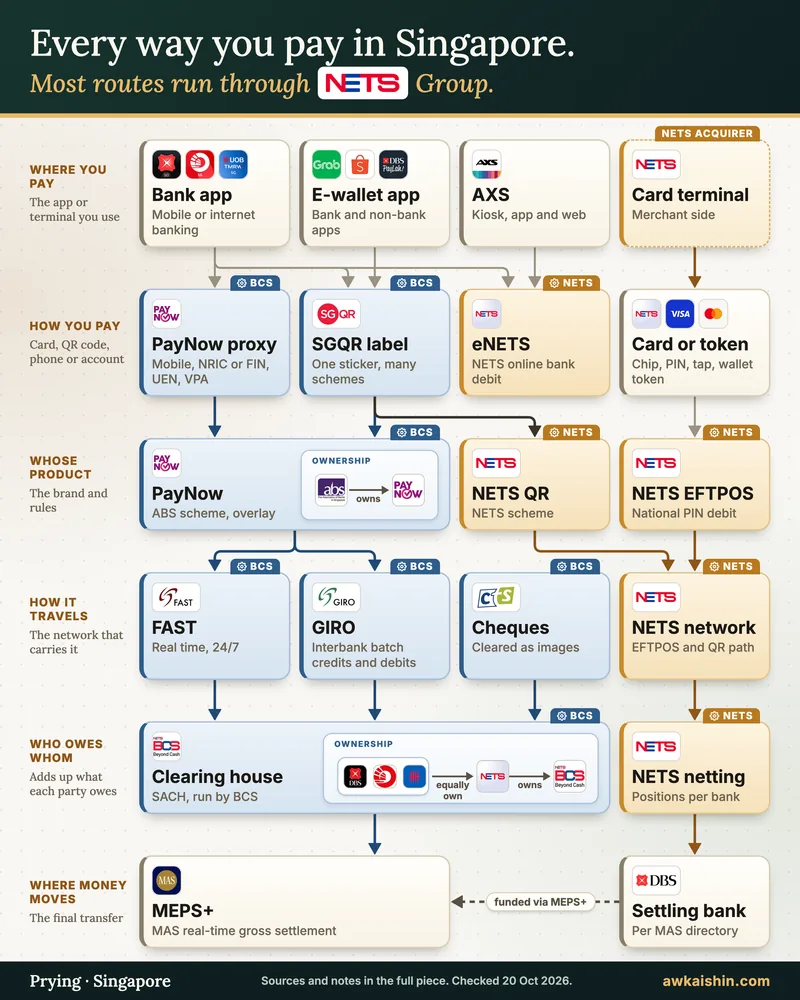
Diagram titled "Every way you pay in Singapore. Most routes run through NETS Group." Six rows run from where you pay down to where money moves, joined by arrows. Boxes run by NETS are amber and boxes run by BCS, a NETS Group subsidiary, are blue. Amber boxes are the card terminal, where NETS can be the acquirer, eNETS, NETS QR, NETS EFTPOS, the NETS network and NETS netting. Blue boxes are the PayNow proxy, the SGQR label, PayNow, FAST, GIRO, cheques and the clearing house. Grey boxes are the bank, e-wallet and AXS apps, card or token, MEPS+ and the settling bank, DBS. One box shows DBS, OCBC and UOB equally own NETS, which owns BCS. Another shows ABS owns PayNow. A dashed arrow runs from the settling bank to MEPS+, labelled funded via MEPS+.
Prying How money changes hands in Singapore: PayNow, FAST, GIRO, NETS and MEPS+
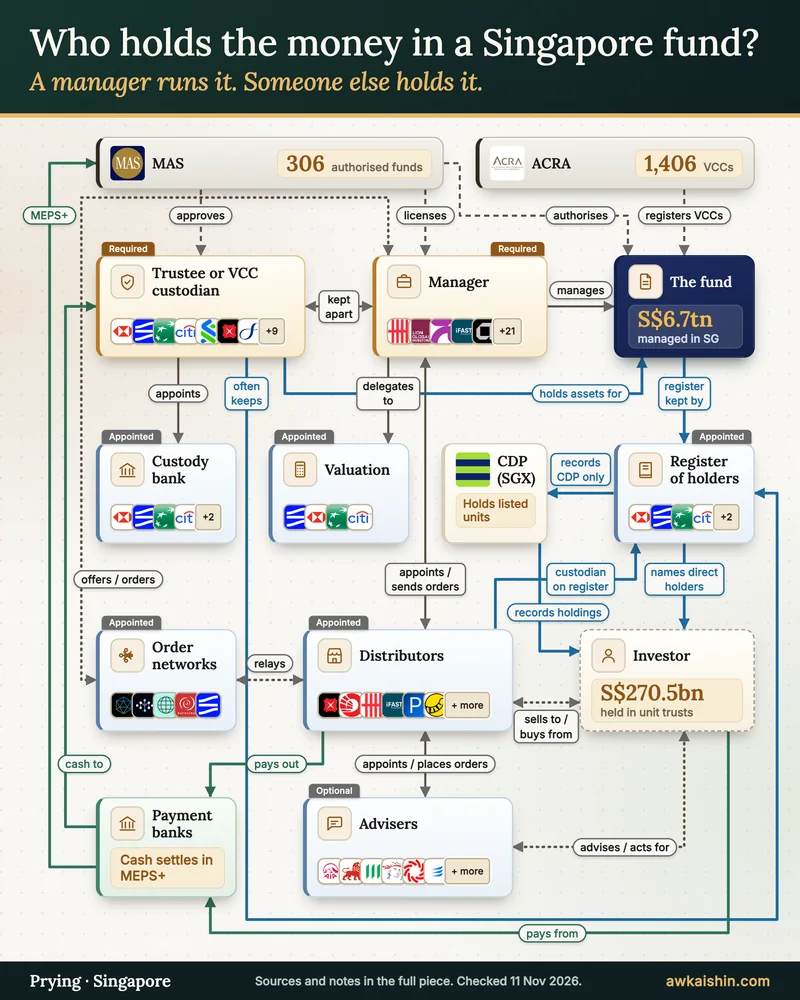
Diagram titled Who holds the money in a Singapore fund, with the line A manager runs it, someone else holds it. At the top are the regulators MAS, with 306 authorised funds, and ACRA, with 1,406 VCCs. Below them sit the trustee or VCC custodian and the manager, which are required roles kept apart from each other, and the fund itself, with S$6.7tn of assets managed in Singapore. The manager manages the fund and the trustee or custodian holds its assets. Appointed roles sit under them: a custody bank, valuation, CDP as the depository for listed fund units, and the register of holders. Further down are order networks, distributors, which sell to the investor, and the investor, with S$270.5bn held in unit trusts. Payment banks, where cash settles in MEPS+, and optional advisers sit at the bottom. Labelled lines show who licenses, appoints, delegates to, records for and pays whom. Logos show the main firms in each role, and the Distributors and Advisers lists are not complete.
Prying Who holds the money in a Singapore fund or yield product?
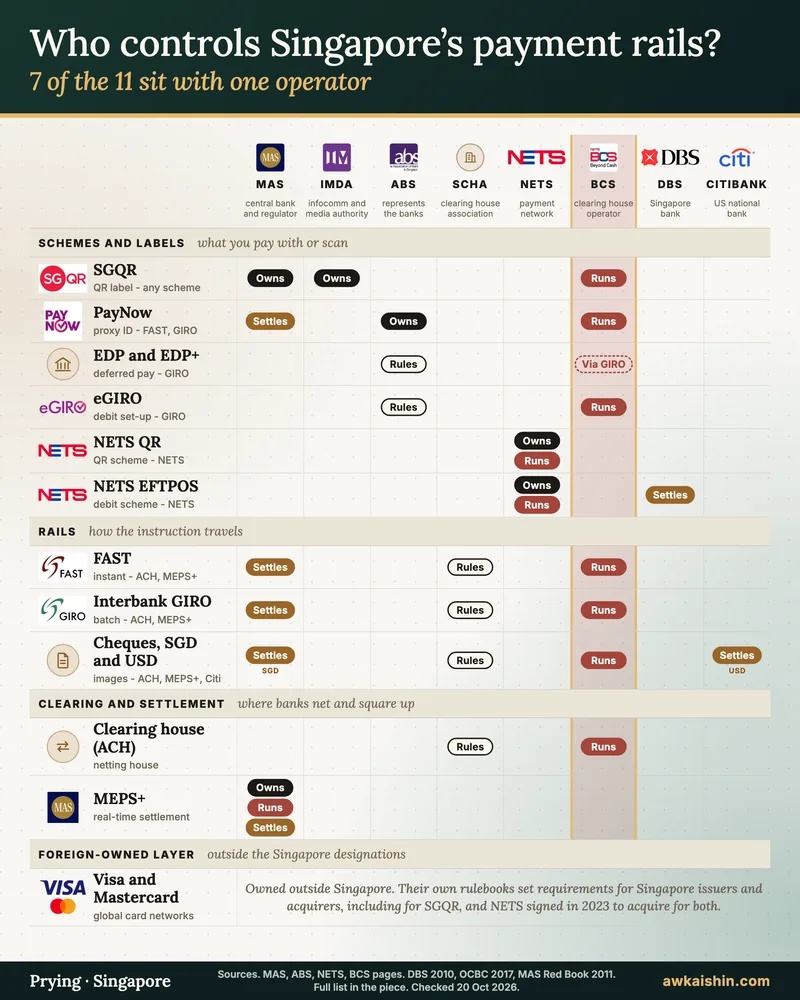
Grid titled Who controls Singapore's payment rails, with the subtitle 7 of the 11 sit with one operator. The columns are MAS, IMDA, ABS, SCHA, NETS, BCS, DBS and Citibank, with BCS highlighted. Each row is a scheme or rail and each pill shows a role: Owns, Rules for sets the rules, Runs or Settles. SGQR is owned by MAS and IMDA and run by BCS. PayNow is owned by ABS, settled by MAS and run by BCS. EDP and EDP+ have ABS setting the rules, and BCS shows Via GIRO. eGIRO has ABS setting the rules and BCS running it. NETS QR and NETS EFTPOS are owned and run by NETS, and DBS settles NETS EFTPOS. FAST and Interbank GIRO have SCHA setting the rules, BCS running them and MAS settling them. Cheques have SCHA setting the rules, BCS running them, MAS settling SGD and Citibank settling USD. The clearing house has SCHA setting the rules and BCS running it. MEPS+ is owned, run and settled by MAS. Visa and Mastercard are owned outside Singapore.
Prying Who owns and runs PayNow, FAST, GIRO and NETS in Singapore?
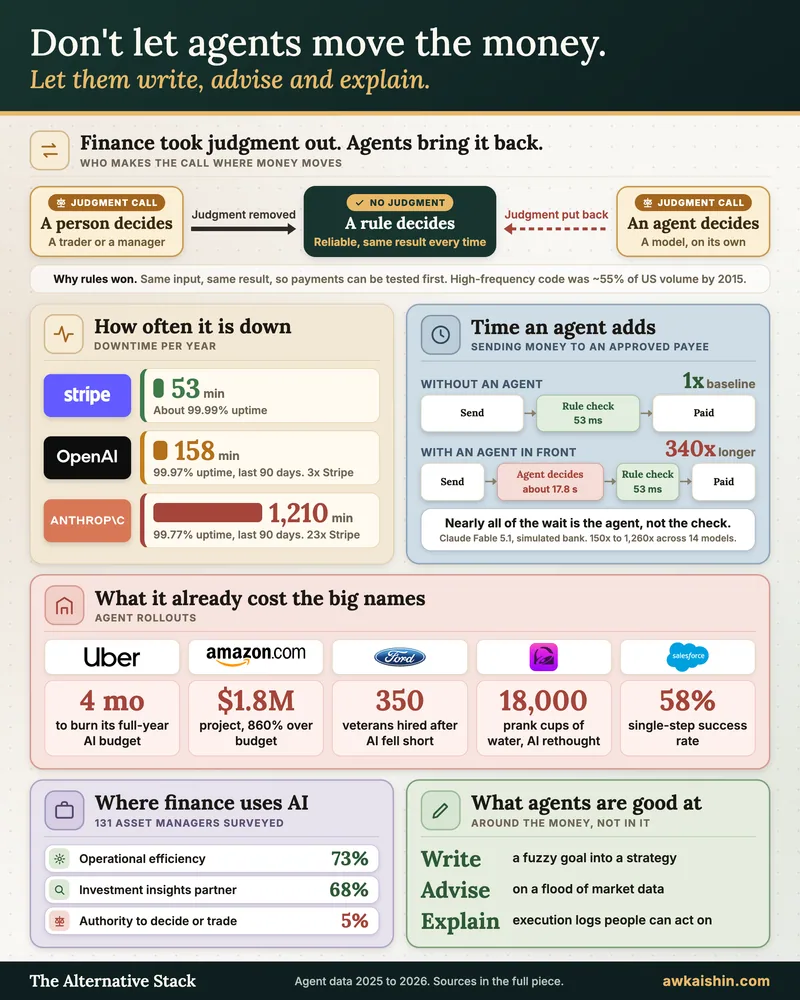
Infographic titled Don't let agents move the money. Let them write, advise and explain. Finance took judgment out and agents bring it back: a person's judgment call is removed in favour of a rule, which has no judgment and gives the same result every time, and an agent puts judgment back. How often it is down, per year: Stripe about 53 minutes (about 99.99% uptime), OpenAI 158 minutes (99.97%, last 90 days, 3x Stripe), Anthropic 1,210 minutes (99.77%, last 90 days, 23x Stripe). Time an agent adds when sending money to an approved payee: without an agent, send, a 53 millisecond rule check, paid, as the 1x baseline; with an agent in front, the agent decides in about 17.8 seconds before the same rule check, 340 times longer. Nearly all of the wait is the agent, not the check. Claude Fable 5.1 in a simulated bank, 150x to 1,260x across 14 models. What it already cost the big names: Uber used its full-year AI budget in 4 months, an Amazon project cost $1.8 million and ran 860% over budget, Ford hired 350 veterans after AI fell short, Taco Bell saw 18,000 cups of water in one prank order and rethought voice AI, and a Salesforce study found a 58% single-step success rate. Where finance uses AI, from 131 asset managers: 73% operational efficiency, 68% investment insights partner, 5% authority to decide or trade. What agents are good at, around the money and not in it: write a fuzzy goal into a strategy, advise on a flood of market data, explain execution logs people can act on.
Writing Agentic finance is a dead end
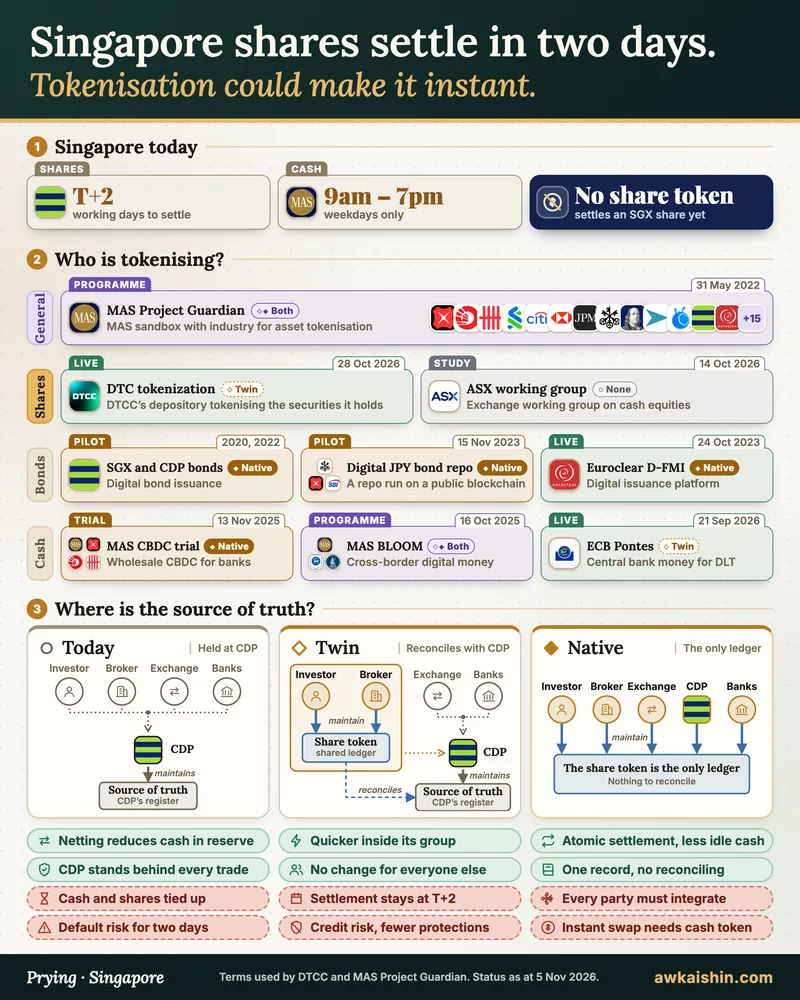
Infographic on tokenised shares in Singapore. Shares settle in two working days (T+2) and Singapore dollars settle only on weekdays from 9am to 7pm, and no share token yet settles an SGX share. Initiatives are grouped as general, shares, bonds and cash, each marked twin, native, both or none. MAS Project Guardian, launched 31 May 2022, is the general programme, with 28 industry group members. For shares, DTC tokenization went live on 28 Oct 2026 as a twin and an ASX working group is studying cash equities. For bonds, SGX and CDP piloted digital bonds in 2020 and 2022, a digital JPY bond repo ran in November 2023 and Euroclear D-FMI went live in October 2023, all native. For cash, the MAS wholesale CBDC trial finished in November 2025 as a native, MAS BLOOM is both and ECB Pontes went live on 21 Sep 2026 as a twin. Three diagrams ask where the source of truth sits. Today it is CDP's register. A twin keeps CDP's register and reconciles a shared ledger with it, with gains of quicker transfers inside its group and no change for everyone else, and costs of settlement staying at T+2 and credit risk with fewer protections. A native makes the share token the only ledger, with gains of atomic settlement and one record with no reconciling, and costs of every party having to integrate and an instant swap needing a cash token.
Prying Tokenised shares in Singapore: Faster settlement, new risks, what changes
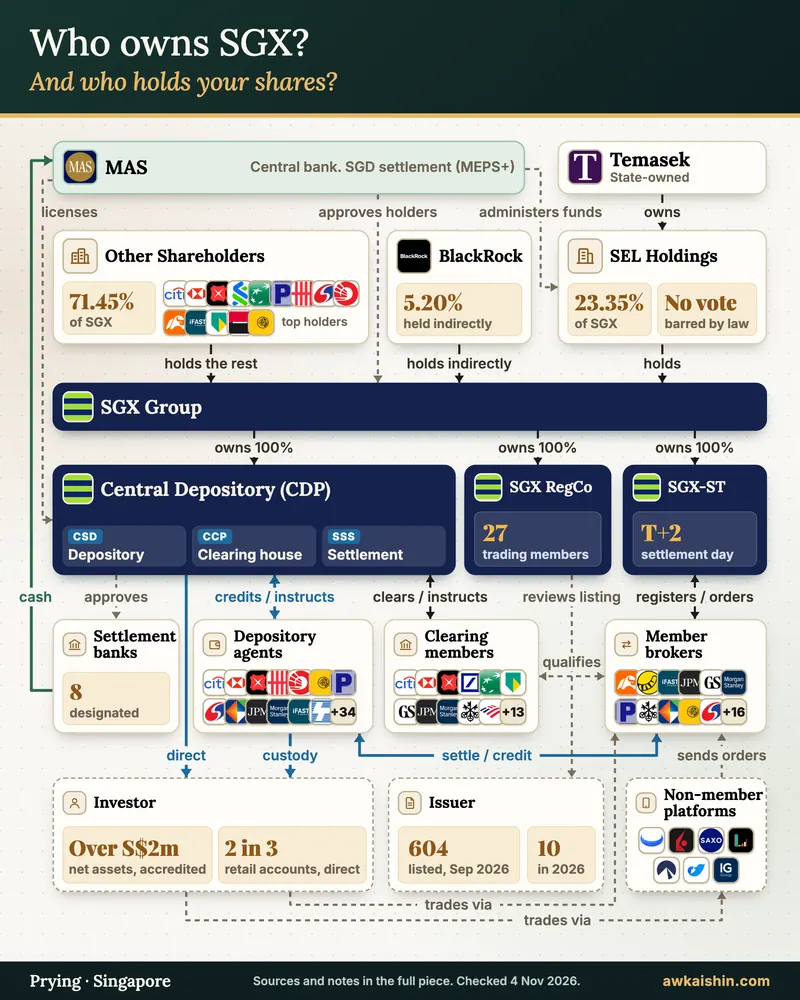
Chain diagram of who owns SGX and who holds Singapore shares. At the top, MAS, the central bank, which settles Singapore dollars through MEPS+, and Temasek, which is state-owned. Temasek owns SEL Holdings, which holds 23.35% of SGX and has no vote, barred by law. Other shareholders, mostly bank nominee companies such as Citibank, HSBC, DBS, Standard Chartered and BNP Paribas, hold the rest at 71.45%. BlackRock holds 5.20% indirectly. All of this sits in SGX Group, which owns 100% of three subsidiaries: the Central Depository (CDP), SGX RegCo, with 27 trading members, and SGX-ST, where trades settle at T+2. Below CDP are settlement banks, depository agents, clearing members and member brokers, each with a strip of bank and broker logos, then the investor, the issuer and non-member trading platforms. Blue arrows show shares moving. An investor either holds directly in an account at CDP, which is the case for 2 in 3 retail accounts, or through a broker's custody account. Over S$2m in net assets counts as accredited. 604 securities were listed in September 2026 and 10 in 2026.
Prying Who owns SGX and who holds your shares: CDP or brokerages?
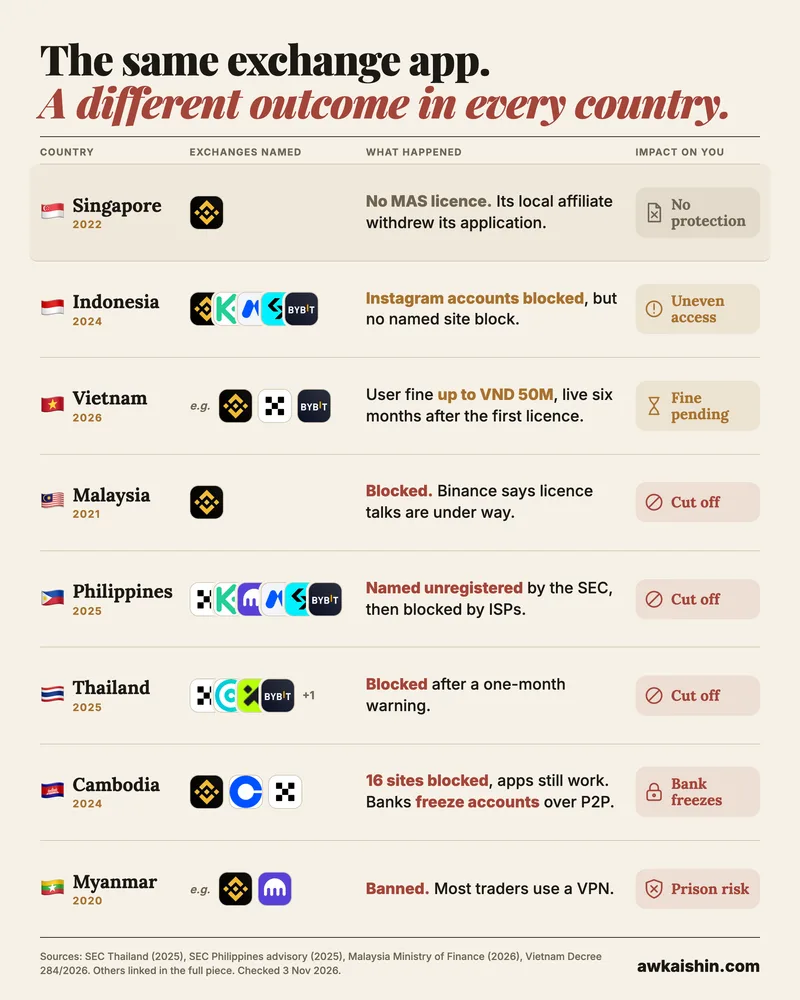
Table of eight ASEAN countries showing what regulators did about offshore crypto exchanges and the impact on users, with exchange logos for each. Singapore: Binance has no MAS licence and its local affiliate withdrew its application in 2022, so users have no protection. Indonesia: the Instagram accounts of Binance, Bybit, Bitget, KuCoin and MEXC were blocked in 2024 but no named site block, so access is uneven. Vietnam: a user fine of up to 50 million dong is law but starts six months after the first exchange licence. Malaysia: Binance blocked since 2021. Philippines: six exchanges named unregistered by the SEC in 2025 then blocked by internet providers. Thailand: Bybit, OKX and three others blocked in 2025 after a one-month warning. Cambodia: 16 exchange sites blocked in 2024 while apps still work, and banks freeze accounts over peer-to-peer trades. Myanmar: trading banned since 2020 with prison risk, though most traders use a VPN.
Prying Mapping ASEAN's crypto scene
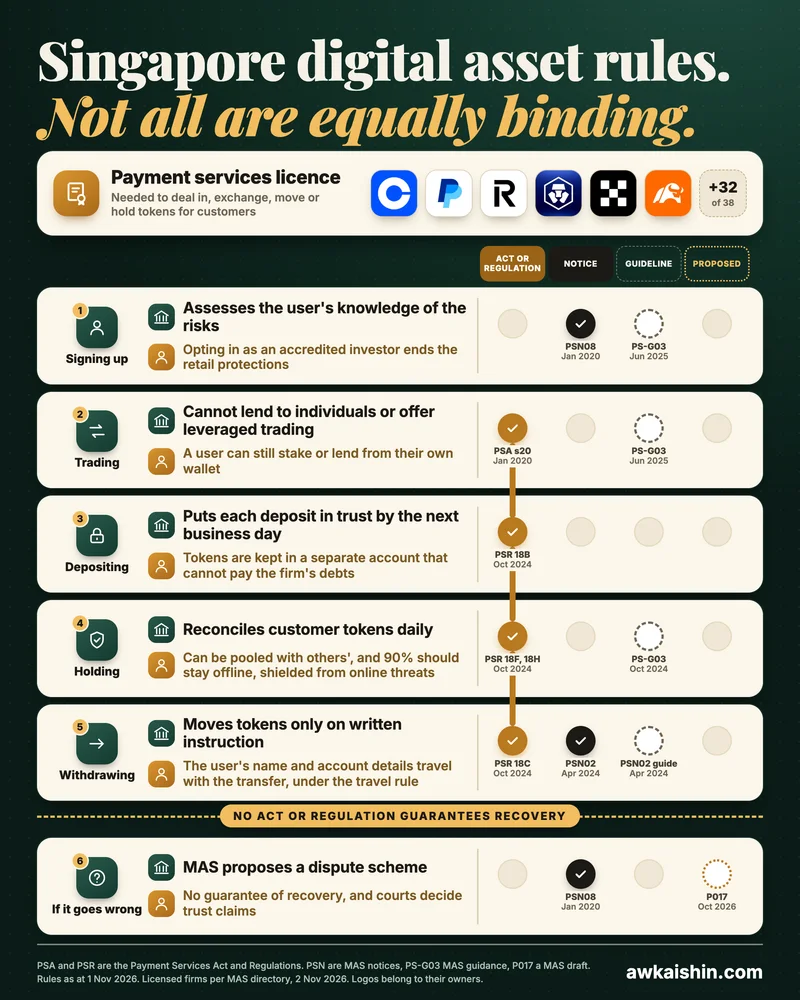
Infographic on the rules for a Singapore firm with a payment services licence, which 38 firms hold, among them Coinbase, PayPal, Revolut, Crypto.com, OKX and moomoo. Six steps from sign-up to a dispute are marked by how firmly each rule is written, as an Act or regulation, a MAS notice, a MAS guideline or a proposal. Signing up rests on a MAS notice from January 2020 and a guideline from June 2025. Trading rests on the Payment Services Act ban on credit to individuals from January 2020 and a guideline. Depositing, holding and withdrawing rest on the Payment Services Regulations from October 2024, joined at withdrawal by a MAS notice and guidance from April 2024 on the travel rule. No Act or regulation guarantees recovery if a firm fails. MAS has a notice warning that a licence is not a guarantee and proposes a dispute scheme from October 2026.
Prying Singapore digital asset regulation: Which rules apply to which activity
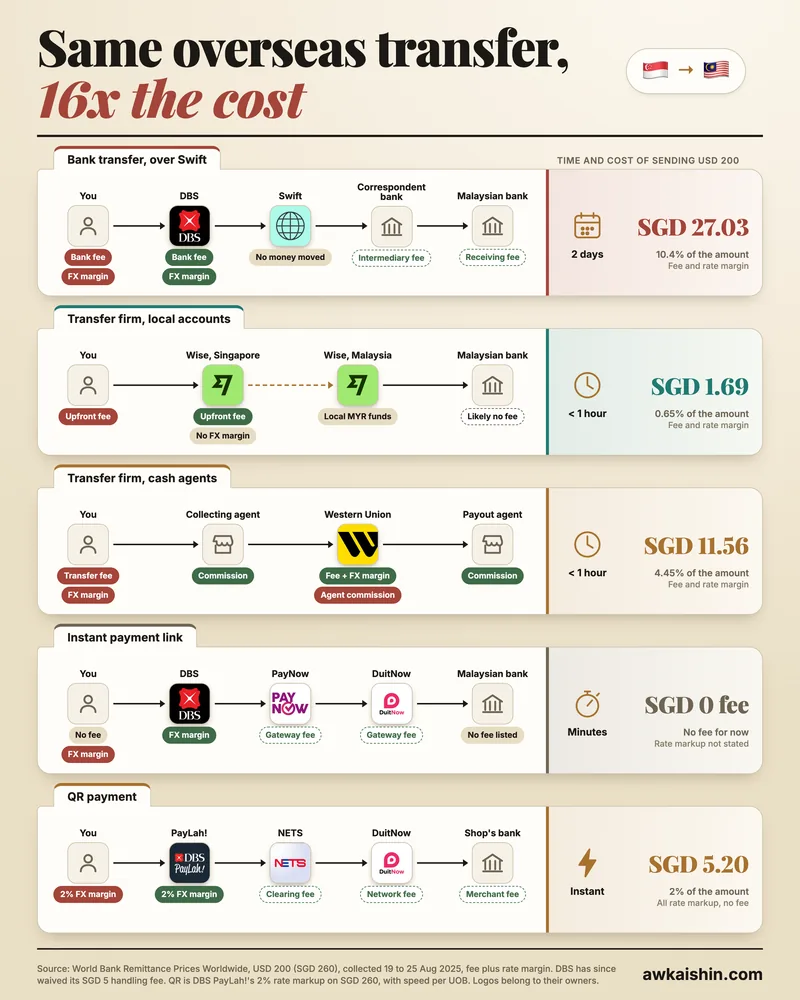
Infographic on the cost and time of sending USD 200 (SGD 260) from Singapore to Malaysia on five routes. A DBS bank transfer over Swift takes 2 days and costs SGD 27.03, or 10.4% of the amount. Wise, with local accounts, takes under 1 hour and costs SGD 1.69, or 0.65%. Western Union, through cash agents, takes under 1 hour and costs SGD 11.56, or 4.45%. A PayNow to DuitNow instant payment link takes minutes with no fee for now. A DBS PayLah! DuitNow QR payment is instant and costs SGD 5.20, a 2% rate markup. Each route shows who is in the flow and what each party pays or earns.
Prying Sending money overseas from Singapore: Banks, Wise, PayNow and QR payments
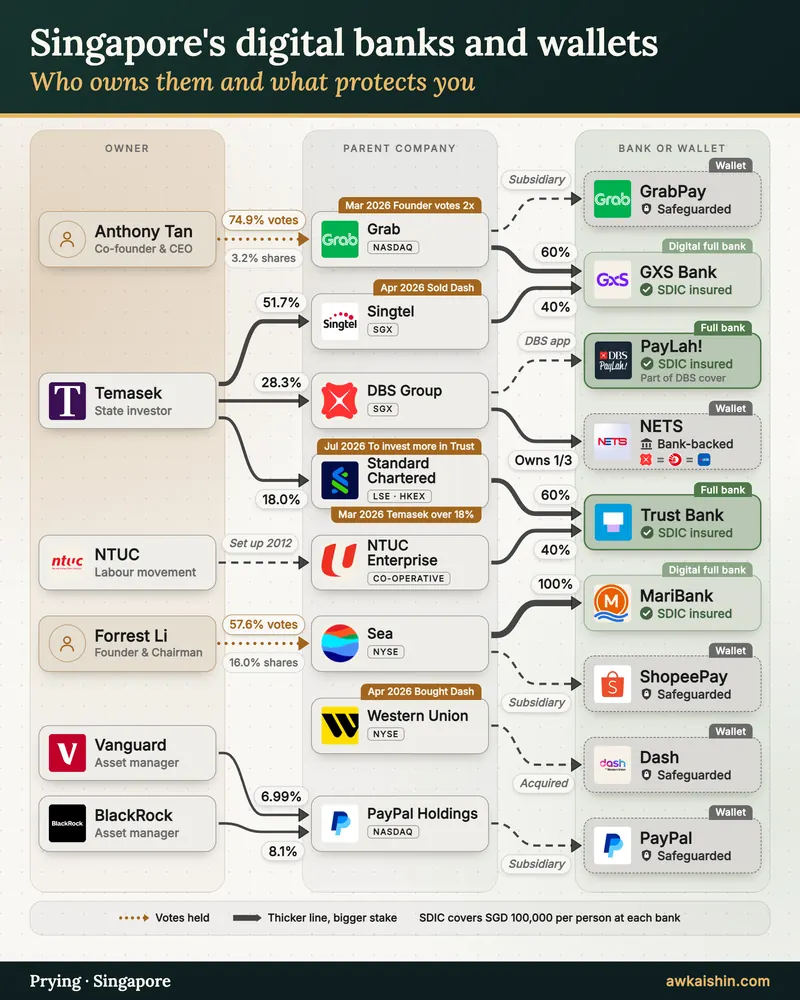
Infographic tracing who owns Singapore’s digital banks and e-wallets. Owners such as Temasek, Vanguard, BlackRock, NTUC and the Grab and Sea founders sit on the left, their parent companies in the middle, and GXS, MariBank, Trust, PayLah!, GrabPay, ShopeePay, Dash, NETS and PayPal on the right, with a tick for SDIC deposit insurance on the banks and a shield for safeguarded wallet money.
Prying Who owns Singapore’s digital banks and wallets, and what protects you
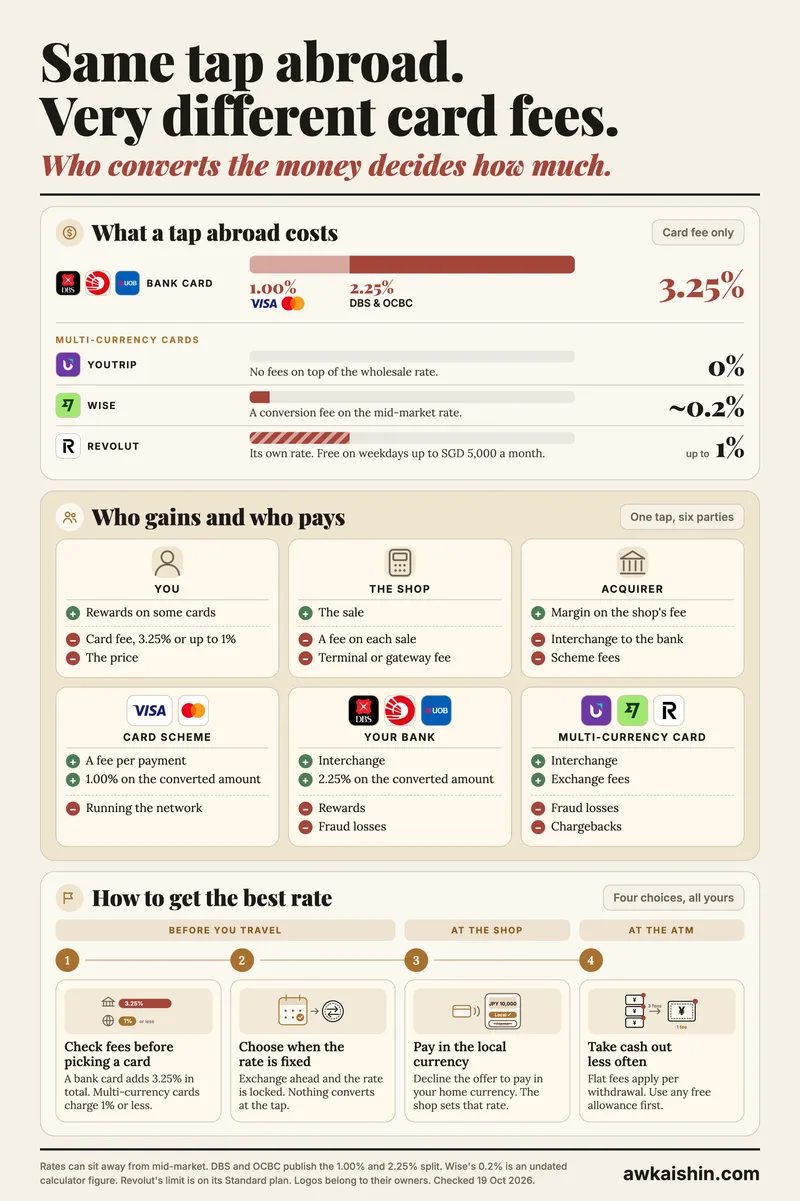
Infographic on what a card costs when you tap abroad from Singapore. It shows the card fee on DBS, OCBC and UOB bank cards split between the card scheme and the bank, compared with YouTrip, Wise and Revolut multi-currency cards, then who gains and who pays among six parties, and four choices that get a better rate.
Prying Why your card costs more abroad
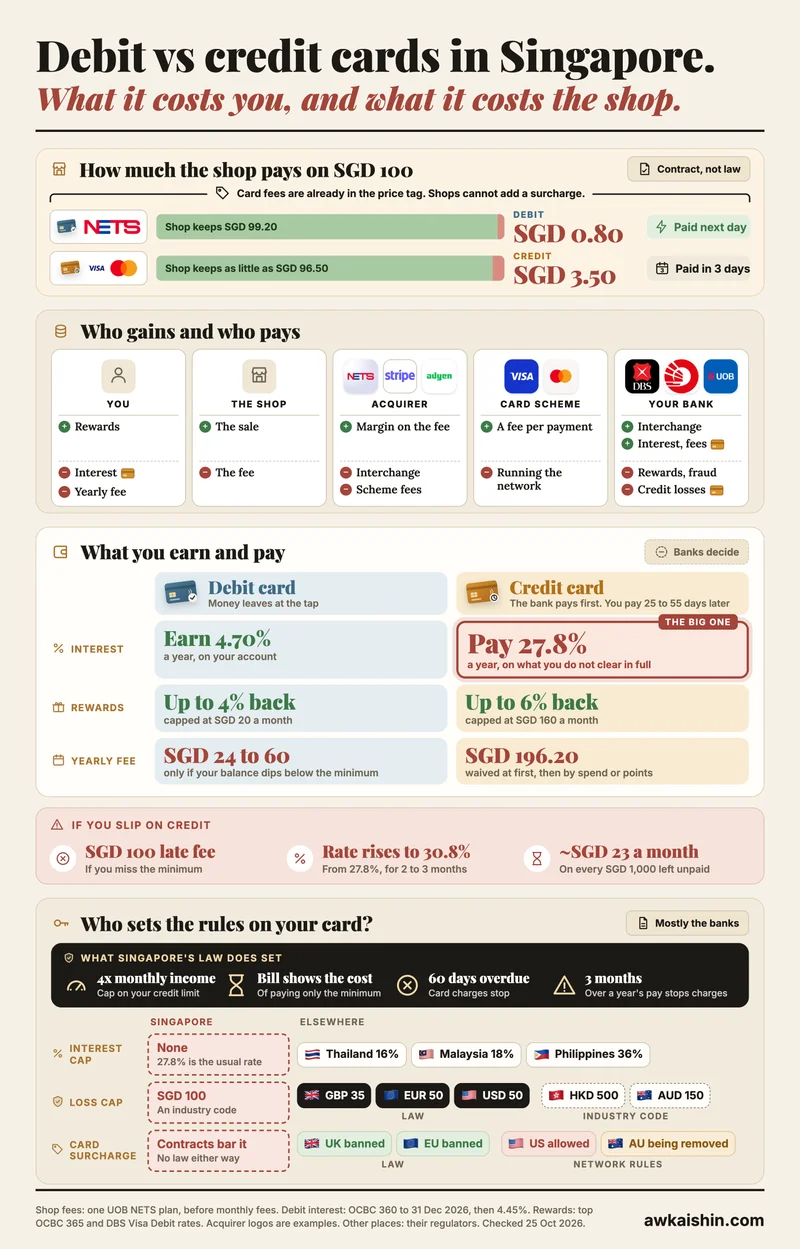
Infographic comparing debit and credit cards in Singapore. It shows what the shop pays on a SGD 100 sale and when it is paid, who gains and who pays among the cardholder, shop, acquirer, card scheme and issuing bank, what a cardholder earns and pays in interest, rewards and yearly fees, the cost of missing a credit card payment, and which card rules are set by Singapore law, an industry code or contract compared with Thailand, Malaysia, the Philippines, the UK, the EU, the US, Hong Kong and Australia.
Prying Debit vs credit card in Singapore: What you pay, what shops pay
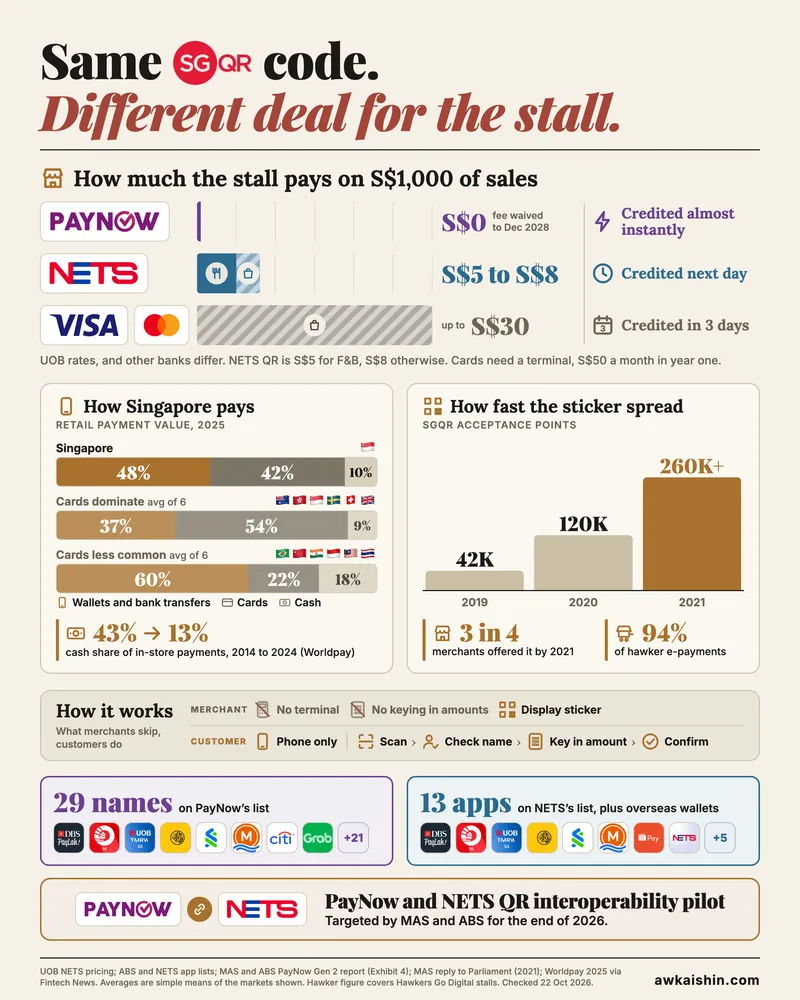
Infographic on Singapore's SGQR sticker comparing PayNow, NETS QR and cards for a stall, with what each costs on S$1,000 of sales and when the stall is credited, how the work moves from merchant to customer, how Singapore pays, how fast the sticker spread, and which apps sit on the PayNow and NETS lists before the planned interoperability pilot.
Prying Why can’t every app scan every QR code? Singapore’s PayNow vs NETS QR
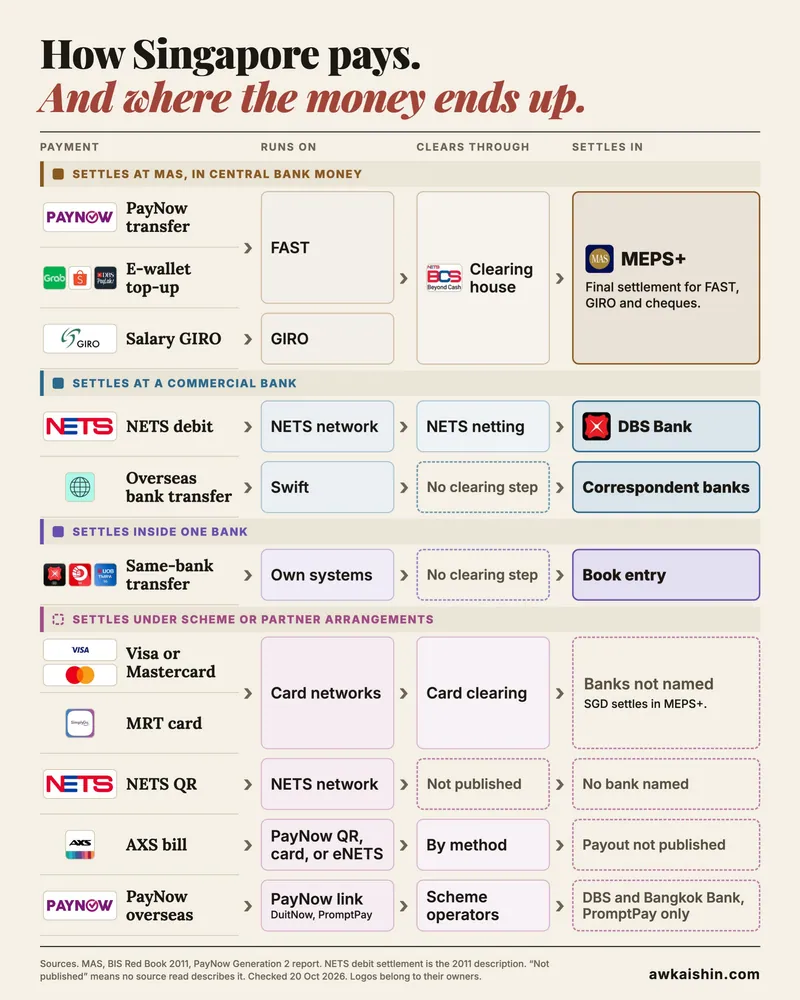
Table of Singapore payment types showing what each one runs on, how it clears and where it settles, grouped by settlement at MAS in central bank money, at a commercial bank, inside one bank, or under scheme or partner arrangements. 7 slides
Prying How money changes hands in Singapore: PayNow, FAST, GIRO, NETS and MEPS+
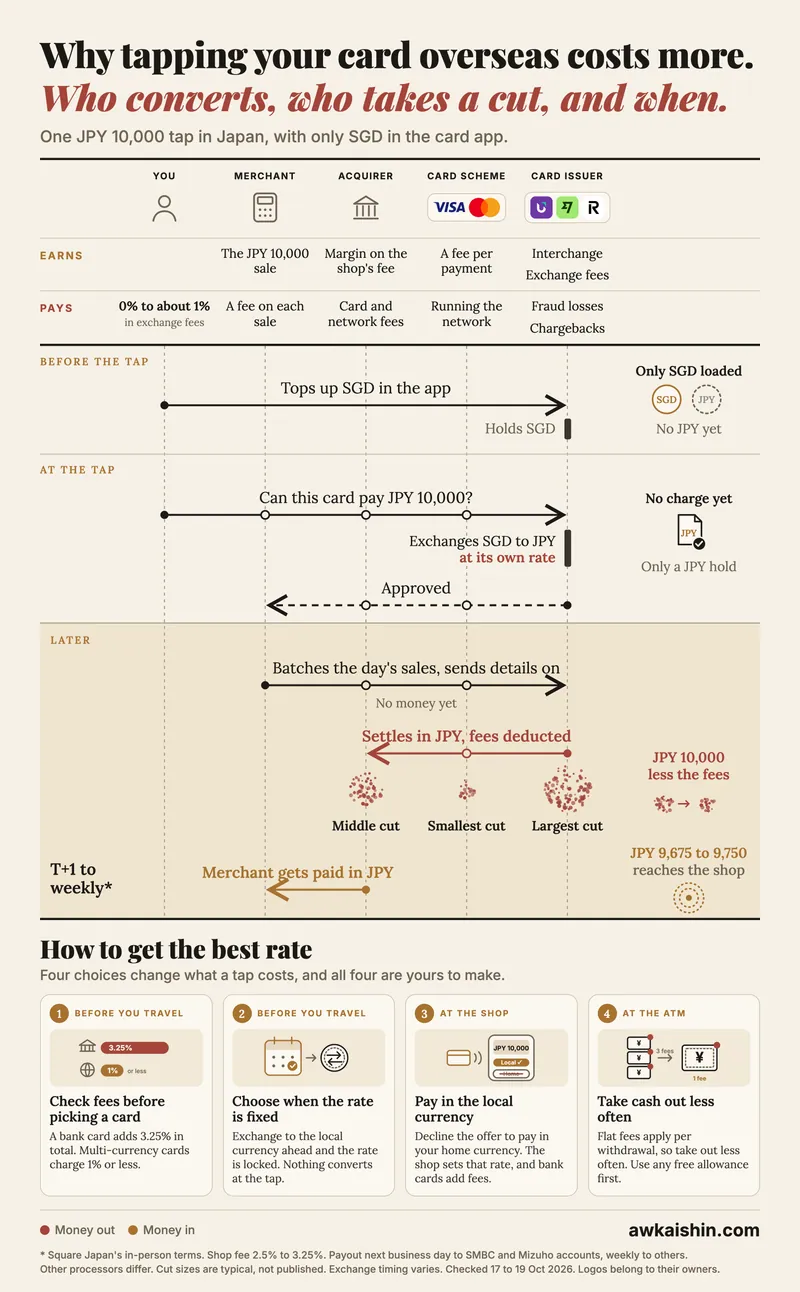
Timeline of a Singapore dollar card tap in Japan, showing where the currency is converted, who takes a cut at each step, and four ways to get the best rate.
Prying Why your card costs more abroad
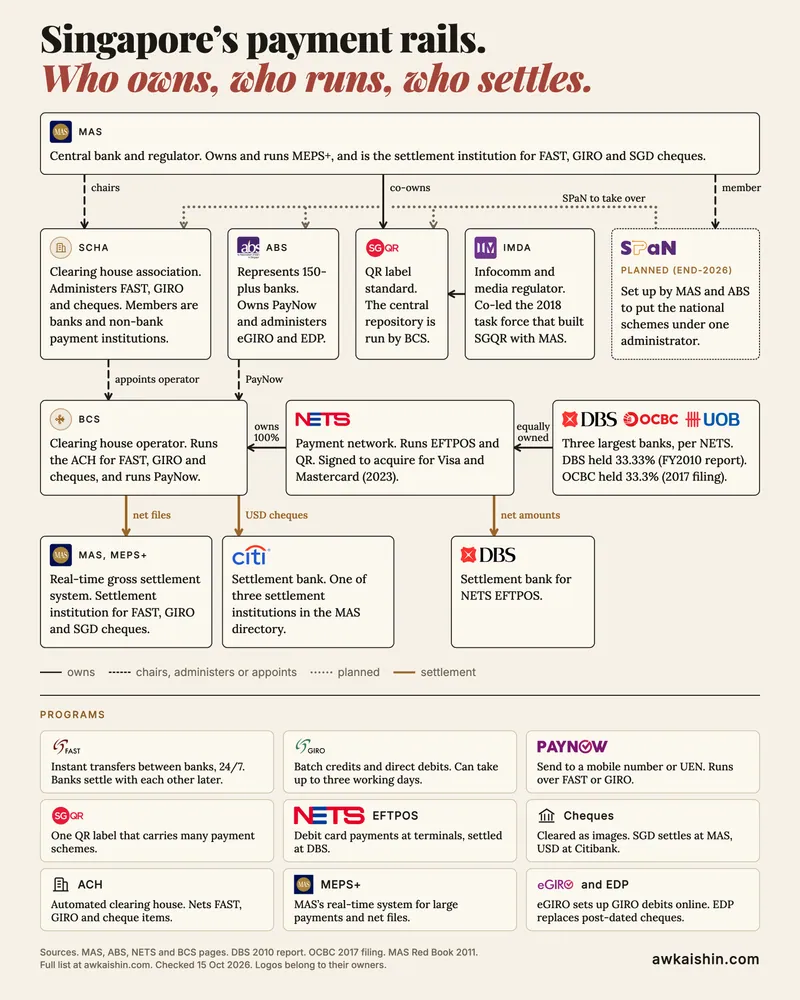
Diagram of the bodies behind Singapore payment rails, showing MAS, the clearing house association, NETS, BCS and the three banks that own NETS.
Prying Who owns and runs PayNow, FAST, GIRO and NETS in Singapore?
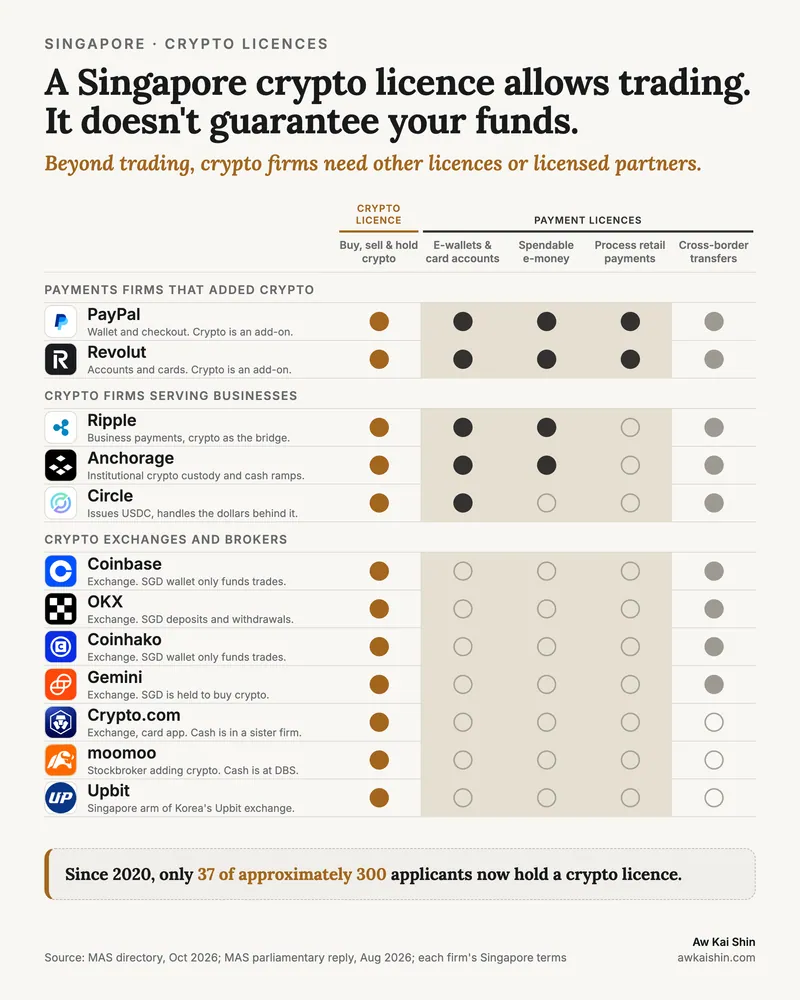
Matrix of Singapore crypto firms against what their licences cover: buying and selling crypto, e-wallets, spendable e-money, retail payments and cross-border transfers.
Prying Singapore's crypto industry: The cost of getting in
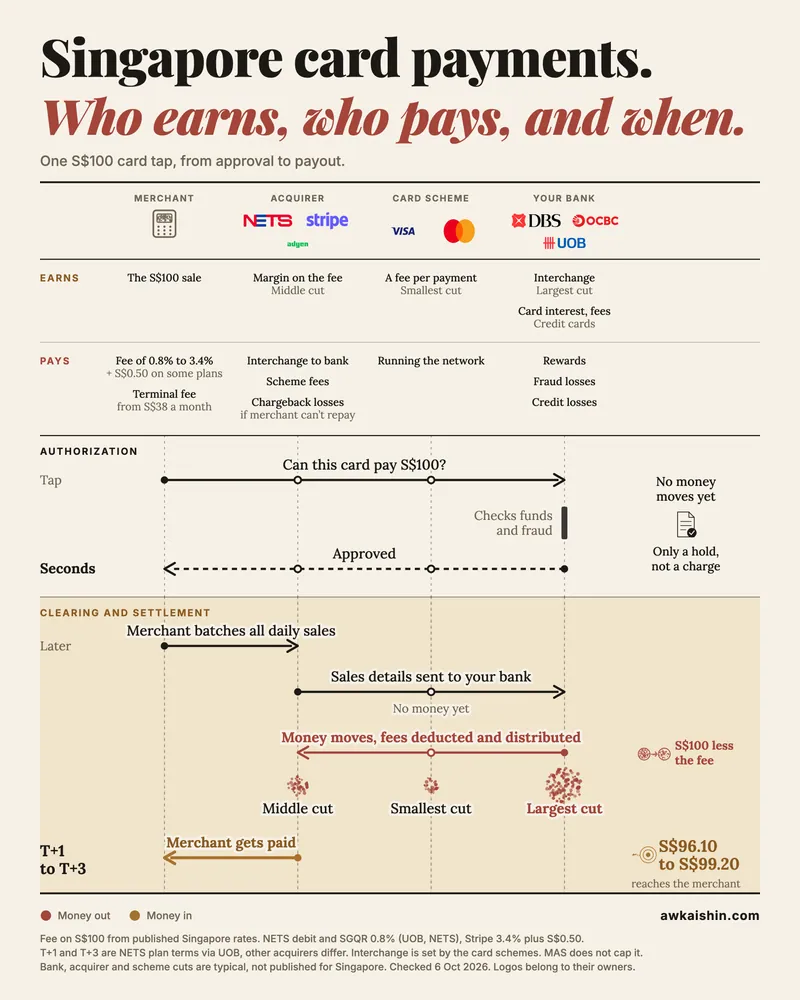
Sequence diagram of a 100 Singapore dollar card tap from approval to payout, showing the fee each party takes and how long the merchant waits.
Prying Why your card costs more abroad
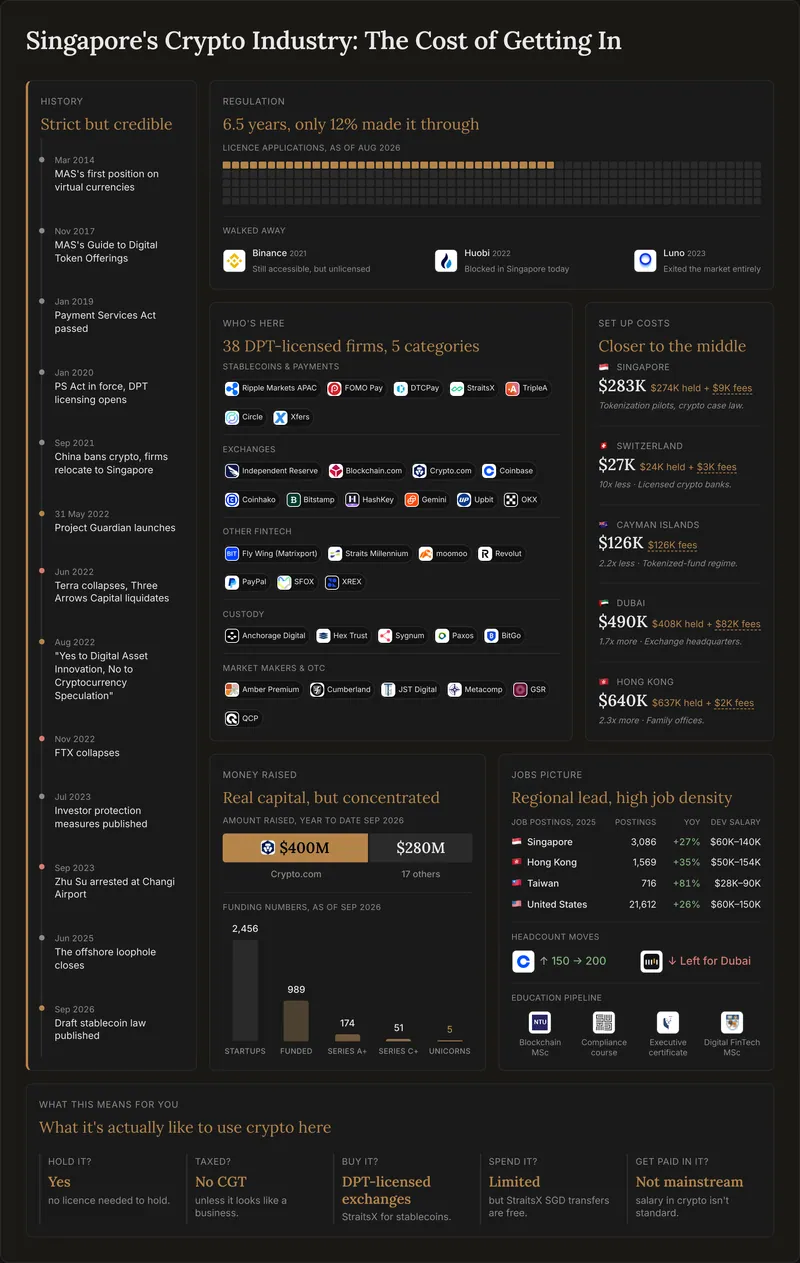
Tall poster covering Singapore crypto licensing history, who holds a licence, set-up costs against other hubs, funding and jobs, and what it means for a user.
Prying Singapore's crypto industry: The cost of getting in
Animated network of DeFi curators and their backers, highlighting one pattern at a time, such as shared investors on both sides of a protocol.
Prying Who's bankrolling the curators?
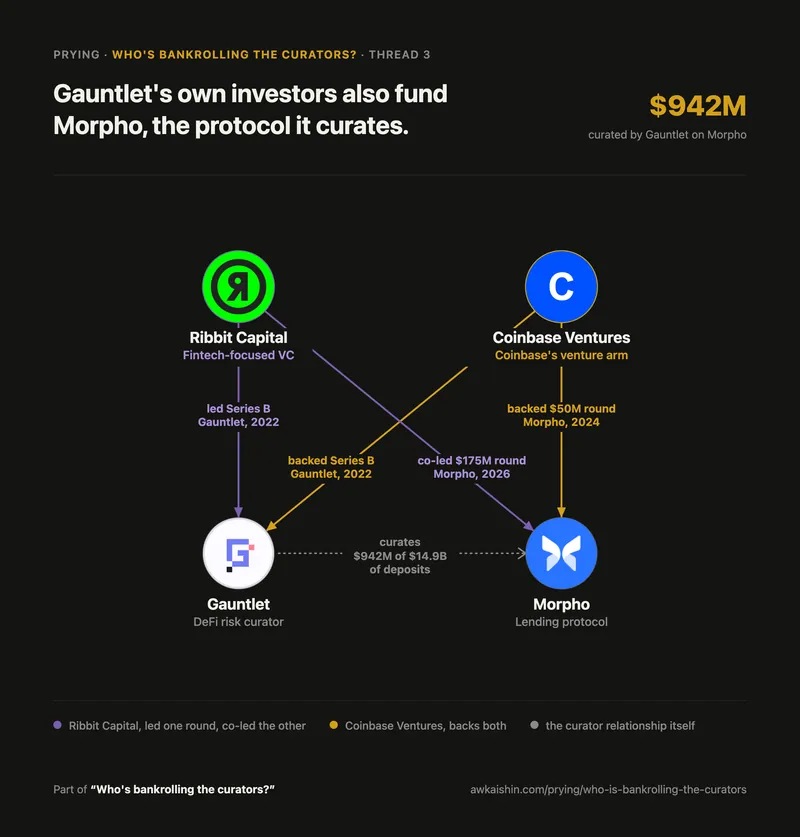
Diagram linking Ribbit Capital and Coinbase Ventures to both Gauntlet and Morpho, with the 942 million dollars Gauntlet curates on Morpho.
Prying Who's bankrolling the curators?
Animated network of issuers, custodians, banks and venture firms, highlighting one connection at a time to show the same names behind most tokenized assets.
Prying Who controls tokenized RWAs?
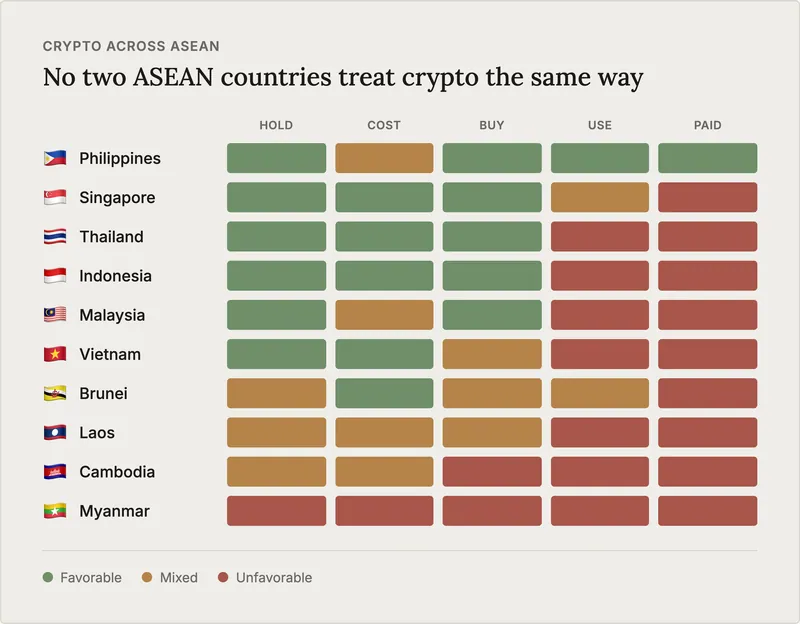
Heatmap of ten ASEAN countries scored favorable, mixed or unfavorable on holding, cost, buying, using and paying with crypto.
Prying Mapping ASEAN's crypto scene
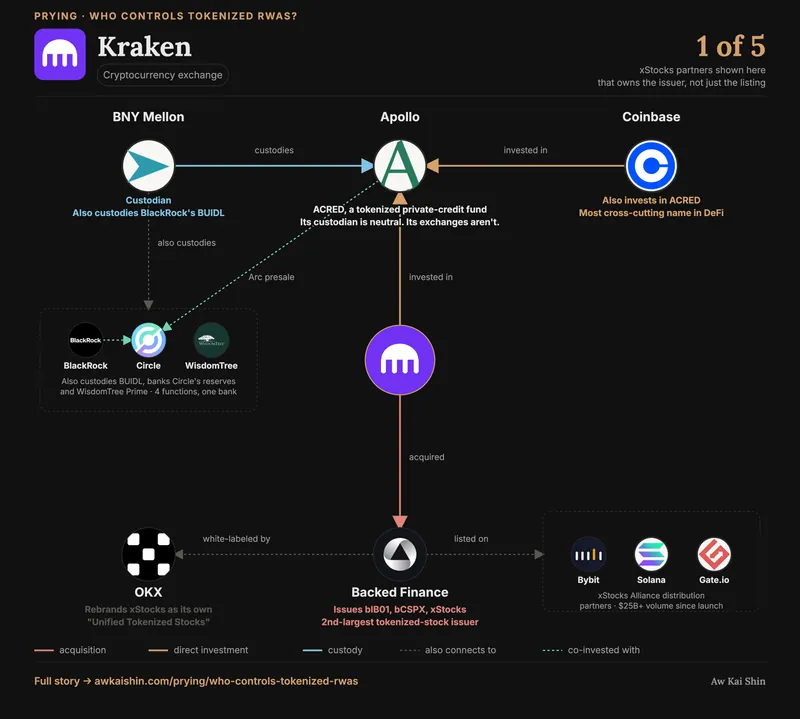
Diagram of Kraken acquiring Backed Finance, the second-largest tokenized stock issuer, with BNY Mellon custody, Apollo and Coinbase investment links, OKX white-labeling the xStocks, and Bybit, Solana and Gate.io as distribution partners.
Prying Who controls tokenized RWAs?
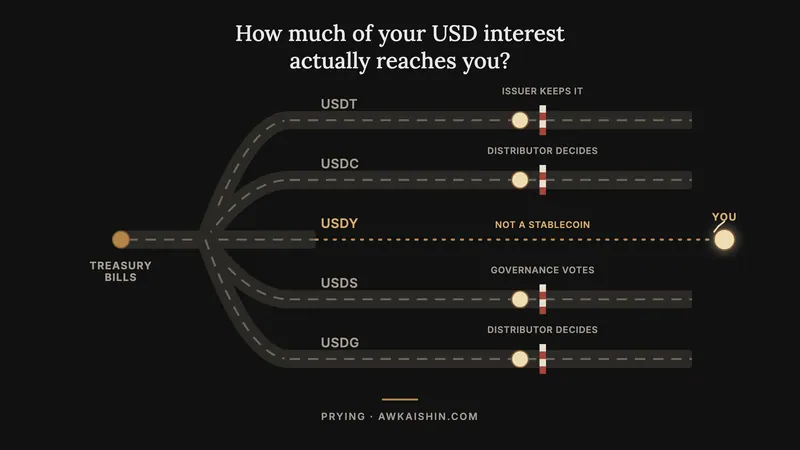
Route map from Treasury bills through five stablecoins, with a stop on each route showing who keeps the interest before it reaches you.
Prying Stablecoins: Who captures your yields?
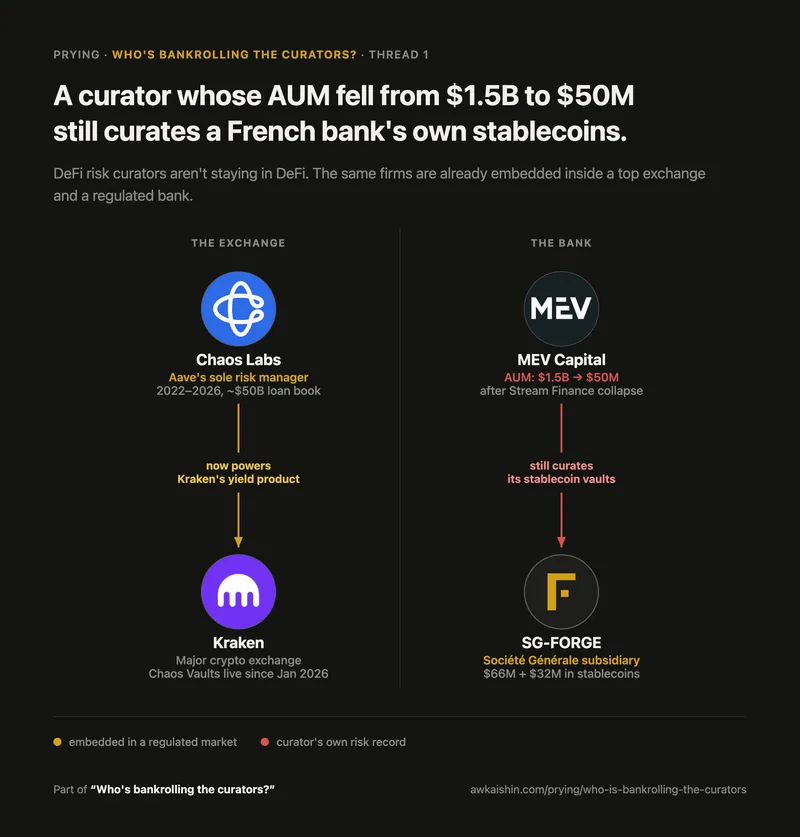
Two columns: Chaos Labs, formerly Aave's risk manager, now behind Kraken's yield product, and MEV Capital, whose AUM fell from 1.5 billion to 50 million dollars, still curating a Societe Generale subsidiary's stablecoin vaults.
Prying Who's bankrolling the curators?
Animated character-select screen comparing a human, an AI agent and deterministic code on reliability, speed, judgment, insight, security and protection.
Writing Agentic finance is a dead end
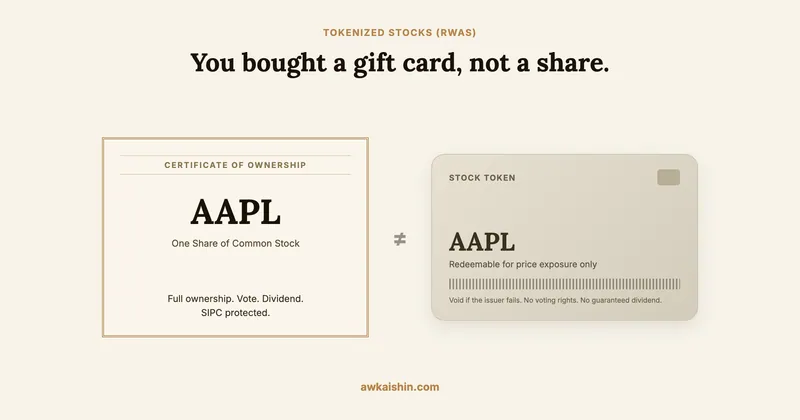
A share certificate with voting rights and dividends next to a tokenized stock shown as a gift card that is only redeemable for price exposure.
Writing The RWA stack
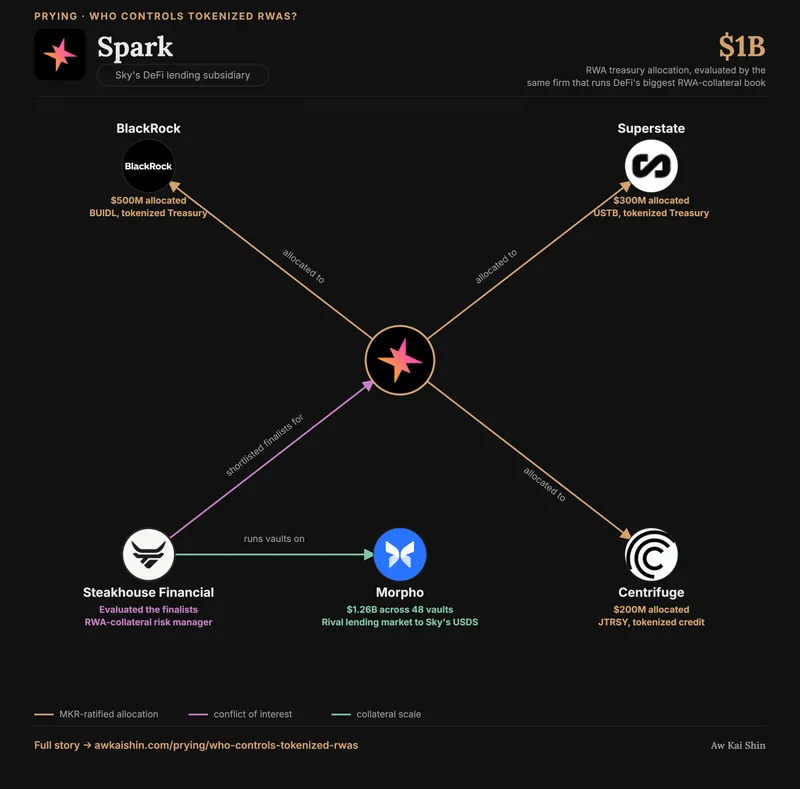
Diagram of Spark allocating 500 million dollars to BlackRock BUIDL, 300 million to Superstate USTB and 200 million to Centrifuge JTRSY, with Steakhouse Financial both shortlisting the finalists and running vaults on rival lending market Morpho.
Prying Who controls tokenized RWAs?
Animated slider dragging leverage from 1x to 200x and showing what holding a 10,000 dollar position for 30 days costs at eight brokerage, perpetual and DeFi venues.
Prying TradFi vs DeFi leverage: 2x by law, 200x by code
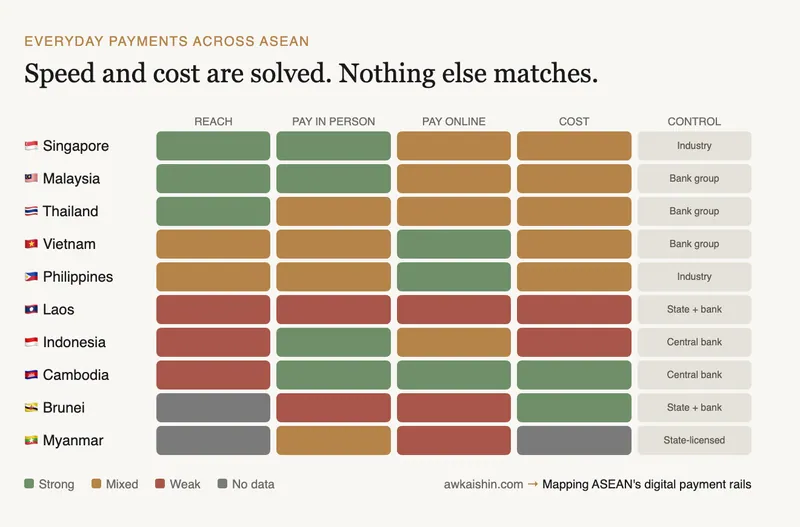
Heatmap of ten ASEAN countries scored on reach, paying in person, paying online, cost and who controls the domestic payment rail.
Prying Mapping ASEAN's digital payment rails
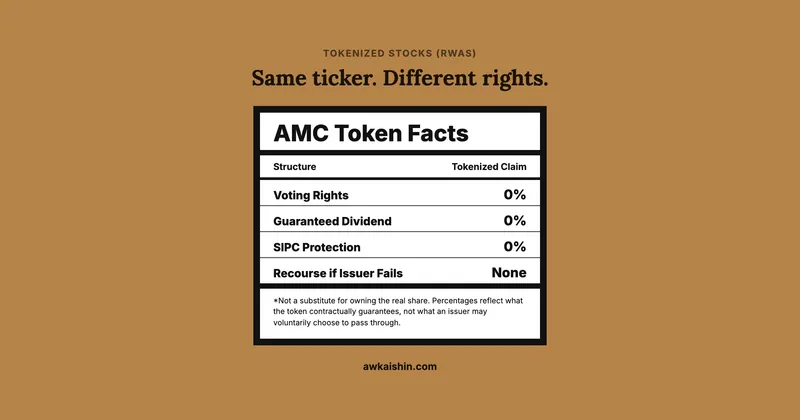
A nutrition-label style panel for a tokenized AMC stock listing voting rights, guaranteed dividend and SIPC protection at 0 percent, and no recourse if the issuer fails.
Writing The RWA stack
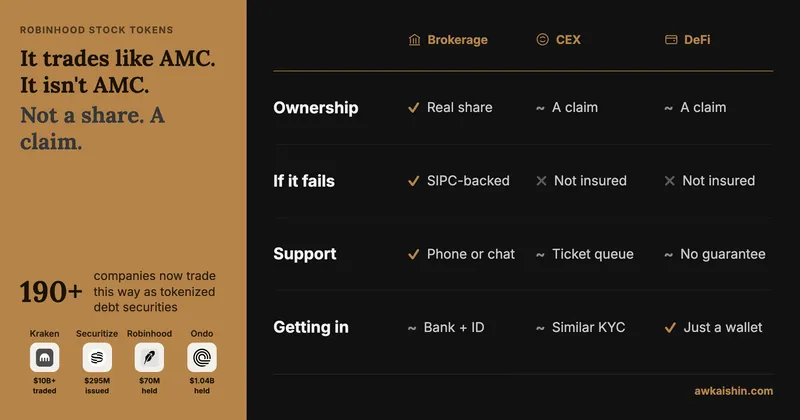
Comparison of owning a stock through a brokerage, a centralized exchange and self-custody DeFi, covering ownership, what happens if it fails, support and how you get in.
Writing The RWA stack