As the Web3 space continues to grow, contextualising the various technologies has become an increasingly demanding task. In this series of articles, we will start with a high level overview of the various concepts and eventually arrive at the use cases which various Web3 protocols are trying to solve.
This article focuses on the various assets which acts as unit-of-account that answers the question of what is being traded/transferred. The articles are divided into 3 levels of increasing detail:
L1 — Overview
An overview of the different layers and how they enable Web3 functionality through building on top of each other:
L2 — Concepts
The key concepts within each layer that informs business and technical decisions. This highlights the different categories of Web3 technologies:
L3 — Implementations
Understanding the difference between various protocol/standard implementations and how they relate to each other. The focus will be on Web3 lego blocks and its affects on value flows:
- Transaction Settlement
- Assets
- Web3 Primitives
- Optimisers (WIP)
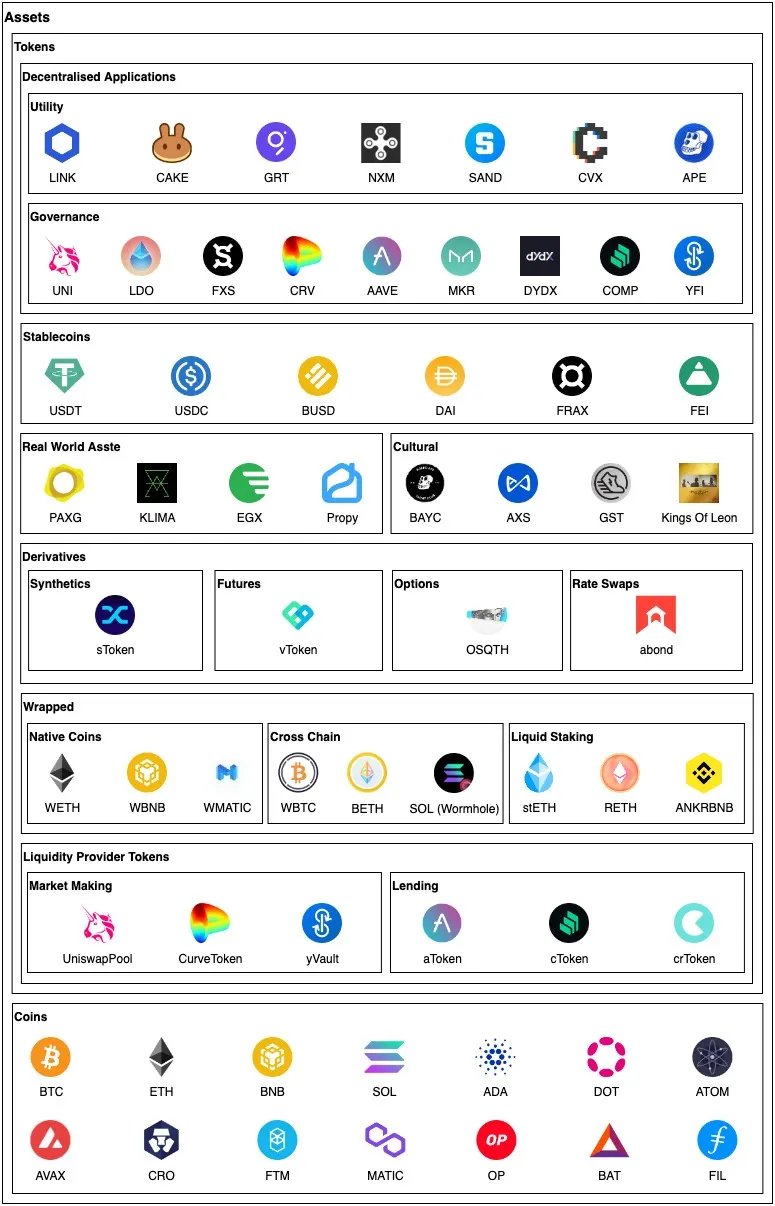
Coins
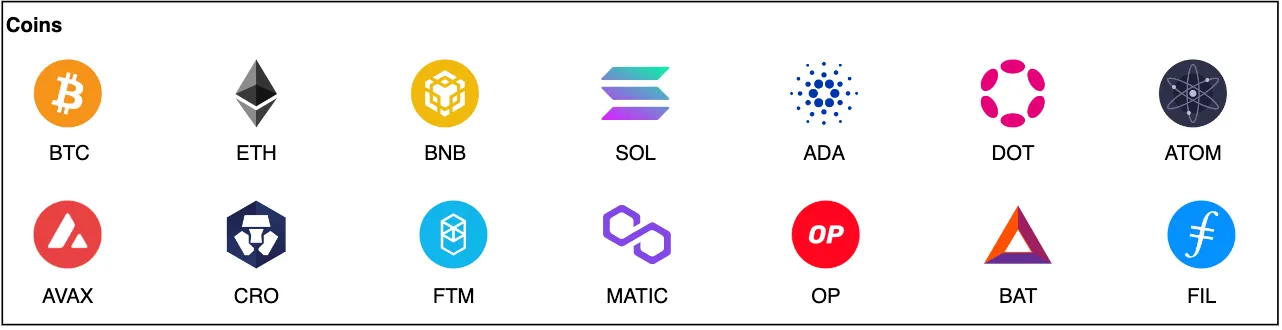
The native asset on a particular blockchain. Coins function as economic incentives for transaction settlement security on a chain. In other words, coins are a prerequisite to participating in any on-chain actions as any transaction requires the corresponding coin amount to be paid to the network as a processing fee. The simplest method for identifying a coin is to check the asset used as a transaction/gas fee on the network.
The blockchain protocol defines the supply curve of coins as well as conditions for burning existing coins. As coins are key to coordinating settlement at the transaction layer, their value is closely tied with the performance and reliability of the chain.
Of note, coins will have different use cases based on the design of the chain. While the majority of coins are used for fuelling general smart contract logic, there are coins which are specific to specialised use cases such as memory rental or secured communications.
Tokens
Representation of asset ownership/rights on a blockchain which usually follows a token standard (ERC20/721) that enables interoperability of tokens across decentralised applications. Critically, there are no limitations on the data that can be tokenised hence token data can represent any kind of asset. The types of assets represented through tokens can range from real world assets to completely virtualised on-chain tokens.
As everything and anything can be tokenised, tokenisation is really about enabling the asset to be digitally transacted via decentralised rails. This brings with it a slew of benefits depending on the underlying chain: faster finality through network consensus; increased transparency through a distributed ledger; increased accessibility through pseudonymous wallets.
Due to the composability of Web3, tokens may also have significant value outside of their primary use cases. Decentralised finance rails enable secondary forms of value to accrue to the token holders but this topic deserves another article on its own.
Decentralised Applications (DApp)
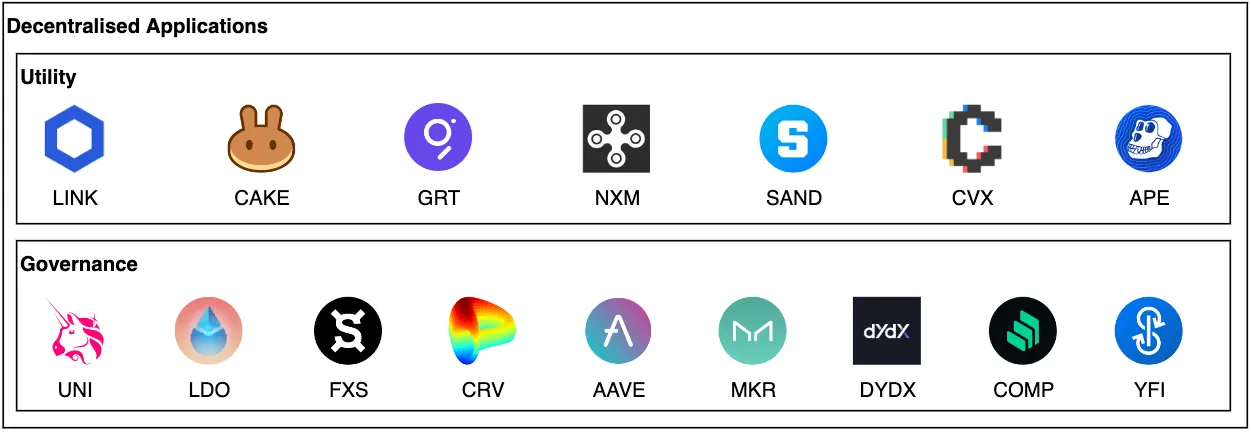
Tokens which are utilised within a DApp ecosystem for application specific use cases. Given that the majority of DApps have closely tied their on-chain governance to token ownership, most DApp tokens have dual functionality as both a utility as well as governance token. For the sake of readability, this article defines a hardline between the two but the reality is actually scalar.
Each DApp will define the tokenomics of their own DApp token. This includes the supply curve as well as the rules governing its usage. Demand is driven organically based on the perceived value of the DApp across both users and other Dapps.
- **Utility: **Tokens which enable users to participate in the value flows of a DApp. This can range from purchasing DApp services to special privileges on a DApp. Some examples include: purchasing reliable data (LINK, GRT); supercharged rewards (CAKE, CVX); purchasing insurance (NXM); in-game transactions (SAND/APE).
- **Governance: **Tokens which entitle the holder to vote on DApp governance. Governance tokens are usually accompanied with a DAO structure whereby each token represents a vote towards governance proposals. Proposals which pass the governance vote will determine the future of the DApp and this ranges from aesthetic changes to changing core functionalities of the DApp.
Stablecoins

Tokens whose value is pegged to a particular value reference. At present, majority of stablecoins are pegged to the USD due to its status as a global reserve currency. Macroeconomic and political factors will likely result in a multi-stablecoin future as nations vie for liquidity.
Stablecoins are usually minted/burned based on a collateralisation ratio of a basket of assets. These assets determine the trust assumptions of the stablecoin and can range from fiat/assets being held in a tradFi account (USDC, USDT, PAXG) or crypto assets/tokens (DAI, TUSD, FRAX). Stablecoin protocols are able to set a target collateralisation ratio in order to drive capital efficiency.
Real World Assets
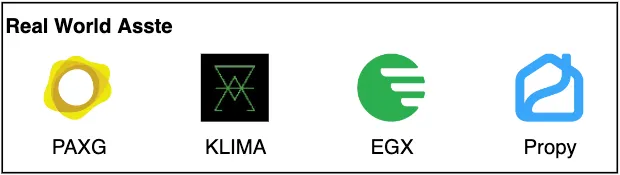
Tokenised representation of real world assets on the blockchain. This requires a trusted party to custody the real world asset and guarantee the convertibility between the token and asset. By tokenising real world assets, new channels of trade are opened up between assets in the real world and digital assets on the chain. Some examples of real world assets which have been tokenised and available for public trading: gold, carbon credits, stocks, property, physical art.
Cultural
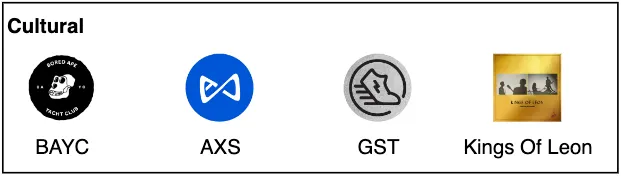
Tokens whose value is derived from cultural assets in the virtual world. Such cultural assets can range from digital art, music, and even games. Through representing ownership of cultural assets in a token, it enables new forms of cultural coordination. Some use cases include: ecosystems built on top of exclusive ownership of NFTs; play in reality, earn in crypto; programmable royalties in perpetuity.
Derivatives

Tokens whose value is derived from one or more underlying assets. Through the creation of derivative tokens, new financial markets are established which enable more complex and fine-grained management of risks.
Majority of derivative implementations involves the creation of a token representing the derivative. Given the pseudonymous nature of DeFi, these assets are usually created upon the smart contract securing funding (i.e. collateral). The derivatives are then free to be traded while the protocol is protected from insolvency through a liquidation market.
- **Synthetics: **Tokens which simulate another instrument while altering key characteristics. Synthetics enable the monetary value of any asset to be represented and traded on-chain without having to tokenise the underlying asset.
- **Futures: Tokens which represents a futures contract. **Futures are a legal contract between parties to buy and sell an asset at a predetermined price at a specified time in the future. Most DeFi DApps implement perpetuals, which are futures with no expiry date. Perpetuals are able to mimic the spot market while offering access to cheap leverage.
- **Options: **Tokens which represents option contracts that provides the buyer the right, not obligation, to buy/sell an underlying asset at a predetermined price and date. Specific to OPYN, their token makes options perpetual by creating a single token that represents the entire options chain.
- **Rate Swaps: **Tokens which represent forward contracts where on stream of future interest payment is exchanged for another based on a specified principal amount. As DeFi interest rates are highly variable, such rate swaps enable a fixed rate of return while enabling management of interest risks.
Wrapped
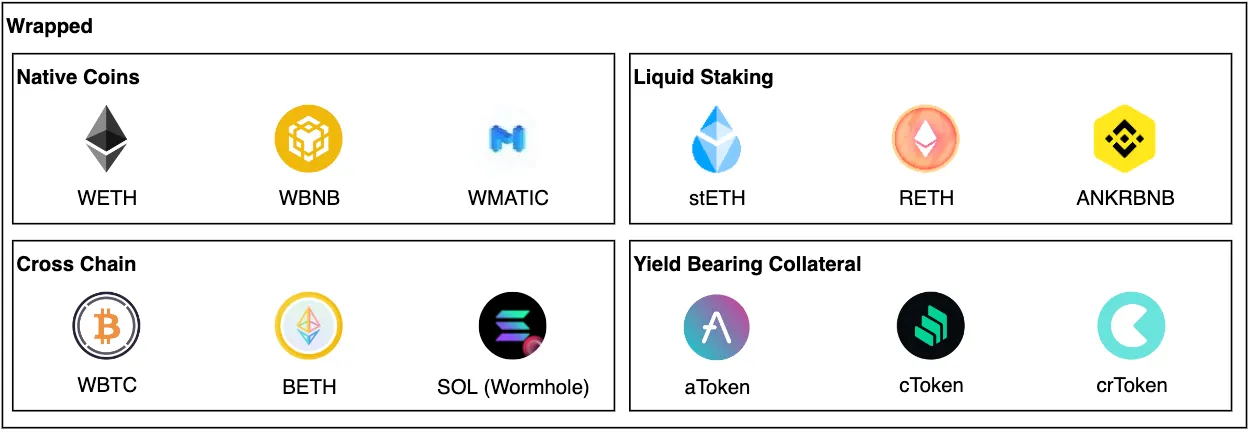
Wrapped tokens enable greater interoperability with all the DApps on a specific chain by “wrapping” the token with a standard interface. The base token that is being wrapped can be a non-standard token on the same chain or even a cross-chain token.
Wrapping a token usually entails locking the base asset and minting a wrapped token representation of the asset. Consequently, wrapped tokens are collateralised by the base token hence their value will be dependent on their redeemability.
- **Native Coins: **Native coin of the chain which powers DApp transactions. The native coin (i.e. ETH, BNB) has to be wrapped in a token interface to enable safe interactions with DApps.
- **Cross Chain: **Tokens which represent assets from a separate chain. The base token will usually be locked on the original chain and a wrapped representation will be minted on the target chain. This enables greater interoperability at the asset level as all transactions are secured on the same chain. Moreover, for chains which lack native smart contract functionality (i.e. BTC), it enables wrapped versions of the coin/token to be traded via smart contracts.
- **Liquid Staking: **Tokens that add flexibility to cash flows by enabling users to utilise the value locked in staked funds. Users can still earn the rewards from staking while gaining liquidity. Proof-of-Stake tokens are provided to a liquid staking provider which then pools the funds to be staked on the protocol. Users receive a token representing their share of the staked funds which can then be utilised for other purposes.
Liquidity Provider Tokens

LP tokens represent a liquidity providers share of a liquidity pool. Liquidity pools are supply side mechanisms where tokens are pooled in order to provide non-custodial market making or lending services. LP tokens are minted to a provider when funds are deposited to a pool. Consequently, based on ownership of LP tokens, a user is able to withdraw the corresponding share of the token(s) making up the pool.
While LP tokens can be seen as a claimable receipt of sorts, it is important to point out that ownership of LP tokens can be transferred. Moreover, further applications have been created to generate additional rewards based on the transferability of the LP token. As such, LP tokens deserve a separate category as even though they are collateralised by another token, LP tokens can be further utilised.
- **Market Making: **Tokens which represent a share of AMM DEX liquidity pools. Trading fees against the pool tokens accrue to the pool and hence yield is automatically generated for LP token holders. By staking LP tokens, a provider might be able to further optimise their yields through specific strategies or protocol rewards.
- **Lending: **Tokens which represent a share of a lending pool. Borrow interest accrues to the pool and hence yield is automatically generated for the LP token holders.